Two particles having mass 'M' and 'm' are moving in a circular path with radius 'R' and 'r' respectively. The time period for both the particles is same. The ratio of angular velocity of the first particle to that of the second particle will be
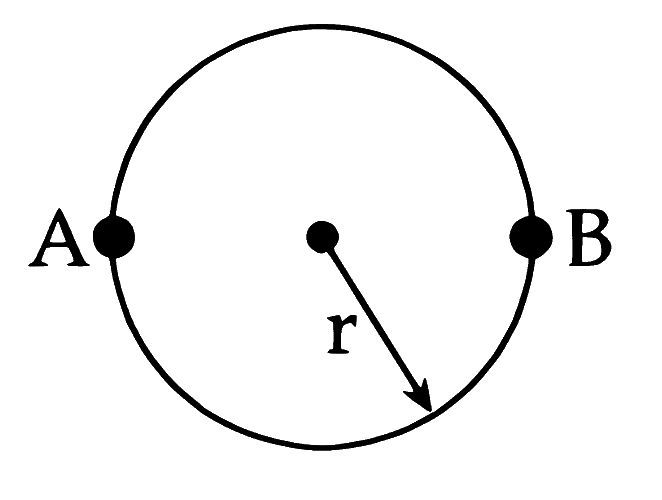
A body moves along a circular path of diameter 30 cm. It starts from one end of diameter, moves along the circular path and reaches the other end of diameter in 3 second. The angular speed of the body in radian per second is
Two particles A and B are moving in uniform circular motion in concentric circles of radii rA and rB with speeds vA and vB respectively. TA and TB are the time periods of rotation of the particles respectively and their relation is TA=3TB. The ratio of angular speed of B to that of A will be
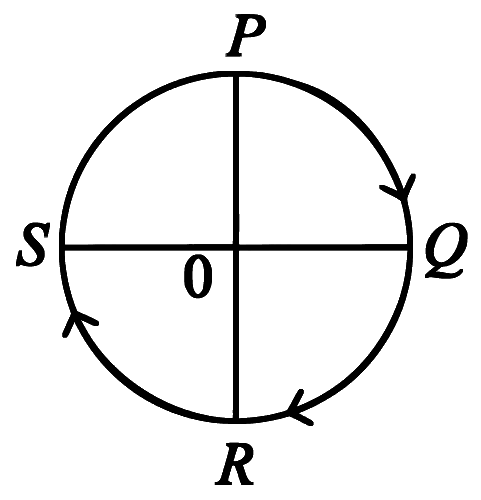
A cyclist starts from the point P of a circular ground of radius 2 km and travels along its circumference to the point S. The displacement of a cyclist is:
A body moves along a circular path of radius 15 cm. It starts from a point on the circular path and reaches the end of diameter in 3 seconds. The angular speed of the body in rad/s is
Two objects of masses ' m1 ' and ' m2 ' are moving in the circles of radii ' r1 ' and ' r2 ' respectively. Their respective angular speeds ' ω1 ' and ' ω2 ' are such that they both complete one revolution in the same time ' t '. The ratio of linear speed of ' m2 ' to that of ' m1 ' is
A clock has 75 cm,60 cm long second hand and minute hand respectively. In 30 minutes duration the tip of second hand will travel x distance more than the tip of minute hand. The value of x in meter is nearly (Take π=3.14):
A wheel of radius 1 m rolls through 180∘ over a plane surface. The magnitude of the displacement of the point of the wheel initially in contact with the surface is.
Two particles having mass 'M' and 'm' are moving in a circular path with radius 'R' and 'r' respectively. The time period for both the particles is same. The ratio of angular velocity of the first particle to the second particle will be
A body is moving with constant speed, in a circle of radius 10 m. The body completes one revolution in 4 s. At the end of 3rd second, the displacement of body (in m) from its starting point is:
A particle moves around a circular path of radius 'r' with uniform speed 'V'. After moving half the circle, the average acceleration of the particle is
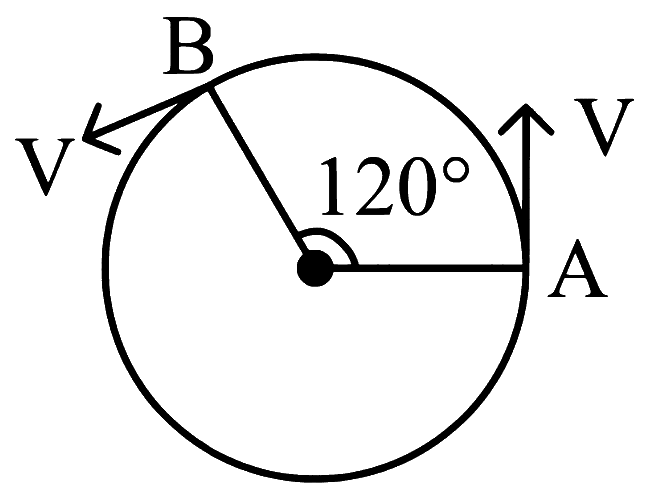
A particle is moving with constant speed in a circular path. When the particle turns by an angle 90∘, the ratio of instantaneous velocity to its average velocity is π:x2. The value of x will be -
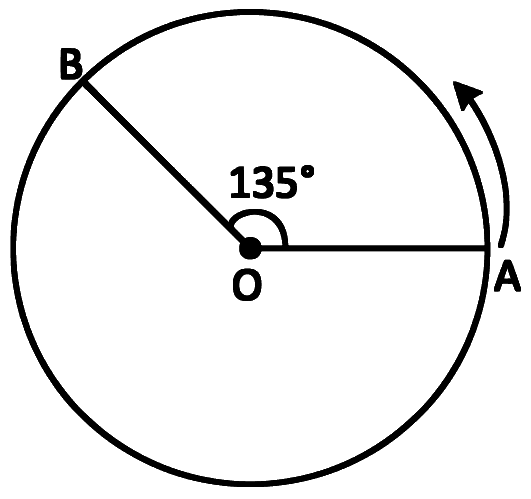
A person moved from A to B on a circular path as shown in figure. If the distance travelled by him is 60 m, then the magnitude of displacement would be:
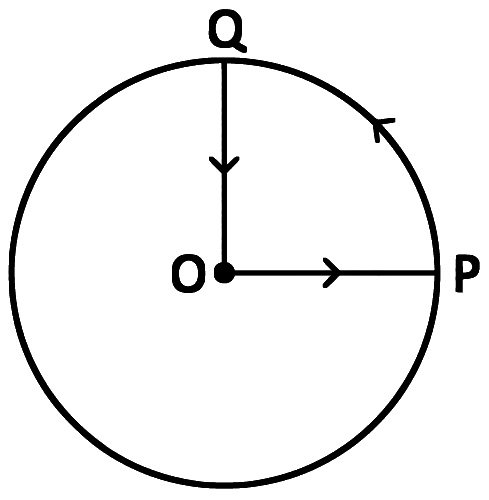
A person starts his journey from centre 'O' of the park and comes back to the same position following path OPQO as shown in the figure. The radius of path taken by the person is 200 m and he takes 3 min 58 sec to complete his journey. The average speed of the person is _____________ ms−1. (take π = 3.14)
Numerical answer type. Work it out, then open the answer.
The angular displacement of body performing circular motion is given by θ=5sin6πt. The angular velocity of the body at t=3 second will be [sin2π=1,cos2π=0]
A huge circular arc of length 4.4 ly subtends an angle of 4″ (4 seconds of arc) at the centre of the circle. How long it would take for a body to complete 4 revolutions if its speed is 8 AU per second? Given: 1 ly = 9.46 × 10¹⁵ m
A particle is moving along a circular path with a constant speed of 10 ms–1. What is the magnitude of the change in velocity of the particle, when it moves through an angle of 60o around the centre of the circle?