Dual Nature of Radiation and Matter PYQs · MHT CET · JEE Main · NEET
Davisson-Germer, Uncertainty, Compton & X-Rays
Questions
24
MHT CET
0
JEE Main
18
NEET
6
0 of 24 attempted
Q1JEE Main 2023 · 31 JAN · SHIFT 1EasyOld syllabus
Davisson-Germer, Uncertainty, Compton & X-Rays
Given below are two statements: One is labelled as Assertion A and the other is labelled as Reason R
Assertion A: The beam of electrons show wave nature and exhibit interference and diffraction. Reason R: Davisson Germer Experimentally verified the wave nature of electrons. In the light of the above statements, choose the most appropriate answer from the options given below:
Q3JEE Main 2022 · 25 JUN · SHIFT 1EasyOld syllabus
Davisson-Germer, Uncertainty, Compton & X-Rays
Given below are two statements:
Statement I: Davisson-Germer experiment establishes the wave nature of electrons. Statement II: If electrons have wave nature, they can interfere and show diffraction. In the light of the above statements choose the correct answer from the option given below:
Q6JEE Main 2021 · 18 MAR · SHIFT 2MediumOld syllabus
Davisson-Germer, Uncertainty, Compton & X-Rays
The speed of electrons in a scanning electron microscope is 1 × 10⁷ ms-1. If the protons having the same speed are used instead of electrons, then the resolving power of scanning proton microscope will be changed by a factor of:
Consider two separate ideal gases of electrons and protons having same number of particles. The temperature of both the gases is the same. The ratio of the uncertainty in determining the position of an electron to that of a proton is proportional to :-
Q10JEE Main 2020 · 5 SEP · SHIFT 1DifficultOld syllabus
Davisson-Germer, Uncertainty, Compton & X-Rays
A beam of electrons of energy E scatters from a target having atomic spacing of 1 A˚. The first maximum intensity occurs at θ = 60o. Then E (in eV) is ______.
(Planck constant h = 6.64 × 10⁻³⁴ Js,
1 eV = 1.6 × 10⁻¹⁹ J, electron
mass m = 9.1 × 10⁻³¹ kg)
Numerical answer type. Work it out, then open the answer.
In an electron microscope, the resolution that can be achieved is of the order of the wavelength of electrons used. To resolve a width of 7.5 × 10⁻¹² m, the minimum electron energy required is close to -
An electron beam is accelerated by a potential difference V to hit a metallic target to produce X– rays. It produces continuous as well as characteristic X-rays. If λmin is the smallest possible wavelength of X-ray in the spectrum, the variation of logλmin with log V is correctly represented in:
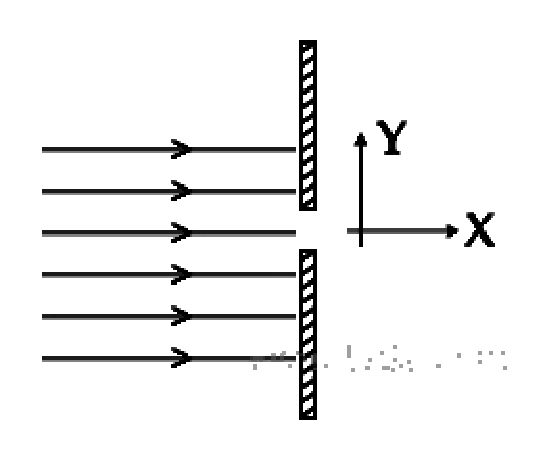
A parallel beam of electrons travelling in x-direction falls on a slit of width d (see figure). If after passing the slit, an electron acquires momentum py in the y-direction then for a majority of electrons passing through the slit (h is Planck's constant):
A photon of wavelength λ is scattered from an electron, which was at rest. The wavelength shift Δλ is three times of λ and the angle of scattering θ is 60o. The angle at which the electron recoiled is ϕ. The value of tan ϕ is: (electron speed is much smaller than the speed of light)
A parallel beam of fast moving electrons is incident normally on a narrow slit. A fluorescent screen is placed at a large distance from the slit. If the speed of the electrons is increased, which of the following statements is correct?
This question has Statement 1 and Statement 2. Of the four choices given after the statements, choose the one that best describes the two statements.
Statement 1: Davisson - Germer experiment established the wave nature of electrons. Statement 2: If electrons have wave nature, they can interfere and show diffraction.
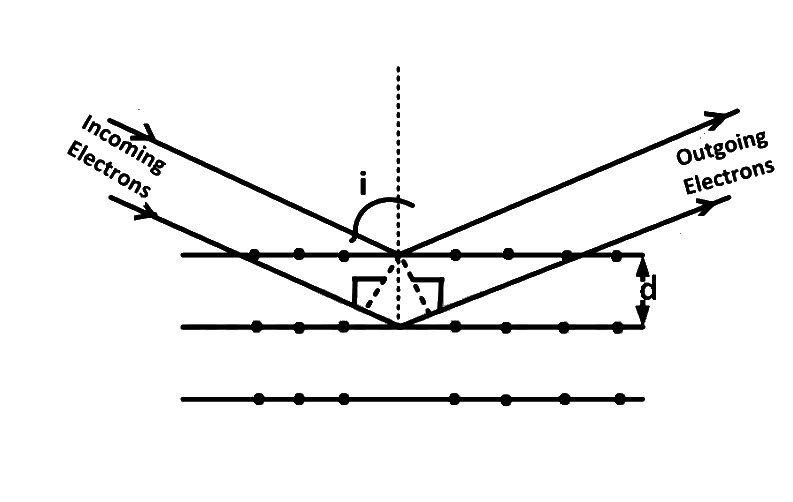
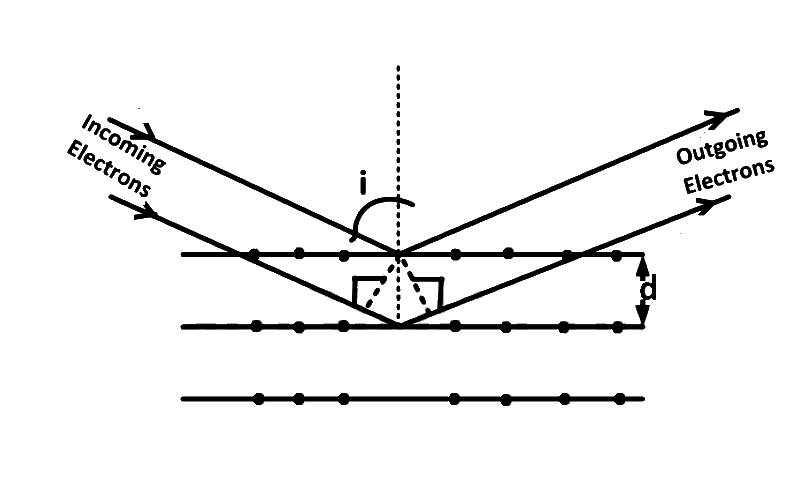
Wave property of electrons implies that they will show diffraction effects. Davisson and Germer demonstrated this by diffracting electrons from crystals. The law governing the diffraction from a crystal is obtained by requiring that electron waves reflected from the planes of atoms in a crystal interfere constructively (see figure).
Electrons accelerated by potential V are diffracted from a crystal. If d=1A˚ and i=30∘,V should be about
Wave property of electrons implies that they will show diffraction effects. Davisson and Germer demonstrated this by diffracting electrons from crystals. The law governing the diffraction from a crystal is obtained by requiring that electron waves reflected from the planes of atoms in a crystal interfere constructively (see figure).
If a strong diffraction peak is observed when electrons are incident at an angle ′i′ from the normal to the crystal planes with distance ′d′ between them (see figure), de Broglie wavelength λdB of electrons can be calculated by the relationship (n is an integer)
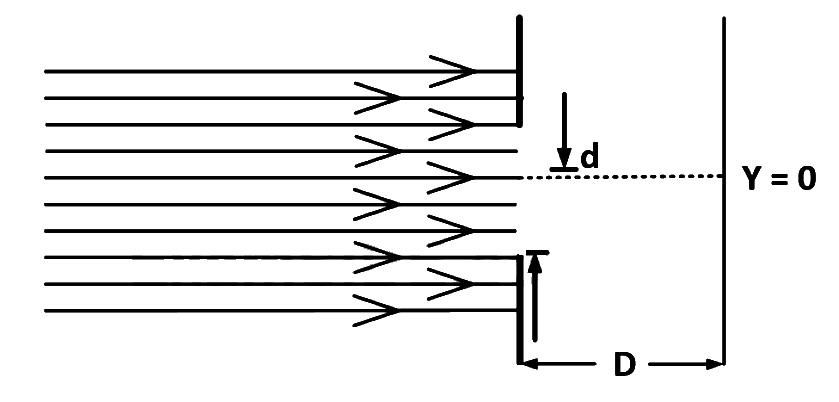
In an experiment, electrons are made to pass through a narrow slit of width ′d′ comparable to their de Broglie wavelength. They are detected on a screen at a distance ′D′ from the slit (see figure).
Which of the following graphs can be expected to represent the number of electrons ′N′ detected as a function of the detector position ′y′(y=0 corresponds to the middle of the slit )