Q1 NEET 2026 · RE-NEET Easy ☆
Electromagnetic Spectrum & Atmosphere · Uses of EM waves
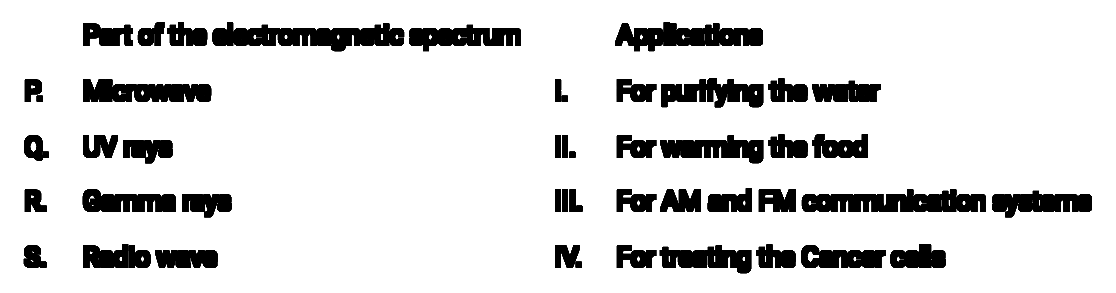
The following table presents the part of the electromagnetic spectrum and their corresponding major applications.
The correct option is:
(a) P-II, Q-IV, R-III, S-I (b) P-I, Q-II, R-III, S-IV (c) P-I, Q-IV, R-II, S-III (d) P-II, Q-I, R-IV, S-III Show answer and solution
Answer: (d)
Loading the solution…
Report a mistake Q2 NEET 2026 Medium ☆
Electromagnetic Spectrum & Atmosphere · How each wave is produced
Match List I with List II:
Choose the correct answer from the options given below:
List-I (Electromagnetic wave) List-II (Production) A. Microwave I. Electrons in atoms emit light when they move from a higher energy level to a lower energy level B. Visible light II. Radioactive decay of nucleus C. Gamma rays III. Vibration of atoms and molecules D. Infra-red rays IV. Klystron valve or magnetron valve
(a) A-III, B-I, C-II, D-IV (b) A-III, B-IV, C-I, D-II (c) A-IV, B-I, C-II, D-III (d) A-IV, B-III, C-II, D-I Show answer and solution
Answer: (c)
Loading the solution…
Report a mistake Q3 JEE Main 2026 · 24 JAN · SHIFT 1 Medium ☆
Electromagnetic Spectrum & Atmosphere · How each wave is produced
Match the LIST-I with LIST-II
Choose the correct answer from the options given below:
(a) A-IV, B-II, C-I, D-III (b) A-IV, B-III, C-I, D-II (c) A-IV, B-I, C-II, D-III (d) A-II, B-IV, C-III, D-I Show answer and solution
Answer: (c)
Loading the solution…
Report a mistake Q4 JEE Main 2025 · 24 JAN · SHIFT 2 Easy ☆
Electromagnetic Spectrum & Atmosphere · Order of the spectrum and wavelength ranges
Arrange the following in the ascending order of wavelength ( λ ) (\lambda) ( λ )
(A) Microwaves ( λ 1 ) (\lambda_1) ( λ 1 )
(B) Ultraviolet rays ( λ 2 ) (\lambda_2) ( λ 2 )
(C) Infrared rays ( λ 3 ) (\lambda_3) ( λ 3 )
(D) X-rays ( λ 4 ) (\lambda_4) ( λ 4 )
Choose the most appropriate answer from the options given below:
(a) λ 4 < λ 3 < λ 2 < λ 1 \lambda_4 < \lambda_3 < \lambda_2 < \lambda_1 λ 4 < λ 3 < λ 2 < λ 1 (b) λ 4 < λ 2 < λ 3 < λ 1 \lambda_4 < \lambda_2 < \lambda_3 < \lambda_1 λ 4 < λ 2 < λ 3 < λ 1 (c) λ 3 < λ 4 < λ 2 < λ 1 \lambda_3 < \lambda_4 < \lambda_2 < \lambda_1 λ 3 < λ 4 < λ 2 < λ 1 (d) λ 4 < λ 3 < λ 1 < λ 2 \lambda_4 < \lambda_3 < \lambda_1 < \lambda_2 λ 4 < λ 3 < λ 1 < λ 2 Show answer and solution
Answer: (b)
Loading the solution…
Report a mistake Q5 NEET 2024 Easy ☆
Electromagnetic Spectrum & Atmosphere · Order of the spectrum and wavelength ranges
The electromagnetic radiation which has the smallest wavelength are
(a) X-rays (b) Gamma rays (c) Ultraviolet rays (d) Microwaves Show answer and solution
Answer: (b)
Loading the solution…
Report a mistake Q6 JEE Main 2024 · 4 APR · SHIFT 2 Easy ☆
Electromagnetic Spectrum & Atmosphere · Order of the spectrum and wavelength ranges
Arrange the following in the ascending order of wavelength:
A. Gamma rays ( λ 1 ) (\lambda_1) ( λ 1 )
B. x x x ( λ 2 ) (\lambda_2) ( λ 2 )
C. Infrared waves ( λ 3 ) (\lambda_3) ( λ 3 )
D. Microwaves ( λ 4 ) (\lambda_4) ( λ 4 )
Choose the most appropriate answer from the options given below
(a) λ 1 < λ 2 < λ 3 < λ 4 \lambda_1 < \lambda_2 < \lambda_3 < \lambda_4 λ 1 < λ 2 < λ 3 < λ 4 (b) λ 2 < λ 1 < λ 4 < λ 3 \lambda_2 < \lambda_1 < \lambda_4 < \lambda_3 λ 2 < λ 1 < λ 4 < λ 3 (c) λ 4 < λ 3 < λ 2 < λ 1 \lambda_4 < \lambda_3 < \lambda_2 < \lambda_1 λ 4 < λ 3 < λ 2 < λ 1 (d) λ 4 < λ 3 < λ 1 < λ 2 \lambda_4 < \lambda_3 < \lambda_1 < \lambda_2 λ 4 < λ 3 < λ 1 < λ 2 Show answer and solution
Answer: (a)
Loading the solution…
Report a mistake Q7 JEE Main 2024 · 5 APR · SHIFT 2 Medium ☆
Electromagnetic Spectrum & Atmosphere · Order of the spectrum and wavelength ranges
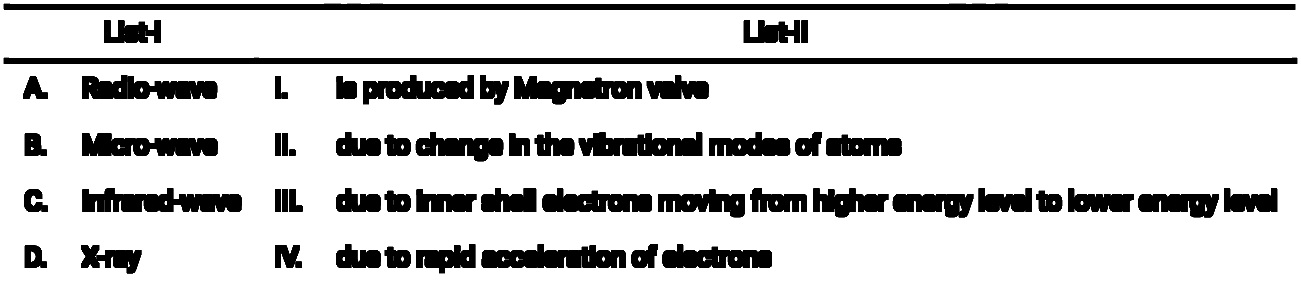
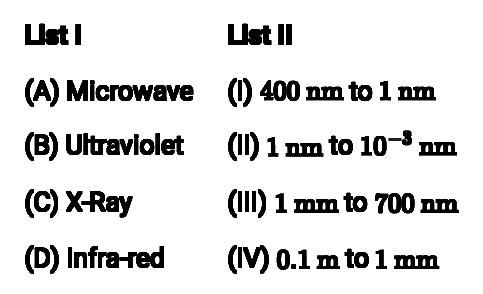
Match List I with List II:
Choose the correct answer from the options given below:
(a) (A)-(I), (B)-(III), (C)-(II), (D)-(IV) (b) (A)-(III), (B)-(II), (C)-(IV), (D)-(I) (c) (A)-(IV), (B)-(III), (C)-(II), (D)-(I) (d) (A)-(II), (B)-(I), (C)-(IV), (D)-(III) Show answer and solution
Answer: (b)
Loading the solution…
Report a mistake Q8 JEE Main 2023 · 31 JAN · SHIFT 2 Easy ☆
Electromagnetic Spectrum & Atmosphere · Uses of EM waves
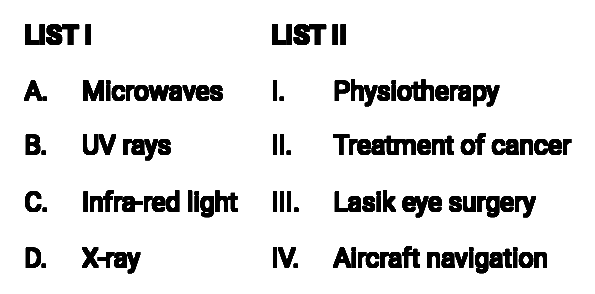
Match List I with List II
Choose the correct answer from the options given below:
(a) A - IV, B - III, C - I, D - II (b) A - II, B - IV, C - III, D - I (c) A - III, B - II, C - I, D - IV (d) A - IV, B - I, C - II, D - III Show answer and solution
Answer: (a)
Loading the solution…
Report a mistake Q9 JEE Main 2023 · 15 APR · SHIFT 1 Medium ☆
Electromagnetic Spectrum & Atmosphere · Order of the spectrum and wavelength ranges
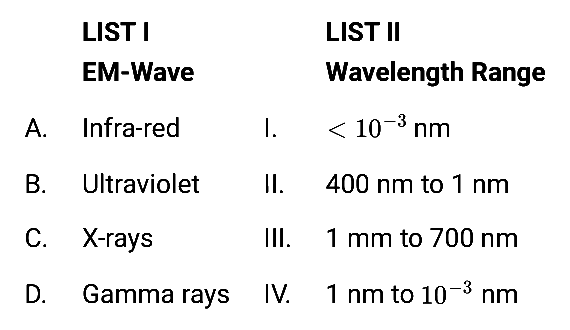
Match List I with List II of Electromagnetic waves with corresponding wavelength range:
Choose the correct answer from the options given below:
(a) (A)-(I), (B)-(IV), (C)-(II), (D)-(III) (b) (A)-(IV), (B)-(I), (C)-(II), (D)-(III) (c) (A)-(IV), (B)-(I), (C)-(III), (D) -(II) (d) (A)-(IV), (B)-(II), (C)-(I), (D)-(III) Show answer and solution
Answer: (b)
Loading the solution…
Report a mistake Q10 JEE Main 2023 · 12 APR · SHIFT 1 Medium ☆
Electromagnetic Spectrum & Atmosphere · Order of the spectrum and wavelength ranges
Given below are two statements: one is labelled as Assertion A \mathbf{A} A R \mathbf{R} R
Assertion A: EM waves used for optical communication have longer wavelengths than that of microwave, employed in Radar technology.
Reason R: Infrared EM waves are more energetic than microwaves, (used in Radar) In the light of given statements, choose the correct answer from the options given below.
(a) Both A \mathrm{A} A R \mathrm{R} R R \mathrm{R} R A \mathrm{A} A (b) A \mathrm{A} A R \mathrm{R} R (c) Both A \mathrm{A} A R \mathrm{R} R R \mathrm{R} R A \mathrm{A} A (d) A \mathrm{A} A R \mathrm{R} R Show answer and solution
Answer: (d)
Loading the solution…
Report a mistake Q11 JEE Main 2023 · 1 FEB · SHIFT 1 Medium ☆
Electromagnetic Spectrum & Atmosphere · How each wave is produced
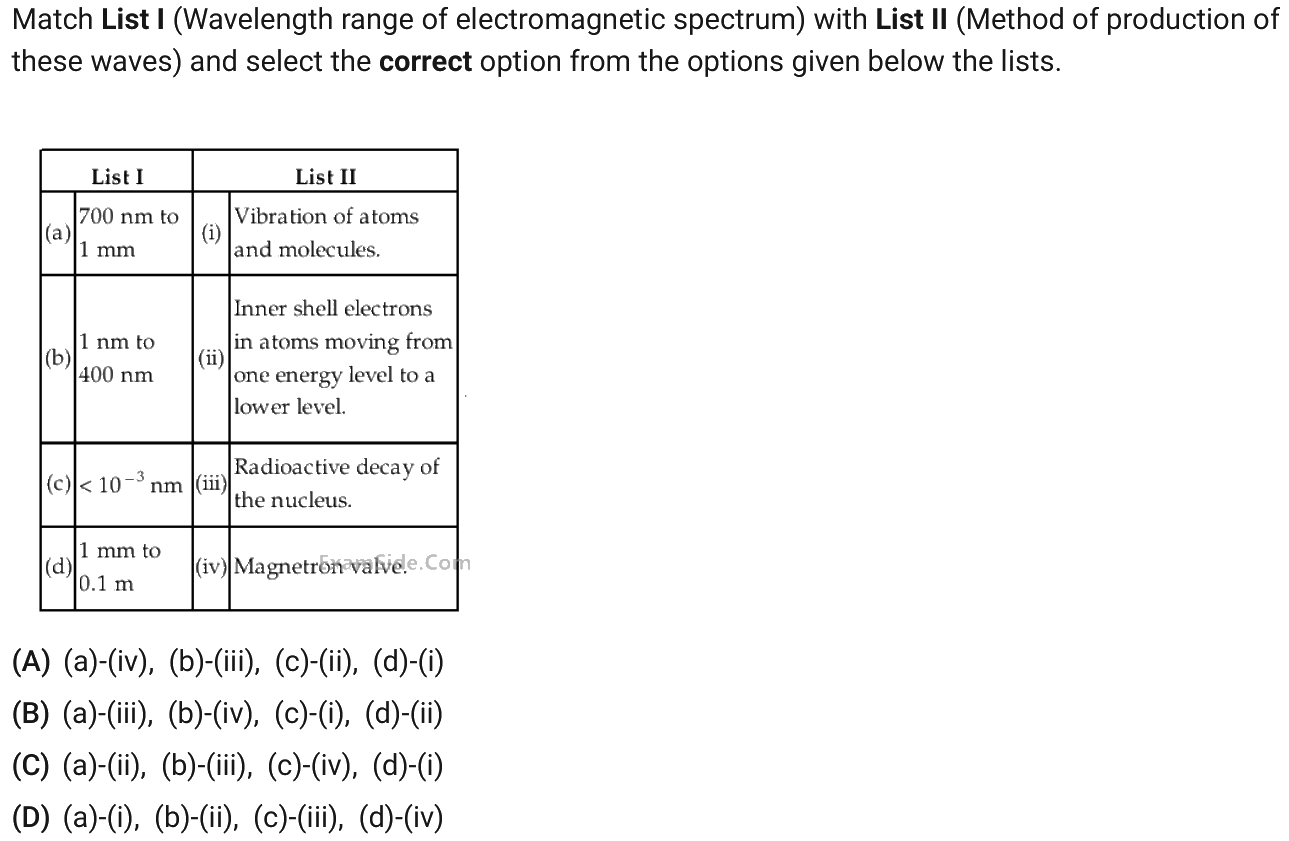
Match List I with List II:
Choose the correct answer from the options given below:
List I List II A. Microwaves I. Radioactive decay of the nucleus B. Gamma rays II. Rapid acceleration and deceleration of electron in aerials C. Radio waves III. Inner shell electrons D. X-rays IV. Klystron valve
(a) A-I, B-III, C-IV, D-II (b) A-IV, B-III, C-II, D-I (c) A-IV, B-I, C-II, D-III (d) A-I, B-II, C-III, D-IV Show answer and solution
Answer: (c)
Loading the solution…
Report a mistake Q12 JEE Main 2022 · 26 JUN · SHIFT 2 Easy ☆
Electromagnetic Spectrum & Atmosphere · Order of the spectrum and wavelength ranges
Which is the correct ascending order of wavelengths?
(a) λ \lambda λ λ \lambda λ λ \lambda λ λ \lambda λ (b) λ \lambda λ λ \lambda λ λ \lambda λ λ \lambda λ (c) λ \lambda λ λ \lambda λ λ \lambda λ λ \lambda λ (d) λ \lambda λ λ \lambda λ λ \lambda λ λ \lambda λ Show answer and solution
Answer: (b)
Loading the solution…
Report a mistake Q13 JEE Main 2022 · 29 JUL · SHIFT 1 Easy ☆
Electromagnetic Spectrum & Atmosphere · Uses of EM waves
Match List - I with List - II:
Choose the correct answer from the options given below:
List - I List - II (a) UV rays (i) Diagnostic tool in medicine (b) X-rays (ii) Water purification (c) Microwave (iii) Communication, Radar (d) Infrared wave (iv) Improving visibility in foggy days
(a) (a)-(iii), (b)-(ii), (c)-(i), (d)-(iv) (b) (a)-(ii), (b)-(i), (c)-(iii), (d)-(iv) (c) (a)-(ii), (b)-(iv), (c)-(iii), (d)-(i) (d) (a)-(iii), (b)-(i), (c)-(ii), (d)-(iv) Show answer and solution
Answer: (b)
Loading the solution…
Report a mistake Q14 JEE Main 2022 · 27 JUN · SHIFT 1 Easy ☆
Electromagnetic Spectrum & Atmosphere · Uses of EM waves
Match List-I with List-II:
Choose the correct answer from the options given below:
List - I List - II (a) Ultraviolet rays (i) Study crystal structure (b) Microwaves (ii) Greenhouse effect (c) Infrared rays (iii) Sterilizing surgical instrument (d) X-rays (iv) Radar system
(a) (a)-(iii), (b)-(iv), (c)-(ii), (d)-(i) (b) (a)-(iii), (b)-(i), (c)-(ii), (d)-(iv) (c) (a)-(iv), (b)-(iii), (c)-(ii), (d)-(i) (d) (a)-(iii), (b)-(iv), (c)-(i), (d)-(ii) Show answer and solution
Answer: (a)
Loading the solution…
Report a mistake Q15 JEE Main 2022 · 26 JUN · SHIFT 1 Easy ☆
Electromagnetic Spectrum & Atmosphere · Uses of EM waves
In free space, an electromagnetic wave of 3 GHz frequency strikes over the edge of an object of size λ 100 \frac{\lambda}{100} 100 λ λ \lambda λ
(a) Reflection (b) Refraction (c) Diffraction (d) Scattering Show answer and solution
Answer: (d)
Loading the solution…
Report a mistake Q16 NEET 2022 · PHASE 1 Medium ☆
Electromagnetic Spectrum & Atmosphere · Order of the spectrum and wavelength ranges
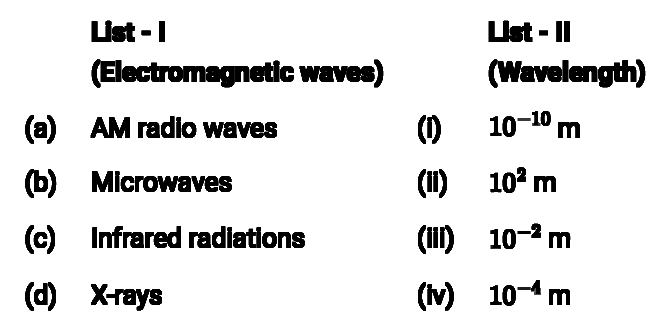
Match List - I with List - II
Choose the correct answer from the options given below
(a) (a) - (iv), (b) - (iii), (c) - (ii), (d) - (i) (b) (a) - (iii), (b) - (ii), (c) - (i), (d) - (iv) (c) (a) - (iii), (b) - (iv), (c) - (ii), (d) - (i) (d) (a) - (ii), (b) - (iii), (c) - (iv), (d) - (i) Show answer and solution
Answer: (d)
Loading the solution…
Report a mistake Q17 JEE Main 2021 · 24 FEB · SHIFT 2 Medium ☆
Electromagnetic Spectrum & Atmosphere · How each wave is produced
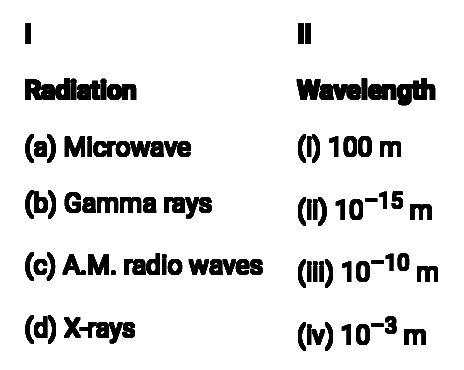
Match List - I with List - II.
Choose the correct answer from the options given below:
List I List II (a) Source of microwave frequency (i) Radioactive decay of nucleus (b) Source of infrared frequency (ii) Magnetron (c) Source of Gamma Rays (iii) Inner shell electrons (d) Source of X-rays (iv) Vibration of atoms and molecules (v) LASER (vi) RC circuit
(a) (a)-(vi), (b)-(v), (c)-(i), (d)-(iv) (b) (a)-(ii), (b)-(iv), (c)-(i), (d)-(iii) (c) (a)-(ii), (b)-(iv), (c)-(vi), (d)-(iii) (d) (a)-(vi), (b)-(iv), (c)-(i), (d)-(v) Show answer and solution
Answer: (b)
Loading the solution…
Report a mistake Q18 NEET 2020 · PHASE 2 Easy ☆
Electromagnetic Spectrum & Atmosphere · Order of the spectrum and wavelength ranges
The E.M. wave with shortest wavelength among the following is,
(a) Microwaves (b) Ultraviolet rays (c) X-rays (d) Gamma-rays Show answer and solution
Answer: (d)
Loading the solution…
Report a mistake Q19 JEE Main 2020 · 4 SEP · SHIFT 1 Easy ☆
Electromagnetic Spectrum & Atmosphere · Order of the spectrum and wavelength ranges
Choose the correct option relating wave lengths of different parts of electromagnetic wave spectrum:
(a) λ \lambda λ λ \lambda λ λ \lambda λ λ \lambda λ (b) λ \lambda λ λ \lambda λ λ \lambda λ λ \lambda λ (c) λ \lambda λ λ \lambda λ λ \lambda λ λ \lambda λ (d) λ \lambda λ λ \lambda λ λ \lambda λ λ \lambda λ Show answer and solution
Answer: (a)
Loading the solution…
Report a mistake Q20 MHT CET 2020 · 16 OCT · SHIFT 1 Easy ☆
Electromagnetic Spectrum & Atmosphere · Greenhouse, ozone and radio propagation
(a) amplitude remains constant but frequency. changes according to information signal (b) amplitude of carrier wave changes according to information signal (c) both amplitude and frequency changes according to information signal (d) both amplitude and frequency do not change according to information signal Show answer and solution
Answer: (b)
Loading the solution…
Report a mistake Q21 JEE Main 2020 · 5 SEP · SHIFT 2 Medium ☆
Electromagnetic Spectrum & Atmosphere · Order of the spectrum and wavelength ranges
The correct match between the entries in column I and column II are:
(a) (a)-(ii), (b)-(i), (c)-(iv), (d)-(iii) (b) (a)-(iv), (b)-(ii), (c)-(i), (d)-(iii) (c) (a)-(iii), (b)-(ii), (c)-(i), (d)-(iv) (d) (a)-(i), (b)-(iii), (c)-(iv), (d)-(ii) Show answer and solution
Answer: (b)
Loading the solution…
Report a mistake Q22 NEET 2019 Easy ☆
Electromagnetic Spectrum & Atmosphere · Order of the spectrum and wavelength ranges
Which colour of the light has the longest wavelength?
(a) blue (b) violet (c) red (d) green Show answer and solution
Answer: (c)
Loading the solution…
Report a mistake Q23 JEE Main 2016 Easy ☆
Electromagnetic Spectrum & Atmosphere · Order of the spectrum and wavelength ranges
Arrange the following electromagnetic radiations per quantum in the order of increasing energy: A: Blue light B: Yellow light
C: X-ray D: Radiowave.
(a) C, A, B, D (b) B, A, D, C (c) D, B, A, C (d) A, B, D, C Show answer and solution
Answer: (c)
Loading the solution…
Report a mistake Q24 JEE Main 2016 · 9 APR · SHIFT 1 Easy ☆
Electromagnetic Spectrum & Atmosphere · Uses of EM waves
Microwave oven acts on the principle of:
(a) transferring electrons from lower to higher energy levels in water molecule (b) giving rotational energy to water molecules (c) giving vibrational energy to water molecules (d) giving translational energy to water molecules Show answer and solution
Answer: (c)
Loading the solution…
Report a mistake Q25 NEET 2015 · AIPMT Easy ☆
Electromagnetic Spectrum & Atmosphere · Order of the spectrum and wavelength ranges
The energy of the em waves is of the order of 15 keV. To which part of the spectrum does it belong?
(a) Ultraviolet rays (b) γ \gamma γ (c) X-rays (d) Infra-red rays Show answer and solution
Answer: (c)
Loading the solution…
Report a mistake Q26 JEE Main 2014 · 19 APR · SHIFT 1 Easy ☆
Electromagnetic Spectrum & Atmosphere · Order of the spectrum and wavelength ranges
If microwaves, X rays, infrared, gamma rays, ultra-violet, radio waves and visible parts of the electromagnetic spectrum are represented by M, X, I, G, U, R and V, the following is the arrangement in ascending order of wavelength:
(a) R, M, I, V, U, X and G (b) M, R, V, X, U, G and I (c) G, X, U, V, I, M and R (d) I, M, R, U, V, X and G Show answer and solution
Answer: (c)
Loading the solution…
Report a mistake Q27 JEE Main 2014 · 9 APR · SHIFT 1 Medium ☆
Electromagnetic Spectrum & Atmosphere · How each wave is produced
Numerical answer type. Work it out, then open the answer.
Show answer and solution
Answer: d
Loading the solution…
Report a mistake Q28 JEE Main 2014 · 11 APR · SHIFT 1 Medium ☆
Electromagnetic Spectrum & Atmosphere · Uses of EM waves
Match the List - I (Phenomenon associated with electromagnetic radiation) with List - II (Part of
electromagnetic spectrum) and select the correct code from the choices given below the lists:
List - I List - II (I) Doublet of sodium (A) Visible radiation (II) Wavelength (B) Microwave corresponding to temperature associated with the isotropic radiation filling all space (III) Wavelength emitted by (C) Short radiowave atomic hydrogen in interstellar space (IV) Wavelength of radiation (D) X - rays arising from two close energy levels in hydrogen
(a) (I)-(A), (II)-(B), (III)-(B), (IV)-(C) (b) (I)-(A), (II)-(B), (III)-(C), (IV)-(C) (c) (I)-(D), (II)-(C), (III)-(A), (IV)-(B) (d) (I)-(B), (II)-(A), (III)-(D), (IV)-(A) Show answer and solution
Answer: (b)
Loading the solution…
Report a mistake Q29 JEE Main 2014 Medium ☆
Electromagnetic Spectrum & Atmosphere · Uses of EM waves
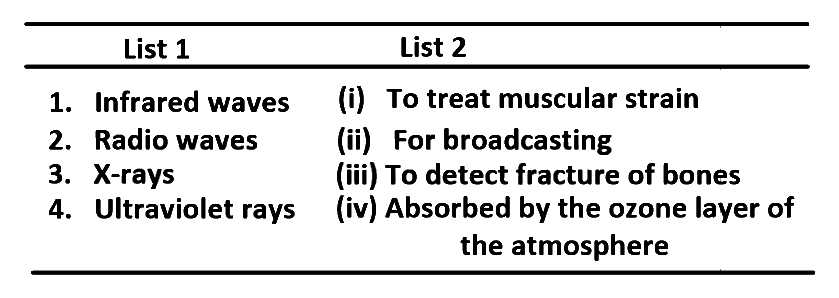
Match List - 1 1 1 2 2 2
correct option from the choices given below the lists:
(a) 1 − i v , 2 − i i i , 3 − i i , 4 − i 1 - iv,\ 2 - iii,\ 3 - ii,\ 4 - i 1 − i v , 2 − iii , 3 − ii , 4 − i (b) 1 − i , 2 − i i , 3 − i v , 4 − i i i 1 - i,\ 2 - ii,\ 3 - iv,\ 4 - iii 1 − i , 2 − ii , 3 − i v , 4 − iii (c) 1 − i i i , 2 − i i , 3 − i , 4 − i v 1 - iii,\ 2 - ii,\ 3 - i,\ 4 - iv 1 − iii , 2 − ii , 3 − i , 4 − i v (d) 1 − i , 2 − i i , 3 − i i i , 4 − i v 1 - i,\ 2 - ii,\ 3 - iii,\ 4 - iv 1 − i , 2 − ii , 3 − iii , 4 − i v Show answer and solution
Answer: (d)
Loading the solution…
Report a mistake Q30 JEE Main 2013 · 9 APR · SHIFT 1 Easy ☆
Electromagnetic Spectrum & Atmosphere · Order of the spectrum and wavelength ranges
Photons of an electromagnetic radiation has an energy 11 keV each. To which region of electromagnetic spectrum does it belong?
(a) X-ray region (b) Ultra violet region (c) Infrared region (d) Visible region Show answer and solution
Answer: (a)
Loading the solution…
Report a mistake Q31 NEET 2013 Medium ☆
Electromagnetic Spectrum & Atmosphere · Uses of EM waves
The condition under which a microwave oven heats up a food item containing water molecules most efficiently is
(a) Microwaves are heat waves, so always produce heating. (b) Infra-red waves produce heating in a microwave oven. (c) The frequency of the microwaves must match the resonant frequency of the water molecules. (d) The frequency of the microwaves has no relation with natural frequency of water molecules. Show answer and solution
Answer: (c)
Loading the solution…
Report a mistake Q32 JEE Main 2013 · 25 APR · SHIFT 1 Medium ☆
Electromagnetic Spectrum & Atmosphere · Uses of EM waves
This question has Statement-1 and Statement-2. Of the four choices given after the Statements, choose the one that best describes the two Statements.
Statement-1: Out of radio waves and microwaves, the radio waves undergo more diffraction. Statement-2: Radio waves have greater frequency compared to microwaves.
(a) Statement-1 is true, Statement-2 is true and Statement-2 is the correct explanation of Statement-1 (b) Statement-1 is false, Statement-2 is true. (c) Statement-1 is true, Statement-2 is false. (d) Statement-1 is true, Statement-2 is true but Statement-2 is not the correct explanation of Statement-1 Show answer and solution
Answer: (c)
Loading the solution…
Report a mistake Q33 NEET 2011 · AIPMT · PRELIMS Easy ☆
Electromagnetic Spectrum & Atmosphere · Order of the spectrum and wavelength ranges
The decreasing order of wavelength of infrared, microwave, ultraviolet and gamma rays is
(a) microwave, infrared, ultraviolet, gamma rays (b) gamma rays, ultraviolet, infraref, microwaves (c) microwaves, gamma rays, infrared, ultraviolet (d) infrared, microwave, ultraviolet, gamma rays Show answer and solution
Answer: (a)
Loading the solution…
Report a mistake Q34 NEET 2005 · AIPMT Easy ☆
Electromagnetic Spectrum & Atmosphere · Order of the spectrum and wavelength ranges
If λ \lambda λ λ \lambda λ λ \lambda λ
(a) λ m > λ x > λ v \lambda_m > \lambda_x > \lambda_v λ m > λ x > λ v (b) λ m > λ v > λ x \lambda_m > \lambda_v > \lambda_x λ m > λ v > λ x (c) λ v > λ x > λ m \lambda_v > \lambda_x > \lambda_m λ v > λ x > λ m (d) λ v > λ m > λ x \lambda_v > \lambda_m > \lambda_x λ v > λ m > λ x Show answer and solution
Answer: (b)
Loading the solution…
Report a mistake Q35 NEET 2003 · AIPMT Easy ☆
Electromagnetic Spectrum & Atmosphere · Order of the spectrum and wavelength ranges
Which of the following rays are not electromagnetic waves?
(a) X-rays (b) γ \gamma γ (c) β \beta β (d) heat rays Show answer and solution
Answer: (c)
Loading the solution…
Report a mistake Q36 NEET 2003 · AIPMT Easy ☆
Electromagnetic Spectrum & Atmosphere · Uses of EM waves
We consider the radiation emitted by the human body. Which one of the following statements is true?
(a) The radiation emitted is in the infra-red region (b) The radiation emitted only during the day (c) The radiation is emitted during the summers and absorbed during the winters (d) The radiation emitted lies in the ultraviolet region and hence is not visible Show answer and solution
Answer: (a)
Loading the solution…
Report a mistake Q37 NEET 2002 · AIPMT Easy ☆
Electromagnetic Spectrum & Atmosphere · Order of the spectrum and wavelength ranges
Which of the following has minimum wavelength?
(a) X-rays (b) Ultraviolet rays (c) γ \gamma γ (d) Cosmic rays Show answer and solution
Answer: (d)
Loading the solution…
Report a mistake Q38 JEE Main 2002 · AIEEE Easy ☆
Electromagnetic Spectrum & Atmosphere · Order of the spectrum and wavelength ranges
Which of the following are not electromagnetic waves?
(a) cosmic rays (b) gamma rays (c) β \beta β (d) X X X Show answer and solution
Answer: (c)
Loading the solution…
Report a mistake Q39 NEET 2002 · AIPMT Easy ☆
Electromagnetic Spectrum & Atmosphere · Greenhouse, ozone and radio propagation
What is the cause of Green house effect?
(a) infra-red rays (b) ultra violet rays (c) X-rays (d) radio waves. Show answer and solution
Answer: (a)
Loading the solution…
Report a mistake Q40 NEET 2001 · AIPMT Easy ☆
Electromagnetic Spectrum & Atmosphere · Greenhouse, ozone and radio propagation
Biological importance of ozone layer is
(a) it stops ultraviolet rays (b) ozone layer reduces green house effect (c) ozone layer reflects radio waves (d) ozone layer controls O2/H2 ratio in atmosphere. Show answer and solution
Answer: (a)
Loading the solution…
Report a mistake Q41 NEET 2000 · AIPMT Easy ☆
Electromagnetic Spectrum & Atmosphere · Order of the spectrum and wavelength ranges
The frequency order for γ \gamma γ
(a) b > > > > > > (b) a > > > > > > (c) c > > > > > > (d) a > > > > > > Show answer and solution
Answer: (b)
Loading the solution…
Report a mistake Q42 NEET 1999 · AIPMT Easy ☆
Electromagnetic Spectrum & Atmosphere · Greenhouse, ozone and radio propagation
Ozone layer blocks the radiations of wave length
(a) less than 3 × 1 0 − 7 m 3 \times 10^{-7}\text{ m} 3 × 1 0 − 7 m (b) equal to 3 × 1 0 − 7 m 3 \times 10^{-7}\text{ m} 3 × 1 0 − 7 m (c) more than 3 × 1 0 − 7 m 3 \times 10^{-7}\text{ m} 3 × 1 0 − 7 m (d) all of the above Show answer and solution
Answer: (a)
Loading the solution…
Report a mistake Q43 NEET 1994 · AIPMT Easy ☆
Electromagnetic Spectrum & Atmosphere · Order of the spectrum and wavelength ranges
Which of the following electromagnetic radiations have the smaller wavelength?
(a) X-rays (b) γ \gamma γ (c) UV waves (d) microwaves Show answer and solution
Answer: (b)
Loading the solution…
Report a mistake Q44 NEET 1993 · AIPMT Easy Old syllabus ☆
Electromagnetic Spectrum & Atmosphere · Greenhouse, ozone and radio propagation
A signal emitted by an antenna from a certain point can be received at another point of the surface in the form of
(a) sky wave (b) ground wave (c) sea wave (d) both (1) and (2) Show answer and solution
Answer: (d)
Loading the solution…
Report a mistake Q45 NEET 1992 · AIPMT Easy ☆
Electromagnetic Spectrum & Atmosphere · Uses of EM waves
The structure of solids is investigated by using
(a) cosmic rays (b) X-rays (c) γ \gamma γ (d) infra-red radiations Show answer and solution
Answer: (b)
Loading the solution…
Report a mistake Q46 NEET 1991 · AIPMT Medium ☆
Electromagnetic Spectrum & Atmosphere · Uses of EM waves
The frequency of electromagnetic wave, which best suited to observe a particle of radius 3 × 1 0 − 4 cm 3 \times 10^{-4}\text{ cm} 3 × 1 0 − 4 cm
(a) 1 0 15 10^{15} 1 0 15 (b) 1 0 14 10^{14} 1 0 14 (c) 1 0 13 10^{13} 1 0 13 (d) 1 0 12 10^{12} 1 0 12 Show answer and solution
Answer: (b)
Loading the solution…
Report a mistake Q47 NEET 1989 · AIPMT Easy ☆
Electromagnetic Spectrum & Atmosphere · Order of the spectrum and wavelength ranges
Which of the following electromagnetic radiations have the longest wavelength?
(a) X-rays (b) γ \gamma γ (c) Microwaves (d) Radiowaves Show answer and solution
Answer: (d)
Loading the solution…
Report a mistake
No questions match these filters.