A wind with speed 50 m/s blows parallel to the roof of a house. The area of the roof is 300 m2. Assume that the pressure inside the house is atmospheric pressure. Density of air is 1.2 kg/m3. The magnitude of the force exerted by the wind on the roof will be
A plane is in level flight at constant speed and each of its two wings has an area of 40 m2. If the speed of the air is 180 km/h over the lower wing surface and 252 km/h over the upper wing surface, the mass of the plane is ___________ kg.
(Take air density to be 1 kg m−3 and g=10 ms−2)
Numerical answer type. Work it out, then open the answer.
In a test experiment on a model aeroplane in wind tunnel, the flow speeds on the upper and lower surfaces of the wings are 70 ms−1 and 65 ms−1 respectively. If the wing area is 2 m2, the lift of the wing is _________ N.
(Given density of air =1.2 kg m−3)
Numerical answer type. Work it out, then open the answer.
A fully loaded boeing aircraft has a mass of 5.4×10⁵ kg. Its total wing area is 500 m2. It is in level flight with a speed of 1080 km/h. If the density of air ρ is 1.2 kg m−3, the fractional increase in the speed of the air on the upper surface of the wing relative to the lower surface in percentage will be. (g=10 m/s2)
A wind with speed 40 m/s blows parallel to the roof of a house. The area of the roof is 250 m2. Assuming that the pressure inside the house is atmospheric pressure, the force exerted by the wind on the roof and the direction of the force will be (ρair=1.2kg/m3)
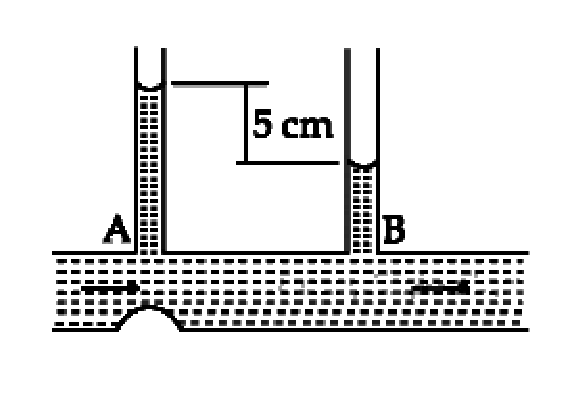
In the diagram shown, if the difference in the two tubes of the manometer is 5 cm, the cross section of the tube at A and B is 6 mm2 and 10 mm2 respectively. The rate at which water flows through the tube ( g = 10 ms−2)
Air of density 1.2 kg m−3 is blowing across the horizontal wings of an aeroplane in such a way that its speeds above and below the wings are 150 ms−1 and 100 ms −1, respectively. The pressure difference between the upper and lower sides of the wings, is: