Heat energy is incident on the surface at the rate of 1000 J/min. If coefficient of absorption is 0.8 and coefficient of reflection is 0.1 then heat energy transmitted by the surface in 5 minute is
When 170 J of energy is incident on a surface of a body, 17 J of energy is reflected by it. If the coefficient of absorption is 0.7, then the amount of energy transmitted will be
'x' joule of heat is incident on a body. Out of it, the total heat reflected and transmitted by it is 'y' joule. The absorption coefficient of the body is
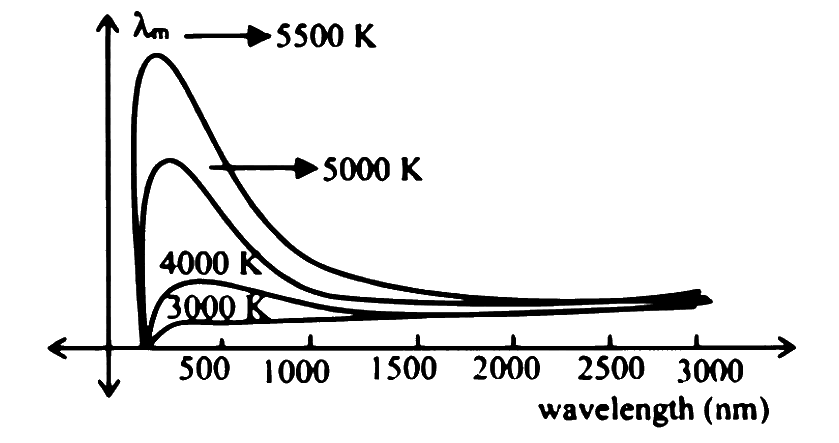
Temperature of two stars are in the ratio 3:2. If wavelength of maximum intensity of first star is 4200 Å, the corresponding wavelength for second star is
Two stars A and B radiate maximum energy at wavelength 3.9×10⁻⁷ m and 5.2×10⁻⁷ m respectively. The ratio of the temperature of star A to that of star B will be
Two bodies 'X' and 'Y' at temperatures T1 K and T2 K respectively have the same dimensions. Their emissivities e1 and e2 are in the ratio of 1:6. If their emissive powers are same, the relation between their temperatures is
Rate of radiation by a black body is 'R' at temperature 'T'. Another body has same area but emissivity is 0.2 and temperature 3T. Its rate of radiation is
A wire of length L and diameter d is used in a bulb. The temperature of wire is T and power radiated by the wire is P. Its emissivity is (σ = Stefan's constant) (Assume that emissivity of wire material is same at all wavelength)
The radiation emitted by a star A is 10000 times that of the sun. If surface temperature of sun and star A are 6000 K and 2000 K respectively, the ratio of radii of star A and sun is
The total radiant energy per unit area normal to the direction of incidence, received at a distance R from the centre of a star of radius r, whose outer surface radiates as a black body at a temperature 'T' K is (σ = Stefan's constant)
A sphere having temperature 600 K is losing heat due to radiation. At this temperature its rate of cooling is R. The rate of cooling of this sphere at 400 K is 243x. The value of x is (Temperature of surrounding is 300 K)
A sphere is at temperature 600 K. In an external environment of 200 K, its cooling rate is R. When the temperature of the sphere falls to 400 K then cooling rate R' will become
Two spherical black bodies of radii R1 and R2 having surface temperature T1 and T2 respectively, radiate the same power. The ratio of R1 to R2 will be
In an external environment of temperature (T) kelvin, a sphere at temperature (3T) kelvin has cooling rate R1. When the temperature of that sphere falls to (2T) kelvin, the cooling rate R2 of the sphere will become
The wavelength of maximum intensity of radiation emitted by a star is 289.8 nm. The radiation intensity of the star is (Stefan's constant = 5.67×10⁻⁸ SI unit, Wein's constant 2898μmk)
A rectangular black body of temperature 27∘C has surface area 6 cm ×3 cm and rate of radiation E. If its temperature is increased by 300∘C and its linear dimensions are reduced to (31)rd of their initial value then the rate of radiation is
A black body is at temperature of 5780 K. The energy of radiation emitted by the body at wavelength 300 nm is U1, at wavelength 500 nm is U2 and that at 900 nm is U3 respectively. Wien's constant b=2.89×10⁶ nmK. This shows that
A black rectangular surface of area 'A' emits energy 'E' per second at 27∘ C. If length and breadth is reduced to half of its initial value and temperature is raised to 327∘C then energy emitted per second becomes
A black rectangular surface of area A emits energy E per second at 127∘ C. If length and breadth is reduced to half of initial value and temperature is raised to 527∘ C then energy emitted becomes
A black rectangular surface of area A emits energy E per unit time at 27∘ C. If length and breadth is reduced to (41)th of initial value and temperature is raised to 327∘ C, then energy emitted per unit time becomes
The power radiated by a black body is P and it radiates maximum energy at wavelength λ0. If the temperature of the black body is now changed so that it radiates maximum energy at wavelength 0.75λ0, the power radiated by it becomes nP. The value n is
The power radiated by a black body is P and it radiates maximum energy at wavelength λ0. If the temperature of the black body is now changed so that it radiates maximum energy at wavelength 43λ0, the power radiated by it becomes nP. The value of n is
A black body radiates maximum energy at wavelength 'λ' at temperature T1 and its emissive power is E. When the temperature of the body is changed to T2, it radiates maximum energy at wavelength 32λ, then the emissive power will become
The energy spectrum of a black body exhibits a maximum around a wavelength 'λ'. The temperature of the black body is now changed such that the energy is maximum around a wavelength 2λ/3. The power radiated by the black body will now increase by a factor
The energy spectrum of a black body exhibits a maximum around a wavelength λ. The temperature of a black body is now changed such that the energy is maximum at wavelength 2λ/3. The power radiated by the black body will now increase by a factor of
A black disc has a radius 'R' and wavelength corresponding to the maximum intensity is 'λ'. The emissive power (E) for the different radii and maximum wavelengths is directly proportional to
The energy spectrum of a black body exhibits a maximum of wavelength λ0. The temperature of the black body is now changed such that the energy is maximum at wavelength 23λ0. The ratio of power radiated by the black body will be
Three spheres, P, Q and R, having radii 4 m, 5 m and 6 m respectively, are coated with lamp black on their outer surfaces. The wavelengths corresponding to maximum intensity (radiated) are 400 nm, 500 nm and 600 nm respectively. If the powers radiated by them are PP,PQ and PR respectively, then PP:PQ:PR is
If 120 J of thermal energy is incident on area 3 m2, the amount of heat transmitted is 12 J, coefficient of absorption is 0.6, then the amount of heat reflected is
The co-efficient of absorption and the coefficient of reflection of a thin uniform plate are 0.77 and 0.17 respectively. If 250 kcal of heat is incident on the surface of the plate, the quantity of heat transmitted is
Black sphere of radius R radiates power P at certain temperature T. If the temperature is doubled, the radius gets doubled. Now the power radiated would be
Two bodies A and B at temperatures ' T1 ' K and ' T2 ' K respectively have the same dimensions. Their emissivities are in the ratio 16:1. At T1=xT2, they radiate the same amount of heat per unit area per unit time. The value of x is
A wire of length 10 cm and diameter 0.5 mm is used in a bulb. The temperature of the wire is 1727∘C and power radiated by the wire is 94.2 W. Its emissivity is 8x where x= _________. (Given σ=6.0×10⁻⁸ W m−2 K−4,π=3.14 and assume that the emissivity of wire material is same at all wavelength.)
Numerical answer type. Work it out, then open the answer.
The outer surface of star in the form of a sphere radiates heat as a black body at temperature ' T '. The total radiant energy per unit area, normal to the direction of incidence, received at a distance ' R ' from the centre of a star of radius ' r ' is (R>r)(σ= Stefan's constant )
Two spherical black bodies have radii ' R1 ' and ' R2 '. Their surface temperatures are ' T1 ' and ' T2 '. If they radiate same power, then R1R2 is
Two spherical black bodies have radii ' R1 ' and ' R2 '. Their surface temperatures are T1K and T2K respectively. If they radiate the same power, the ratio R2R1 is
If a black body at 400 K surrounded by atmosphere at 300 K has rate of cooling ' R0 ', the same body at 900 K, surrounded by same atmosphere, will have rate of cooling nearly
Two spherical bodies of same materials having radii 0.2 m and 0.8 m are placed in same atmosphere. The temperature of the smaller body is 800 K and temperature of the bigger body is 400 K. If the energy radiated from the smaller body is E, the energy radiated from the bigger body is (assume, effect of the surrounding temperature to be negligible),
A rectangular black body of temperature 127∘C has surface area 4 cm×2 cm and rate of radiation is E. If its temperature is increased by 400∘C and surface area is reduced to half of the initial value then the rate of radiation is
Black bodies A and B radiate maximum energy with wavelength difference 4μm. The absolute temperature of body A is 3 times that of B. The wavelength at which body B radiates maximum energy is
A rectangular block of surface area A emits energy E per second at 27∘C. If length and breadth is reduced to half of initial value and temperature is raised to 327∘C then energy emitted per second becomes
Two black spheres P&Q have radii in the ratio 4:3. The wavelength of maximum intensity of radiation are in the ratio 4:5 respectively. The ratio of radiated power by P to Q is
Three identical metal spheres (of same surface area) have red, black and white colors and they are heated up to same temperature. They are allowed to cool. Arrange them from maximum rate of cooling to minimum rate of cooling
Given that ' x ' joule of heat is incident on a body. Out of that, total heat reflected and transmitted is ' y ' joule. The absorption coefficient of body is
Two spheres S1 and S2 have same radii but temperatures T1 and T2 respectively. Their emissive power is same and emissivity in the ratio 1:4. Then the ratio T1:T2 is
Rate of radiation by a black body is ' R ' at temperature 'T'. Another body has same area but emissivity is 0.2 and temperature 3T. Its rate of radiation is
Two bodies ' X ' and ' Y ' at temperatures ' T1 ' K and ' T2 ' K respectively have the same dimensions. If their emissive powers are same, the relation between their temperatures is
A sphere is at temperature 600 K. In an external environment of 200 K, its cooling rate is ' R ' When the temperature of the sphere falls to 400 K, then cooling rate ' R′ ' will become
Two spherical black bodies of radii ' R1 ' and ' R2 ' and with surface temperature ' T1 ' and ' T2 ' respectively radiate the same power. The ratio of ' R1 ' to ' R2 ' will be
Ordinary bodies P and Q radiate maximum energy with wavelength difference 3μm. The absolute temperature of body P is four times that of Q. The wavelength at which body Q radiates maximum energy is
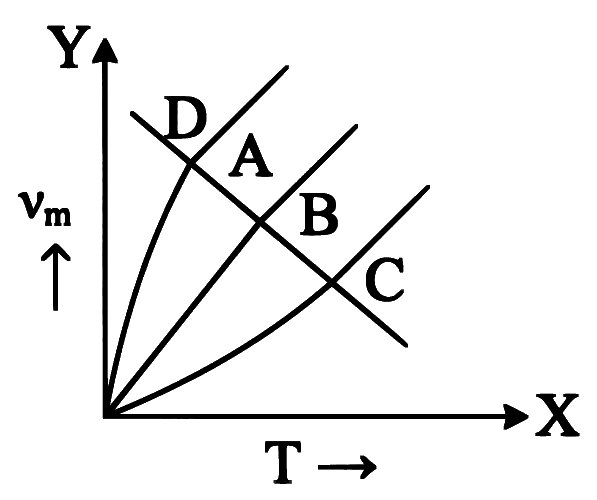
The frequency ' νm ' corresponding to which the energy emitted by a black body is maximum may vary with the temperature ' T ' of the body as shown by the curves ' A ', ' B ', ' C ' and ' D ' in the figure. Which one of these represents the correct variation?
The power radiated by a black body is P and it radiates maximum energy around the wavelength λ0. Now the temperature of the black body is changed so that it radiates maximum energy around wavelength (2λ0). The power radiated by it will now increase by a factor of
The black discs x,y and z have radii 1 m,2 m and 3 m respectively. The wavelengths corresponding to maximum intensity are 200 nm,300 nm and 400 nm respectively. The relation between emissive power Ex,Ey and Ez is
A black body radiates power ' P ' and maximum energy is radiated by it at a wavelength λ0. The temperature of the black body is now so changed that it radiates maximum energy at the wavelength 4λ0. The power radiated by it at new temperature is
Heat energy is incident on the surface at the rate of X J/min. If 'a' and 'r' represent coefficient of absorption and reflection respectively then the heat energy transmitted by the surface in 't' minutes is
Two bodies A and B at temperatures 'T1' K and 'T2' K respectively have the same dimensions. Their emissivities are in the ratio 1:3. If they radiate the same amount of heat per unit area per unit time, then the ratio of their temperatures (T1:T2) is
A sphere and a cube, both of copper have equal volumes and are black. They are allowed to cool at same temperature and in same atmosphere. The ratio of their rate of loss of heat will be
A sphere, a cube and a thin circular plate all made of same material and having the same mass are heated to same temperature of 200∘C. When these are left in a room.
Compare the rate of loss of heat from a metal sphere at 627∘C with the rate of loss of heat from the same sphere at 327∘C, if the temperature of the surrounding is 27∘C. (nearly)
A black sphere has radius 'R' whose rate of radiation is 'E' at temperature 'T'. If radius is made R/3 and temperature '3T', the rate of radiation will be
A black body radiates maximum energy at wavelength 'λ' and its emissive power is 'E'. Now due to a change in temperature of that body, it radiates maximum energy at wavelength 3λ. At that temperature emissive power is
A black body radiates maximum energy at wavelength 'λ' and its emissive power is 'E' Now due to change in temperature of that body, it radiates maximum energy at wavelength 32λ. At that temperature emissive power is
A black body radiates maximum energy at wavelength 'λ' and its emissive power is E. Now due to change in temperature of that body, it radiates maximum energy at wavelength 32λ. At that temperature emissive power is
Three discs x,y and z having radii 2 m,3 m and 6 m respectively are coated on outer surfaces. The wavelength corresponding to maximum intensity are 300 nm,400 nm and 500 nm respectively. If Px,Py and Pz are power radiated by them respectively then
Assume that for solar radiation, surface temperature of the sun is 6000 K. If Wien's constant 'b' is 2.897×10⁻³ mK, the value of maximum wavelength will be
A black reactangular surface of area 'a' emits energy 'E' per second at 27∘C. If length and breadth is reduced to (31)rd of initial value and temperature is raised to 327∘C then energy emitted per second becomes
A black rectangular surface of area 'A' emits energy 'E' per second at 27∘C. If length and breadth is reduced to (1/3)rd of its initial value and temperature is raised to 327∘C then energy emitted per second becomes
The maximum wavelength of radiation emitted by a star is 289.8 nm. Then intensity of radiation for the star is (Given: Stefan's constant =5.67×10⁻⁸ W m−2 K−4, Wien's constant, b=2898μm K)
The power radiated by a black body is P and it radiates maximum energy at wavelength, λ0. If the temperature of the black body is now changed so that it radiates maximum energy at wavelength 43λ0, the power radiated by it becomes nP. The value of n is
A black coloured solid sphere of radius R and mass M is inside a cavity with vacuum inside. The walls of the cavity are maintained at a temperature T0. The initial temperature of the sphere is 3T0. If the specific heat of the material of the sphere varies as αT3 per unit mass with the temperature T of the sphere, where α is a constant, then the time taken for the sphere to cool down to temperature 2T0 will be (σ is Stefan Boltzmann constant)
Assuming the Sun to be a spherical body of radius R at a temperature of TK, evaluate the total radiant power incident on Earth at a distance r from the Sun
Where r0 is the radius of the Earth and σ is Stefan's constant.
If the temperature of the sun were to increase from T to 2T and its radius from R to 2R, then the ratio of the radiant energy received on earth to what it was previously will be
Two spheres of the same material have radii 1 m and 4 m and temperatures 4000 K and 2000 K respectively. The ratio of the energy radiated per second by the first sphere to that by the second is
The radiant energy from the sun, incident normally at the surface of earth is 20 kcal/m2 min. What would have been the radiant energy, incident normally on the earth, if the sun had a temperature, twice of the present one?