A cylindrical rod of length 1 m and radius 4 cm is mounted vertically. It is subjected to a shear force of 105 N at the top. Considering infinitesimally small displacement in the upper edge, the angular displacement θ of the rod axis from its original position would be: (shear moduli, G=1010 N/m2)
Two slabs with square cross section of different materials (1,2) with equal sides (l) and thickness d1 and d2 such that d2=2d1 and l>d2. Considering lower edges of these slabs are fixed to the floor, we apply equal shearing force on the narrow faces. The angle of deformation is θ2=2θ1. If the shear moduli of material 1 is 4×10⁹ N/m2, then shear moduli of material 2 is x×109 N/m2, where value of x is ________.
Numerical answer type. Work it out, then open the answer.
A square aluminum (shear modulus is 25×109 Nm−2) slab of side 60 cm and thickness 15 cm is subjected to a shearing force (on its narrow face) of 18.0×10⁴ N. The lower edge is riveted to the floor. The displacement of the upper edge is ____________ μm.
Numerical answer type. Work it out, then open the answer.
Shear Modulus & Poisson's Ratio · Relations between elastic constants
If Y, K and η are the values of Young's modulus, bulk modulus and modulus of rigidity of any material respectively. Choose the correct relation for these parameters.
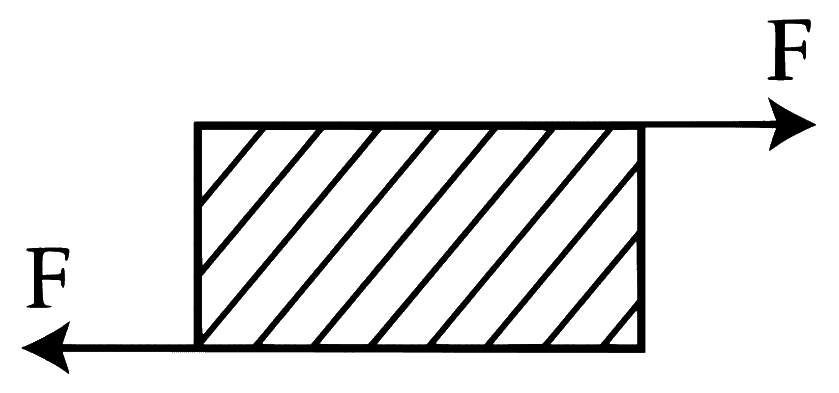
As shown in the figure, forces of 105 N each are applied in opposite directions, on the upper and lower faces of a cube of side 10 cm, shifting the upper face parallel to itself by 0.5 cm. If the side of another cube of the same material is 20 cm, then under similar conditions as above, the displacement will be:
A uniform wire (Young's modulus 2×10¹¹ Nm −2) is subjected to longitudinal tensile stress of 5×10⁷ Nm−2. If the overall volume change in the wire is 0.02%, the fractional decrease in the radius of the wire is close to: