
Moving Charge in a Magnetic Field · Magnetic force on a moving charge
When an electron is kept in a strong magnetic field, then
Show answer and solution
Answer: (d)
Loading the solution…
Home›Practice Hub›Chapters›Moving Charges and Magnetism›Moving Charge in a Magnetic Field
Moving Charges and Magnetism PYQs · MHT CET · JEE Main · NEET
Moving Charge in a Magnetic Field · Magnetic force on a moving charge
When an electron is kept in a strong magnetic field, then
Answer: (d)
Moving Charge in a Magnetic Field · Magnetic force on a moving charge
Lorentz magnetic force is acting on a particle of charge moving with velocity in magnetic field . The work done by this force on the charged particle is
Answer: (a)
Moving Charge in a Magnetic Field · Magnetic force on a moving charge
A current carrying solenoid is placed vertically and a particle of mass with charge is released from rest. The particle moves along the axis of solenoid. If is acceleration due to gravity then the acceleration (a) of the charged particle will satisfy:
Answer: (d)
Moving Charge in a Magnetic Field · Magnetic force on a moving charge
The charged particle moving in a uniform magnetic field of has an acceleration . The value of is
Numerical answer type. Work it out, then open the answer.
Answer: 12
Moving Charge in a Magnetic Field · Circular path: radius & time period
A charged particle of mass and charge travels on a circular path, (of radius unit) is perpendicular to a magnetic field . The time taken by a particle to complete revolutions is
Answer: (b)
Moving Charge in a Magnetic Field · Circular path: radius & time period
A charge moves in a circular path perpendicular to a magnetic field. The time period of revolution is independent of
Answer: (b)
Moving Charge in a Magnetic Field · Cyclotron
In the cyclotron, as radius of the circular path of the charged particle increases, ( = angular velocity, V = linear velocity)
Answer: (b)
Moving Charge in a Magnetic Field · Magnetic force on a moving charge
1 μC charge moving with velocity m/s in the region of magnetic field T. The magnitude of force acting on it is N. The value of is _______.
Numerical answer type. Work it out, then open the answer.
Answer: 171
Moving Charge in a Magnetic Field · Circular path: radius & time period
Two particles X and Y of masses '' and '' respectively, having equal charges after being accelerated through the same potential difference enter a region of uniform magnetic field and describe circular paths of radii ' ' and '' respectively. The ratio of '' and '' is
Answer: (c)
Moving Charge in a Magnetic Field · Circular path: radius & time period
A charged particle is moving in a uniform magnetic field in a circular path of radius 'R'. When the energy of the particle becomes 3 times the original, the new radius will be
Answer: (c)
Moving Charge in a Magnetic Field · Circular path: radius & time period
A charged particle is accelerated by a potential difference of enters a region of uniform magnetic field of induction at right angles to the direction of the field. The charged particle completes semi circle of the radius inside the magnetic field. The mass of the charged particle is (all quantities are in SI units)
Answer: (b)
Moving Charge in a Magnetic Field · Helical path & pitch
A 5 mg particle carrying a charge of is moving with velocity of in a region having magnetic field . It moves a distance of meter along when it completes 5 revolutions. The value of is ______。
Numerical answer type. Work it out, then open the answer.
Answer: 2
Moving Charge in a Magnetic Field · Lorentz force & velocity selector
A particle having charge C moving in plane in fields of N/C and T experiences a force of N. The velocity of the particle at that instant is _________ m/s.
Answer: (a)
Moving Charge in a Magnetic Field · Lorentz force & velocity selector
A particle of charge and mass is projected from origin with an initial velocity . There exists a uniform magnetic field and a space varying electric field within the region . After travelling a distance such that -coordinate has changed from to , the change in the kinetic energy is ______.
Answer: (a)
Moving Charge in a Magnetic Field · Magnetic force on a moving charge
Lorentz magnetic force is acting on a particle of charge q moving with velocity in a magnetic field . The work done by this force on the charged particle is
Answer: (a)
Moving Charge in a Magnetic Field · Magnetic force on a moving charge
Given below are two statements. One is labelled as Assertion (A) and the other is labelled as Reason (R).
Assertion (A): An electron in a certain region of uniform magnetic field is moving with constant velocity in a straight line path.
Reason (R): The magnetic field in that region is along the direction of velocity of the electron. In the light of the above statements, choose the correct answer from the options given below:
Answer: (b)
Moving Charge in a Magnetic Field · Circular path: radius & time period
A particle of charge and mass is present in a strong magnetic field of 6.28 T. The particle is then fired perpendicular to magnetic field. The time required for the particle to return to original location for the first time is _________ s.
Numerical answer type. Work it out, then open the answer.
Answer: 0
Moving Charge in a Magnetic Field · Magnetic force on a moving charge
A particle of charge moves with a velocity in a magnetic field , where ' ', ' b ' and ' c ' are constants. The magnitude of force experienced by particle is
Answer: (a)
Moving Charge in a Magnetic Field · Circular path: radius & time period
A particle of charge , mass and kinetic energy enters in magnetic field perpendicular to its velocity and undergoes a circular arc of radius (r). Which of the following curves represents the variation of with ?
Answer: (a)
Moving Charge in a Magnetic Field · Circular path: radius & time period
Given below are two statements: one is labelled as Assertion A and the other is labelled as Reason
Assertion A: If Oxygen ion and Hydrogen ion enter normal to the magnetic field with equal momentum, then the path of ion has a smaller curvature than that of . Reason R: A proton with same linear momentum as an electron will form a path of smaller radius of curvature on entering a uniform magnetic field perpendicularly.
In the light of the above statements, choose the correct answer from the options given below
Answer: (c)
Moving Charge in a Magnetic Field · Lorentz force & velocity selector
An electron (mass and charge ) moving with speed speed of light) is injected into a magnetic field of magnitude perpendicular to its direction of motion. We wish to apply a uniform electric field together with the magnetic field so that the electron does not deflect from its path. Then (speed of light )
Answer: (d)
Moving Charge in a Magnetic Field · Lorentz force & velocity selector
A proton is moving undeflected in a region of crossed electric and magnetic fields at a constant speed of . When the electric field is switched off, the proton moves along a circular path of radius 2 cm. The magnitude of electric field is . The value of is _________. Take the mass of the proton .
Numerical answer type. Work it out, then open the answer.
Answer: 2
Moving Charge in a Magnetic Field · Magnetic force on a moving charge
Consider a long thin conducting wire carrying a uniform current I. A particle having mass " " and charge " " is released at a distance " " from the wire with a speed along the direction of current in the wire. The particle gets attracted to the wire due to magnetic force. The particle turns round when it is at distance from the wire. The value of is [ is vacuum permeability]
Answer: (b)
Moving Charge in a Magnetic Field · Circular path: radius & time period
Bohr model is applied to a particle of mass m and charge is moving in a plane under the influence of a transverse magnetic field (B). The energy of the charged particle in the second level will be ( Planck's constant)
Answer: (c)
Moving Charge in a Magnetic Field · Circular path: radius & time period
Uniform magnetic fields of different strengths and , both normal to the plane of the paper exist as shown in the figure. A charged particle of mass and charge , at the interface at an instant, moves into the region 2 with velocity and returns to the interface. It continues to move into region 1 and finally reaches the interface. What is the displacement of the particle during this movement along the interface?
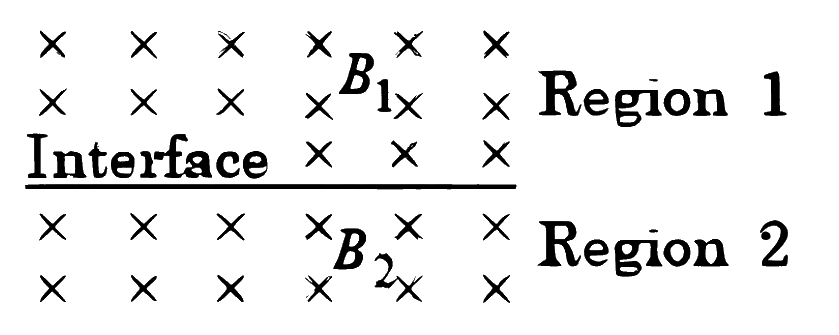
(Consider the velocity of the particle to be normal to the magnetic field and )
Answer: (a)
Moving Charge in a Magnetic Field · Circular path: radius & time period
An electron projected perpendicular to a uniform magnetic field B moves in a circle. If Bohr's quantization is applicable, then the radius of the electronic orbit in the first excited state is:
Answer: (a)
Moving Charge in a Magnetic Field · Magnetic force on a moving charge
A charged particle is moving along a magnetic field line. What is the magnetic force acting on the particle?
Answer: (c)
Moving Charge in a Magnetic Field · Magnetic force on a moving charge
The electrostatic force and magnetic force acting on a charge moving with velocity can be written:
Answer: (c)
Moving Charge in a Magnetic Field · Magnetic force on a moving charge
An electron is projected with uniform velocity along the axis inside a current carrying long solenoid. Then:
Answer: (d)
Moving Charge in a Magnetic Field · Magnetic force on a moving charge
A charge of is moving with a velocity of along the positive axis under a magnetic field of strength . The force acting on the charge is . The value of is __________.
Numerical answer type. Work it out, then open the answer.
Answer: 32
Moving Charge in a Magnetic Field · Cyclotron
Cyclotron is used to
Answer: (b)
Moving Charge in a Magnetic Field · Magnetic force on a moving charge
An electron moves through a uniform magnetic field . At a particular instant of time, the velocity of electron is . If the magnetic force acting on electron is , where is the charge of electron, then the value of is _________ .
Numerical answer type. Work it out, then open the answer.
Answer: 5
Moving Charge in a Magnetic Field · Circular path: radius & time period
A charged particle is moving in a uniform magnetic field in a circular path of radius ' '. When the kinetic energy of the particle is increased to three times, then the new radius will be
Answer: (c)
Moving Charge in a Magnetic Field · Circular path: radius & time period
Electron of mass ' ' and charge ' ' is travelling with speed ' ' along a circular path of radius ' ' at right angles to a uniform magnetic field of intensity ' B '. If the speed of the electron is halved and the magnetic field is doubled, the resulting path would have radius
Answer: (b)
Moving Charge in a Magnetic Field · Circular path: radius & time period
A charged particle of charge ' ' is accelerated by a potential difference ' ' enters a region of uniform magnetic field ' ' at right angles to the direction of field. The charged particle completes semicircle of radius ' ' inside magnetic field. The mass of the charged particle is
Answer: (a)
Moving Charge in a Magnetic Field · Circular path: radius & time period
A charged particle is moving in a uniform magnetic field in a circular path with radius ' '. When the energy of the particle is doubled, then the new radius will be
Answer: (d)
Moving Charge in a Magnetic Field · Circular path: radius & time period
A proton and a deuteron having same kinetic energies enter a region of uniform magnetic field , moving perpendicular to . The ratio of the radius of deuteron path to the radius of the proton path is:
Answer: (c)
Moving Charge in a Magnetic Field · Circular path: radius & time period
Two particles and having equal charges are being accelerated through the same potential difference. Thereafter they enter normally in a region of uniform magnetic field and describe circular paths of radii and respectively. The mass ratio of and is:
Answer: (d)
Moving Charge in a Magnetic Field · Lorentz force & velocity selector
A proton moving with a constant velocity passes through a region of space without any change in its velocity. If and represent the electric and magnetic fields respectively, then the region of space may have:
(A)
(B)
(C)
(D)
Choose the most appropriate answer from the options given below:
Answer: (c)
Moving Charge in a Magnetic Field · Lorentz force & velocity selector
An electron with kinetic energy enters a region of uniform magnetic field of 3 perpendicular to its direction. An electric field is applied perpendicular to the direction of velocity and magnetic field. The value of E, so that electron moves along the same path, is __________ . (Given, mass of electron , electric charge )
Numerical answer type. Work it out, then open the answer.
Answer: 4
Moving Charge in a Magnetic Field · Magnetic force on a moving charge
An electron is projected along the axis of circular conductor carrying current I. Electron will experience
Answer: (a)
Moving Charge in a Magnetic Field · Magnetic force on a moving charge
An electron is moving along the positive -axis. If the uniform magnetic field is applied parallel to the negative z-axis, then
A. The electron will experience magnetic force along positive y-axis
B. The electron will experience magnetic force along negative y-axis
C. The electron will not experience any force in magnetic field
D. The electron will continue to move along the positive -axis
E. The electron will move along circular path in magnetic field
Choose the correct answer from the options given below:
Answer: (c)
Moving Charge in a Magnetic Field · Magnetic force on a moving charge
An electron is allowed to move with constant velocity along the axis of current carrying straight solenoid.
A. The electron will experience magnetic force along the axis of the solenoid.
B. The electron will not experience magnetic force.
C. The electron will continue to move along the axis of the solenoid.
D. The electron will be accelerated along the axis of the solenoid.
E. The electron will follow parabolic path-inside the solenoid.
Choose the correct answer from the options given below:
Answer: (b)
Moving Charge in a Magnetic Field · Helical path & pitch
A charge particle moving in magnetic field B, has the components of velocity along B as well as perpendicular to B. The path of the charge particle will be
Answer: (a)
Moving Charge in a Magnetic Field · Lorentz force & velocity selector
A uniform electric field and a uniform magnetic field are acting along the same direction in a certain region. If an electron is projected in the region such that its velocity is pointed along the direction of fields, then the electron:
Answer: (c)
Moving Charge in a Magnetic Field · Circular path: radius & time period
Electron of mass '' and charge '' is travelling with speed '' along a circular path of radius '', at right angles to a uniform magnetic field of intensity ''. If the speed of the electron is halved and the magnetic field is doubled, the resulting path would have radius
Answer: (d)
Moving Charge in a Magnetic Field · Circular path: radius & time period
A charge particle of accelerated by a potential difference of enters a region of uniform magnetic field of magnitude at right angle to the direction of field. The charge particle completes semicircle of radius inside magnetic field. The mass of the charge particle is __________
Numerical answer type. Work it out, then open the answer.
Answer: 144
Moving Charge in a Magnetic Field · Helical path & pitch
A proton with a kinetic energy of moves into a region of uniform magnetic field of magnitude . The angle between the direction of magnetic field and velocity of proton is . The pitch of the helical path taken by the proton is __________ . (Take, mass of proton and Charge on proton ).
Numerical answer type. Work it out, then open the answer.
Answer: 40
Moving Charge in a Magnetic Field · Magnetic force on a moving charge
Given below are two statements:
Statement I: The electric force changes the speed of the charged particle and hence changes its kinetic energy; whereas the magnetic force does not change the kinetic energy of the charged particle.
Statement II: The electric force accelerates the positively charged particle perpendicular to the direction of electric field. The magnetic force accelerates the moving charged particle along the direction of magnetic field.
In the light of the above statements, choose the most appropriate answer from the options given below:
Answer: (c)
Moving Charge in a Magnetic Field · Magnetic force on a moving charge
Given below are two statements: One is labelled as Assertion (A) and the other is labelled as Reason (R).
Assertion (A): In an uniform magnetic field, speed and energy remains the same for a moving charged particle.
Reason (R): Moving charged particle experiences magnetic force perpendicular to its direction of motion.
Answer: (a)
Moving Charge in a Magnetic Field · Circular path: radius & time period
An electron and a proton having the same momenta enter perpendicularly into a magnetic field. What are their trajectories in the field?
Answer: (d)
Moving Charge in a Magnetic Field · Circular path: radius & time period
A charge particle moves along circular path in a uniform magnetic field in a cyclotron. The kinetic energy of the charge particle increases to 4 times its initial value. What will be the ratio of new radius to the original radius of circular path of the charge particle:
Answer: (c)
Moving Charge in a Magnetic Field · Circular path: radius & time period
A proton and an alpha particle of the same velocity enter in a uniform magnetic field which is acting perpendicular to their direction of motion. The ratio of the radii of the circular paths described by the alpha particle and proton is:
Answer: (c)
Moving Charge in a Magnetic Field · Circular path: radius & time period
A deuteron and a proton moving with equal kinetic energy enter into a uniform magnetic field at right angle to the field. If rd and rp are the radii of their circular paths respectively, then the ratio will be : 1 where x is __________.
Numerical answer type. Work it out, then open the answer.
Answer: 2
Moving Charge in a Magnetic Field · Magnetic force on a moving charge
A charge particle is moving in a uniform magnetic field . If it has an acceleration of , then the value of will be:
Answer: (b)
Moving Charge in a Magnetic Field · Circular path: radius & time period
Two charged particles, having same kinetic energy, are allowed to pass through a uniform magnetic field perpendicular to the direction of motion. If the ratio of radii of their circular paths is and their respective masses ratio is . Then, the ratio of their charges will be:
Answer: (b)
Moving Charge in a Magnetic Field · Circular path: radius & time period
A proton, a deuteron and an -particle with same kinetic energy enter into a uniform magnetic field at right angle to magnetic field. The ratio of the radii of their respective circular paths is:
Answer: (d)
Moving Charge in a Magnetic Field · Circular path: radius & time period
A singly ionized magnesium atom (A = 24) ion is accelerated to kinetic energy 5 keV, and is projected perpendicularly into a magnetic field B of the magnitude 0.5 T. The radius of path formed will be _____________ cm.
Numerical answer type. Work it out, then open the answer.
Answer: 10
Moving Charge in a Magnetic Field · Lorentz force & velocity selector
A velocity selector consists of electric field and magnetic field with . The value of required for an electron of energy moving along the positive -axis to pass undeflected is:
(Given, mass of electron )
Answer: (a)
Moving Charge in a Magnetic Field · Cyclotron
A cyclotron is used to accelerate protons. If the operating magnetic field is and the radius of the cyclotron 'dees' is , the kinetic energy of the accelerated protons in MeV will be: ]
Answer: (b)
Moving Charge in a Magnetic Field · Cyclotron
A cyclotron is working at a frequency of 10 MHz. If the radius of its dees is 60 cm. The maximum kinetic energy of accelerated proton will be:
(Take: e = 1.6 1019 C, mp = 1.67 1027 kg)
Answer: (a)
Moving Charge in a Magnetic Field · Magnetic force on a moving charge
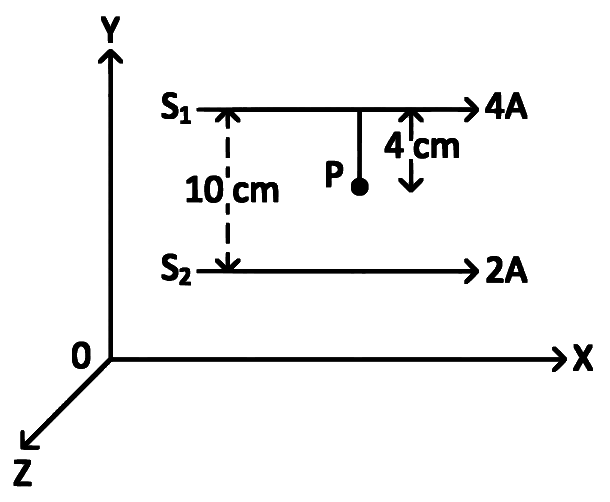
Two long parallel conductors S1 and S2 are separated by a distance 10 cm and carrying currents of 4A and 2A respectively. The conductors are placed along x-axis in X-Y plane. There is a point P located between the conductors (as shown in figure).
A charged particle of 3 coulomb is passing through the point P with velocity m/s; where and represents unit vector along x & y axis respectively.
The force acting on the charged particle is N. The value of x is:
Answer: (c)
Moving Charge in a Magnetic Field · Magnetic force on a moving charge
An electron is projected along the axis of circular conductor carrying current '' The electron will experience
Answer: (d)
Moving Charge in a Magnetic Field · Magnetic force on a moving charge
A charge Q is moving distance in the magnetic field . Find the value of work done by .
Answer: (a)
Moving Charge in a Magnetic Field · Circular path: radius & time period
Two ions having same mass have charges in the ratio 1: 2. They are projected normally in a uniform magnetic field with their speeds in the ratio 2: 3. The ratio of the radii of their circular trajectories is:
Answer: (b)
Moving Charge in a Magnetic Field · Lorentz force & velocity selector
A charge moves with velocity '' through electric field as well as magnetic field (B). then the force acting on it is
Answer: (c)
Moving Charge in a Magnetic Field · Magnetic force on a moving charge
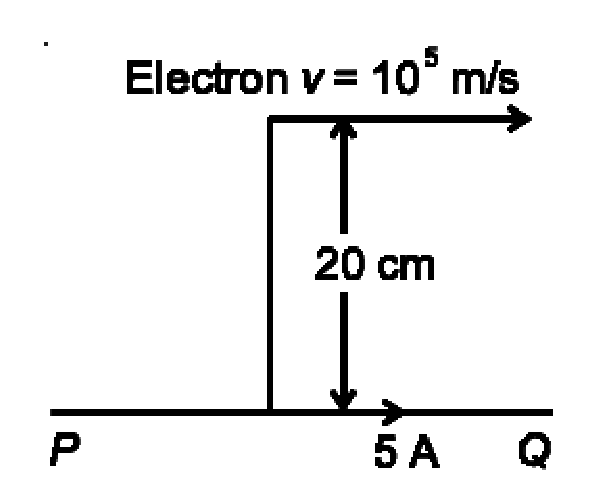
An infinitely long straight conductor carries a current of 5A as shown. An electron is moving with a speed of 105 m/s parallel to the conductor. The perpendicular distance between the electron and the conductor is 20cm at an instant. Calculate the magnitude of the force experienced by the electron at that instant.
Answer: (a)
Moving Charge in a Magnetic Field · Circular path: radius & time period
Two ions of masses 4 amu and 16 amu have charges +2e and +3e respectively. These ions pass through the region of constant perpendicular magnetic field. The kinetic energy of both ions is same. Then:
Answer: (b)
Moving Charge in a Magnetic Field · Circular path: radius & time period
A deuteron and an alpha particle having equal kinetic energy enter perpendicularly into a magnetic field. Let rd and r be their respective radii of circular path. The value of is equal to:
Answer: (c)
Moving Charge in a Magnetic Field · Circular path: radius & time period
A proton and an -particle, having kinetic energies Kp and K respectively, enter into a magnetic field at right angles.
The ratio of the radii of trajectory of proton to that of -particle is 2: 1. The ratio of Kp: K is:
Answer: (b)
Moving Charge in a Magnetic Field · Circular path: radius & time period
A proton, a deuteron and an particle are moving with same momentum in a uniform magnetic field. The ratio of magnetic forces acting on them is _________ and their speed is _______, in the ratio.
Answer: (a)
Moving Charge in a Magnetic Field · Cyclotron
If the maximum value of accelerating potential provided by a radio frequency oscillator is 12 kV. The number of revolutions made by a proton in a cyclotron to achieve one sixth of the speed of light is ...............
[mp = 1.67 1027 kg, e = 1.6 1019 C, Speed of light = 3 108 m/s]
Numerical answer type. Work it out, then open the answer.
Answer: 543
Moving Charge in a Magnetic Field · Lorentz force & velocity selector
A charge moves with velocity through electric field as well as magnetic field (B). Then, the force acting on it is
Answer: (c)
Moving Charge in a Magnetic Field · Magnetic force on a moving charge
A charged particle carrying charge 1 C is moving
with velocity ms–1. If an external
magnetic field of × 10–3 T exists in the region where the particle is moving then the force on the particle is × 10–9 N. The vector is:
Answer: (c)
Moving Charge in a Magnetic Field · Magnetic force on a moving charge
Proton with kinetic energy of 1MeV moves from south to north. It gets an acceleration of 1012 m/s2 by an applied magnetic field (west to east). The value of magnetic field: (Rest mass of proton is 1.6 × 10⁻²⁷ kg):
Answer: (a)
Moving Charge in a Magnetic Field · Circular path: radius & time period
An -particle of energy 10 eV is moving in a circular path in uniform magnetic field. The energy of proton moving in the same path and same magnetic field will be [mass of -particle times mass of proton]
Answer: (d)
Moving Charge in a Magnetic Field · Circular path: radius & time period
A charged particle is moving in a uniform magnetic field in a circular path of radius . When the energy of the particle becomes three times the original, the new radius will be
Answer: (b)
Moving Charge in a Magnetic Field · Helical path & pitch
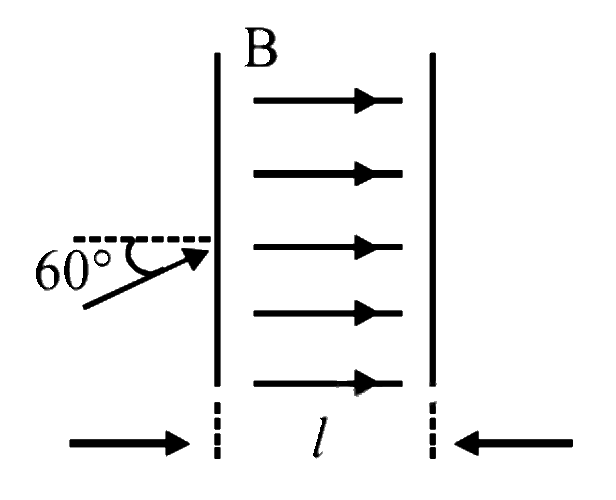
The figure shows a region of length ‘l’ with a uniform magnetic field of 0.3 T in it and a proton entering the region with velocity 4 105 ms–1 making an angle 60° with the field. If the proton completes 10 revolution by the time it cross the region shown, ‘l’ is close to
(mass of proton = 1.67 10–27 kg, charge of the proton = 1.6 10–19 C)
Answer: (d)
Moving Charge in a Magnetic Field · Helical path & pitch
A beam of protons with speed 4 × 10⁵ ms–1 enters a uniform magnetic field of 0.3 T at an angle of 60° to the magnetic field. The pitch of the resulting helical path of protons is close to: (Mass of the proton = 1.67 10–27 kg, charge
of the proton = 1.69 10–19 C)
Answer: (d)
Moving Charge in a Magnetic Field · Lorentz force & velocity selector
An electron is moving along +x direction with a velocity of 6 106 ms–1. It enters a region of uniform electric field of 300 V/cm pointing along +y direction. The magnitude and direction of the magnetic field set up in this region such that the electron keeps moving along the x direction will be:
Answer: (c)
Moving Charge in a Magnetic Field · Circular path: radius & time period
A particle of charge q and mass m is moving with a velocity (v 0) towards a large screen placed in the Y - Z plane at a distance d. If there is a magnetic field , the maximum value of v for which the particle will not hit the screen is:
Answer: (d)
Moving Charge in a Magnetic Field · Circular path: radius & time period
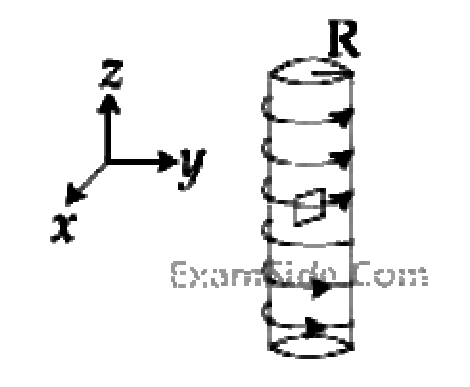
An electron gun is placed inside a long solenoid of radius R on its axis. The solenoid has n turns/length and carries a current I. The electron gun shoots an electron along the radius of the solenoid with speed v. If the electron does not hit the surface of the solenoid, maximum possible value of v is (all symbols have their standard meaning):
Answer: (c)
Moving Charge in a Magnetic Field · Lorentz force & velocity selector
A charged particle of mass 'm' and charge 'q' moving under the influence of uniform electric field and a uniform magnetic field follows a trajectory from point P to Q as shown in figure. The velocities at P and Q are respectively, and . Then which of the following statements (A, B, C, D) are correct?
(Trajectory shown is schematic and not to scale):
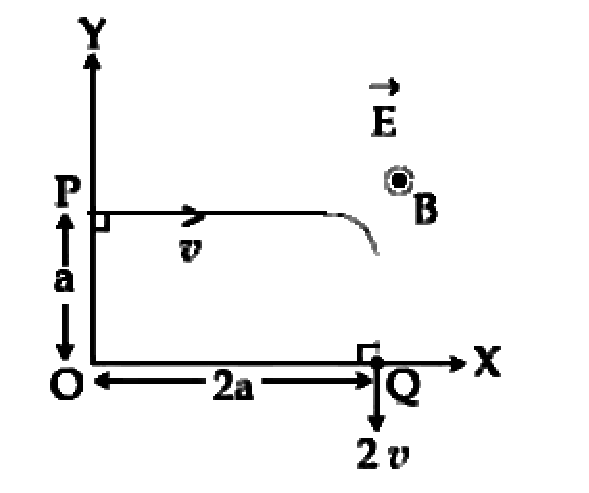
(A) E =
(B) Rate of work done by the electric field at P is
(C) Rate of work done by both the fields at Q is zero
(D) The difference between the magnitude of angular momentum of the particle at P and Q is 2mav.
Answer: (b)
Moving Charge in a Magnetic Field · Lorentz force & velocity selector
A particle of mass m and charge q has an initial velocity. If an electric field and magnetic field act on the particle, its speed will double after a time:
Answer: (c)
Moving Charge in a Magnetic Field · Circular path: radius & time period
Ionized hydrogen atoms and -particles with same momenta enters perpendicular to a constant magnetic field, B. The ratio of their radii of their paths rH: r will be:
Answer: (d)
Moving Charge in a Magnetic Field · Cyclotron
Maximum kinetic energy gained by the charged particle in the cyclotron is independent of
Answer: (d)
Moving Charge in a Magnetic Field · Circular path: radius & time period
A proton, an electron, and a Helium nucleus, have the same energy. They are in circular orbits in a plane due to magnetic field perpendicualr to the plane. Let rp, re and rHe be their respective radii, then
Answer: (b)
Moving Charge in a Magnetic Field · Circular path: radius & time period
A proton and an -particle (with their masses in the ratio of 1: 4 and charges in the ratio of 1: 2) are accelerated from rest through a potential difference V. If a uniform magnetic field (B) is set up perpendicular to their velocities, the ratio of the radii rp: r of the circular paths described by them will be;
Answer: (c)
Moving Charge in a Magnetic Field · Circular path: radius & time period
In an experiment, electrons are accelerated, from rest, by applying a voltage of 500 V. Calculate the radius of the path if a magnetic field 100 mT is then applied. [Charge of the electron = 1.6 10–19 C Mass of the electron = 9.1 10–31 kg]
Answer: (a)
Moving Charge in a Magnetic Field · Lorentz force & velocity selector
A particle of mass m and charge q is in an electric and magnetic field given by
The charged particle is shifted from the origin to the point P(x = 1; y = 1) along a straight path. The magnitude of the total work done is:
Answer: (d)
Moving Charge in a Magnetic Field · Lorentz force & velocity selector
A particle having the same charge as of electron moves in a circular path of radius 0.5 cm under the influence of a magnetic field of 0.5 T. If an electric field of 100 V/m makes it to move in a straight path, then the mass of the particle is (Given charge of electron = 1.6 1019 C)
Answer: (d)
Moving Charge in a Magnetic Field · Circular path: radius & time period
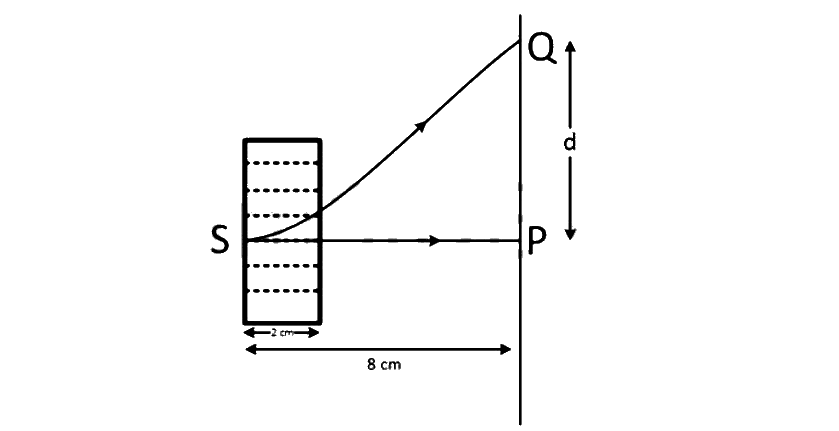
An electron, moving along the x-axis with an initial energy of 100 eV, enters a region of magnetic field at S (See figure). The field extends between x = 0 and x = 2 cm. The electron is detected at the point Q on a screen placed 8 cm away from the point S. The distance d between P and Q (on the screen) is: (electron’s charge = 1.6 × 10⁻¹⁹ C, mass of electron = 9.1 × 10⁻³¹ kg)
Answer: (b)
Moving Charge in a Magnetic Field · Circular path: radius & time period
The region between y = 0 and y = d contains a magnetic field . A particle of mass m and charge q enters the region with a velocity If d the acceleration of the charged particle at the point of its emergence at the other side is:
Answer: (a)
Moving Charge in a Magnetic Field · Circular path: radius & time period
An electron, a proton and an alpha particle having the same kinetic energy are moving in circular orbits of radii re, rp, r respectively in a uniform magnetic field B. The relation between re, rp, r is:
Answer: (c)
Moving Charge in a Magnetic Field · Magnetic force on a moving charge
A negative test charge is moving near a long straight wire carrying a current. The force acting on the test charge is parallel to the direction of the current. The motion of the charge is:
Answer: (b)
Moving Charge in a Magnetic Field · Lorentz force & velocity selector
In a certain region static electric and magnetic fields exist. The magnetic field is given by . If a test charge moving with a velocity experiences no force in that region, then the electric field in the region, in SI units, is:
Answer: (d)
Moving Charge in a Magnetic Field · Circular path: radius & time period
An electron is moving in a circular path under the influence of a transverse magnetic field of 3.57 10-2 T. If the value of e/m is 1.76 1011 C kg, the frequency of revolution of the electron is
Answer: (a)
Moving Charge in a Magnetic Field · Circular path: radius & time period
A proton and an alpha particle both enter a region of uniform magnetic field B, moving at right angles to the field B. If the radius of circular orbits for both the particles is equal and the kinetic energy acquired by proton is 1 MeV, the energy acquired by the alpha particle will be
Answer: (b)
Moving Charge in a Magnetic Field · Circular path: radius & time period
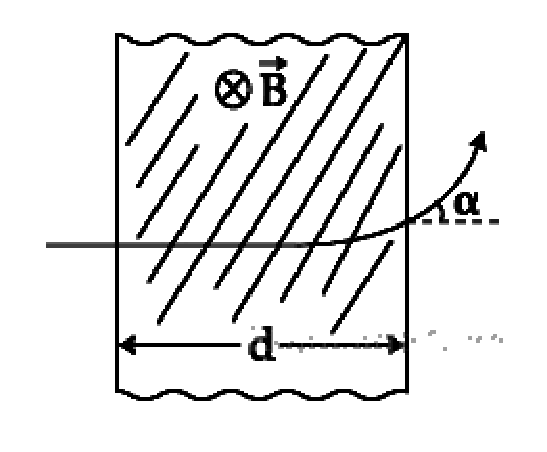
A proton (mass m) accelerated by a potential difference V flies through a uniform transverse magnetic field B. The field occupies a region of space by width 'd'. If '' be the angle of deviation of proton from initial direction of motion (see figure), the value of sin will be:
Answer: (c)
Moving Charge in a Magnetic Field · Circular path: radius & time period
A positive charge 'q' of mass 'm' is moving along the + x axis. We wish to apply a uniform magnetic field B for time t so that the charge reverses its direction crossing the y axis at a distance d. Then:
Answer: (c)
Moving Charge in a Magnetic Field · Lorentz force & velocity selector
A particle of charge C moving with velocity 10 ms along x-axis enters a region where magnetic field of induction is along the y-axis and an electric field of magnitude Vm is along the negative z-axis. If the charged particle continues moving along x-axis, the magnitude of is:
Answer: (c)
Moving Charge in a Magnetic Field · Magnetic force on a moving charge
A long straight wire carries a certain current and produces a magnetic field 2 104 Wb m at a perpendicular distance of 5 cm from the wire. An electron situated at 5 cm from the wire moves with a velocity 107 m/s towards the wire along perpendicular to it. The force experienced by the electron will be (charge on electron 1.6 1019 C)
Answer: (b)
Moving Charge in a Magnetic Field · Lorentz force & velocity selector
When a proton is released from rest in a room, it starts with an initial acceleration 0 towards west. When it is projected towards north with a speed 0 it moves with an initial acceleration 30 towards west. The electric and magnetic fields in the room are
Answer: (d)
Moving Charge in a Magnetic Field · Circular path: radius & time period
A proton carrying 1 MeV kinetic energy is moving in a circular path of radius R in uniform magnetic field. What should be the energy of an -particle to describe a circle of same radius in the same field?
Answer: (b)
Moving Charge in a Magnetic Field · Circular path: radius & time period
Proton, deuteron and alpha particle of same kinetic energy are moving in circular trajectories in a constant magnetic field. The radii of proton, deuteron and alpha particle are respectively and . Which one of the following relations is correct?
Answer: (b)
Moving Charge in a Magnetic Field · Cyclotron
An alternating electric field, of frequency , is applied across the dees (radius = R) of a cyclotron that is being used to accelerate protons (mass = m). The operating magnetic field (B) used in the cyclotron and the kinetic energy (K) of the proton beam, produced by it, are given by
Answer: (c)
Moving Charge in a Magnetic Field · Lorentz force & velocity selector
A uniform electric field and a uniform magnetic field are acting along the same direction in a certain region. If an electron is projected in the region such that its velocity is pointed along the direction of fields, then the electron
Answer: (b)
Moving Charge in a Magnetic Field · Lorentz force & velocity selector
A particle having a mass of 102 kg carries a charge of 5 108 C. The particle is given an initial horizontal velocity of 105 m s in the presence of electric field and magnetic field . To keep the particle moving in a horizontal direction, it is necessary that
(1) should be perpendicular to the direction of velocity and should be along the direction of velocity
(2) Both and should be along the direction of velocity
(3) Both and are mutually perpendicular and perpendicular to the direction of velocity. (4) should be along the direction of velocity and should be perpendicular to the direction of velocity
Which one of the following pairs of statements is possible?
Answer: (c)
Moving Charge in a Magnetic Field · Magnetic force on a moving charge
The magnetic force acting on a charged particle of charge 2 C in a magnetic field of 2 T acting in y direction, when the particle velocity is , is
Answer: (d)
Moving Charge in a Magnetic Field · Circular path: radius & time period
Under the influence of a uniform magnetic field, a charged particle moves with constant speed v in a circle of radius R. The time period of rotation of the particle
Answer: (b)
Moving Charge in a Magnetic Field · Magnetic force on a moving charge
A particle of mass m, charge Q and kinetic energy T enters a transverse uniform magnetic field of induction . After 3 seconds the kinetic energy of the particle will be
Answer: (a)
Moving Charge in a Magnetic Field · Magnetic force on a moving charge
A charged particle moves through a magnetic field perpendicular to its direction. Then
Answer: (b)
Moving Charge in a Magnetic Field · Circular path: radius & time period
Under the influence of a uniform magnetic field, a charged particle moves with constant speed v in a circle of radius R. The time period of rotation of the particle
Answer: (b)
Moving Charge in a Magnetic Field · Lorentz force & velocity selector
A charged particle with charge enters a region of constant, uniform and mutually orthogonal fields and with a velocityperpendicular to both and and comes out without any change in magnitude or direction of. Then
Answer: (b)
Moving Charge in a Magnetic Field · Magnetic force on a moving charge
When a charged particle moving with velocityis subjected to a magnetic field of induction , the force on it is non-zero. This implies that
Answer: (d)
Moving Charge in a Magnetic Field · Lorentz force & velocity selector
In a region, steady and uniform electric and magnetic fields are present. These two fields are parallel to each other. A charged particle is released from rest in this region. The path of the particle will be a
Answer: (b)
Moving Charge in a Magnetic Field · Circular path: radius & time period
A charged particle of mass and charge travels on a circular path of radius that is perpendicular to a magnetic field The time taken by the particle to complete one revolution is
Answer: (c)
Moving Charge in a Magnetic Field · Lorentz force & velocity selector
A uniform electric field and a uniform magnetic field are acting along the same direction in a certain region. If an electron is projected along the direction of the fields with a certain velocity then
Answer: (b)
Moving Charge in a Magnetic Field · Magnetic force on a moving charge
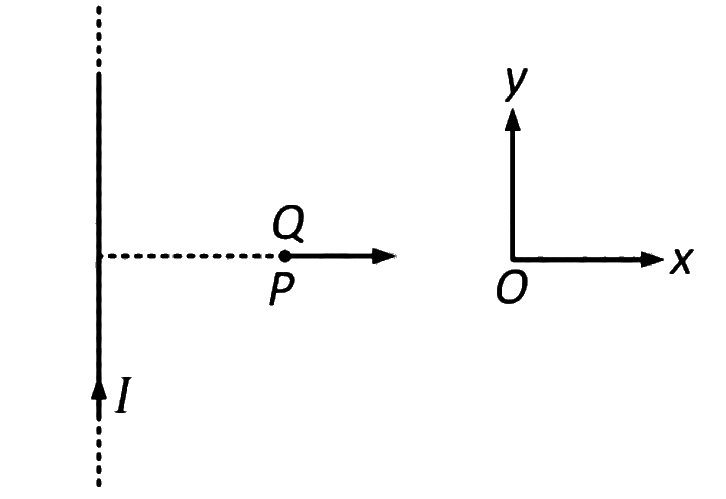
A very long straight wire carries a current . At the instant when a charge +Q at point P has velocity , as shown, the force on the charge is
Answer: (a)
Moving Charge in a Magnetic Field · Magnetic force on a moving charge
A charged particle moves through a magnetic field in a direction perpendicular to it. Then the
Answer: (a)
Moving Charge in a Magnetic Field · Magnetic force on a moving charge
A particle of mass and charge moving with velocitydescribes a circular path of radius when subjected to a uniform transverse magnetic field of induction The net work done by the field when the particle completes one full circle is
Answer: (b)
Moving Charge in a Magnetic Field · Lorentz force & velocity selector
A particle of charge coulomb moving with velocity along the -axis enters a region where a magnetic field of induction is along the -axis, and an electric field of magnitude is along the negative -axis. If the charged particle continues moving along the -axis, the magnitude of is
Answer: (a)
Moving Charge in a Magnetic Field · Circular path: radius & time period
If an electron and a proton having same momentum enter perpendicular to a magnetic field, then
Answer: (a)
Moving Charge in a Magnetic Field · Circular path: radius & time period
The time period of a charged particle undergoing a circular motion in a uniform magnetic field is independent of its
Answer: (a)
Moving Charge in a Magnetic Field · Lorentz force & velocity selector
A charge q moves in a region where electric field and magnetic field both exist, then force on it is
Answer: (b)
Moving Charge in a Magnetic Field · Circular path: radius & time period
An electron having mass m and kinetic energy E enters a uniform magnetic field B perpendicularly, then its frequency will be
Answer: (c)
Moving Charge in a Magnetic Field · Helical path & pitch
An electron moves with a velocity in a magnetic field of induction at an angle . If of electron is , the radius of the path is nearly
Answer: (a)
Moving Charge in a Magnetic Field · Magnetic force on a moving charge
Due to earth's magnetic field, the charged cosmic rays particles
Answer: (c)
Moving Charge in a Magnetic Field · Circular path: radius & time period
A positively charged particle moving due East enters a region of uniform magnetic field directed vertically upwards. This particle will
Answer: (b)
Moving Charge in a Magnetic Field · Circular path: radius & time period
A electron is circulating in a plane at right angles to a uniform field at magnetic induction (= 1.0 gauss), the orbital radius of electron is
Answer: (a)
Moving Charge in a Magnetic Field · Lorentz force & velocity selector
A beam of electrons is moving with constant velocity in a region having electric and magnetic fields of strength and at right angles to the direction of motion of the electrons. What is the velocity of the electrons?
Answer: (d)
Moving Charge in a Magnetic Field · Magnetic force on a moving charge
A charge moving with velocity in -direction is subjected to a field of magnetic induction in negative -direction. As a result, the charge will
Answer: (a)
Moving Charge in a Magnetic Field · Circular path: radius & time period
A uniform magnetic field acts right angles to the direction of motion of electrons. As a result, the electron moves in a circular path of radius . If the speed of electrons is doubled, then the radius of the circular path will be
Answer: (c)
Moving Charge in a Magnetic Field · Circular path: radius & time period
A deuteron of kinetic energy is describing a circular orbit of radius metre in a plane perpendicular to magnetic field . The kinetic energy of the proton that describes a circular orbit of radius metre in the same plane with the same is
Answer: (d)
No questions match these filters.