0 of 83 attemptedPick an answer to see the solution
Q1MHT CET 2026 · 19 MAY · SHIFT 1Easy
Periodic Motion & SHM Basics · Restoring force and differential equation
The differential equation of a particle performing S.H.M. is dt2d2x+64x=0, where x is in meter. The period of oscillation of the particle is (in second)
Periodic Motion & SHM Basics · Time and distance in SHM
A mass attached to a spring performs S.H.M. whose displacement is x=3×10⁻³cos2πt m. The time taken to obtain maximum speed for the first time is (in s)
Periodic Motion & SHM Basics · Periodic and oscillatory motion
A ball released from height (h) which makes perfectly elastic collision with ground. The frequency of periodic vibratory motion is (g = acceleration due to gravity)
Periodic Motion & SHM Basics · Displacement equation and circle of reference
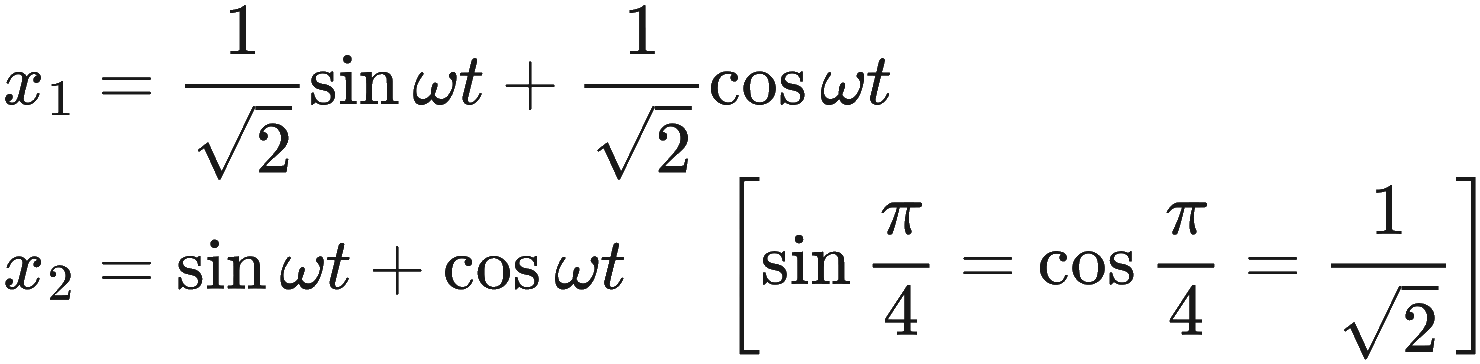
Two simple harmonic motions are represented as y1=10sinωt and y2=5sinωt+5cosωt, both in cm. The ratio of the amplitudes of y2 (A2) to that of y1 (A1 ), is
Periodic Motion & SHM Basics · Displacement equation and circle of reference
The displacement of a particle performing linear S.H.M. is given by y=Acos[π(t+ϕ)]. If at t=0, the displacement is y=2 cm and velocity is 2π cm/s, the value of amplitude A in cm is
Periodic Motion & SHM Basics · Time and distance in SHM
A particle oscillates simple harmonically along a straight line with period 8 s and amplitude 82 m. It starts from mean position then the ratio of the distances travelled by it in the 2nd second and the first second of its motion is (sin45∘=21)(sin90∘=1)
Periodic Motion & SHM Basics · Time and distance in SHM
A particle performing S.H.M., has a period of 12 s. The particle starts from a mean position. The ratio of distances travelled by the particle in the first and second second is {cos(π/6)=23}
Periodic Motion & SHM Basics · Time and distance in SHM
A particle executes a simple harmonic motion with a periodic time 8 second. At time t=0, it is at a mean position. The ratio of the distance traveled by a particle in the 2nd and that in the 1st second of its motion is
Periodic Motion & SHM Basics · Time and distance in SHM
A particle executes simple harmonic motion between x=−A and x=+A. If time taken by particle to go from x=0 to 2A is 2s, then time taken by particle in going from x=2A to A is
Periodic Motion & SHM Basics · Time and distance in SHM
A particle is executing simple harmonic motion. Its amplitude is A and time period is 5 sec. The time required by it to move from x=A to x=2A is ______ sec.
Periodic Motion & SHM Basics · Time and distance in SHM
The equation of motion of a particle is given by x=asin(50t+π/3) cm. The particle will come to rest at time t1 and it will have zero acceleration at time t2. The t1 and t2 respectively are ________.
Periodic Motion & SHM Basics · Periodic and oscillatory motion
Given below are two statements. One is labelled as Assertion (A) and the other is labelled as Reason (R).
Assertion (A): Knowing initial position x0 and initial momentum p0 is enough to determine the position and momentum at any time t for a simple harmonic motion with a given angular frequency ω.
Reason (R): The amplitude and phase can be expressed in terms of x0 and p0.
In the light of the above statements, choose the correct answer from the options given below:
Periodic Motion & SHM Basics · Phase and phase difference
Two particles ' A ' and ' B ' execute SHMs of periods ' T ' and 23T. If they start from the mean position then the phase difference between them, when the particle ' A ' completes two oscillations will be
Periodic Motion & SHM Basics · Time and distance in SHM
A particle performing linear S.H.M. has period 8 seconds. At time t=0, it is in the mean position. The ratio of the distances travelled by the particle in the 1st and 2nd second is (cos45∘=1/2)
Periodic Motion & SHM Basics · Time and distance in SHM
A particle oscillates in straight line simple harmonically with period 8 second and amplitude 42 m. Particle starts from mean position. The ratio of the distance travelled by it in 1st second of its motion to that in 2nd second is (sin45∘=1/2,sin2π=1)
Periodic Motion & SHM Basics · Time and distance in SHM
A particle is executing simple harmonic motion with time period 2 s and amplitude 1 cm. If D and d are the total distance and displacement covered by the particle in 12.5 s, then dD is
Periodic Motion & SHM Basics · Restoring force and differential equation
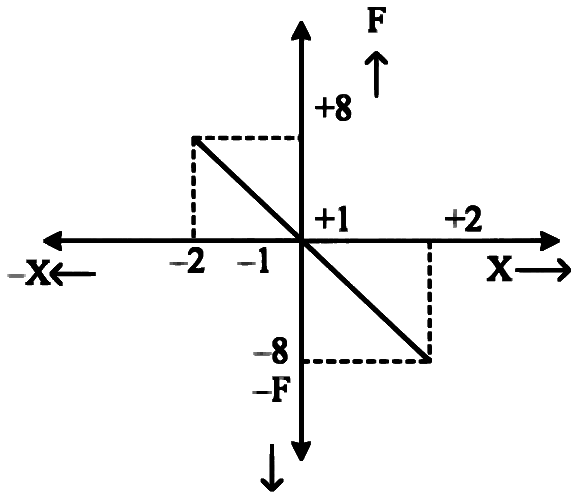
The motion of a particle is described by the equation a=−bx where ' a ' is the acceleration, x is the displacement from the equilibrium position and b is a constant. The periodic time will be
Periodic Motion & SHM Basics · Restoring force and differential equation
A particle of mass 0.50 kg executes simple harmonic motion under force F=−50(N m−1)x. The time period of oscillation is 35x s. The value of x is _________.
(Given π=722)
Numerical answer type. Work it out, then open the answer.
Periodic Motion & SHM Basics · Displacement equation and circle of reference
The displacement of a particle performing S.H.M. is given by Y=Acos[π(t+ϕ)]. If at t=0, the displacement is y=2 cm and velocity is 2π cm/s, the value of amplitude A in cm is
Periodic Motion & SHM Basics · Time and distance in SHM
A simple harmonic oscillator has an amplitude A and time period 6π second. Assuming the oscillation starts from its mean position, the time required by it to travel from x= A to x=23 A will be xπ s, where x= _________.
Numerical answer type. Work it out, then open the answer.
Periodic Motion & SHM Basics · Displacement equation and circle of reference
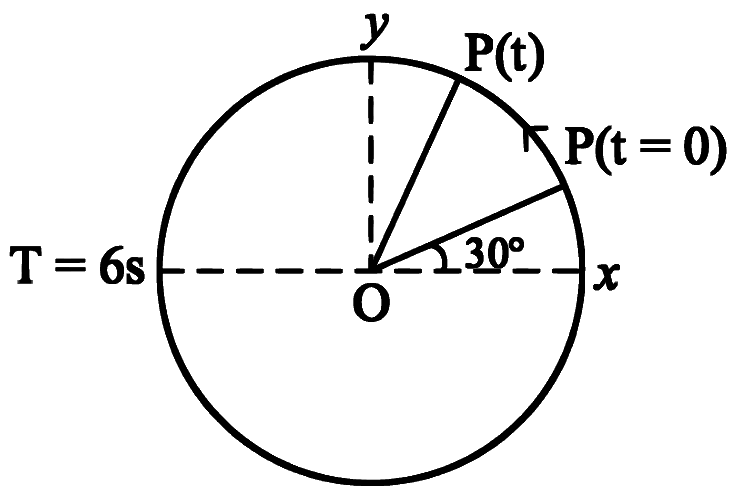
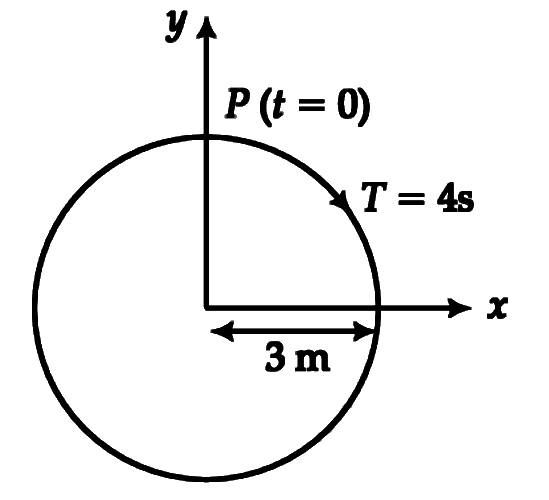
For particle P revolving round the centre O with radius of circular path r and angular velocity ω, as shown in below figure, the projection of OP on the x-axis at time t is
Periodic Motion & SHM Basics · Displacement equation and circle of reference
A particle executes S.H.M. of amplitude A along x-axis. At t = 0, the position of the particle is x=2A and it moves along positive x-axis. The displacement of particle in time t is x=Asin(ωt+δ), then the value of δ will be
Periodic Motion & SHM Basics · Time and distance in SHM
A particle executes simple harmonic motion between x=−A and x=+A. If time taken by particle to go from x=0 to 2A is 2 s; then time taken by particle in going from x=2A to A is
Periodic Motion & SHM Basics · Phase in waves (mixed)
A simple harmonic progressive wave is represented by y=Asin(100πt+3x). The distance between two points on the wave at a phase difference of 3π radian is
Periodic Motion & SHM Basics · Time and distance in SHM
The displacement of simple harmonic oscillator after 3 seconds starting from its mean position is equal to half of its amplitude. The time period of harmonic motion is:
Periodic Motion & SHM Basics · Restoring force and differential equation
The potential energy of a particle of mass 4 kg in motion along the x-axis is given by U=4(1−cos4x) J. The time period of the particle for small oscillation (sinθ≃θ) is (Kπ) s. The value of K is _________.
Numerical answer type. Work it out, then open the answer.
Periodic Motion & SHM Basics · Time and distance in SHM
A particle executes simple harmonic motion. Its amplitude is 8 cm and time period is 6 s. The time it will take to travel from its position of maximum displacement to the point corresponding to half of its amplitude, is ___________ s.
Numerical answer type. Work it out, then open the answer.
Periodic Motion & SHM Basics · Phase in waves (mixed)
In a medium, the phase difference between two particles separated by a distance 'x' is (5π)c. If the frequency of the oscillation of particles is 25 Hz and the velocity of propagation of the waves is 75 m/s, then the value of x is
Periodic Motion & SHM Basics · Displacement equation and circle of reference
Y = A sin(ωt + ϕ0) is the time-displacement equation of a SHM. At t = 0 the displacement of the particle is Y=2A and it is moving along negative x-direction. Then the initial phase angle ϕ0 will be:
Periodic Motion & SHM Basics · Time and distance in SHM
A particle performs simple harmonic motion with a period of 2 second. The time taken by the particle to cover a displacement equal to half of its amplitude from the mean position is a1s. The value of 'a' to the nearest integer is _________.
Numerical answer type. Work it out, then open the answer.
Periodic Motion & SHM Basics · Phase and phase difference
Two particles P and Q performs S.H.M. of same amplitude and frequency along the same straight line. At a particular instant, maximum distance between two particles is 2 a. The initial phase difference between them is
Periodic Motion & SHM Basics · Displacement equation and circle of reference
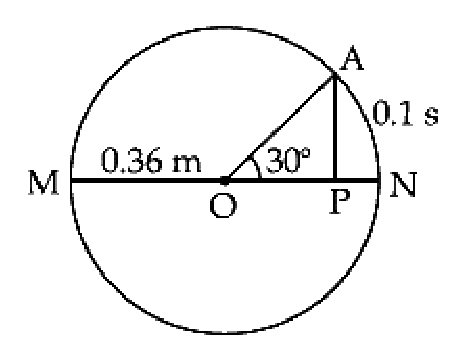
The point A moves with a uniform speed along the circumference of a circle of radius 0.36 m and covers 30∘ in 0.1 s. The perpendicular projection 'P' from 'A' on the diameter MN represents the simple harmonic motion of 'P'. The restoration force per unit mass when P touches M will be:
Periodic Motion & SHM Basics · Displacement equation and circle of reference
Two simple harmonic motion, are represented by the equations y1=10sin(3πt+3π)y2=5(sin3πt+3cos3πt) Ratio of amplitude of y1 to y2 = x: 1. The value of x is ______________.
Numerical answer type. Work it out, then open the answer.
Periodic Motion & SHM Basics · Displacement equation and circle of reference
A particle executes simple harmonic motion represented by displacement function as x(t) = A sin(ωt + ϕ)
If the position and velocity of the particle at t = 0 s are 2 cm and 2ω cm s−1 respectively, then its amplitude is x2 cm where the value of x is _________________.
Numerical answer type. Work it out, then open the answer.
Periodic Motion & SHM Basics · Phase in waves (mixed)
'n' waves are produced on a string in 1 second. When the radius of the string is doubled, keeping tension same, the number of waves produced in 1 second for the same harmonic will be
Periodic Motion & SHM Basics · Time and distance in SHM
A particle performs simple harmonic motion with period of 3 s. The time taken by it to cover a distance equal to half the amplitude from mean position is [sin30∘=0.5]
Periodic Motion & SHM Basics · Time and distance in SHM
A particle executes simple harmonic motion and is located at x = a, b and c at times t0, 2t0 and 3t0 respectively. The frequency of the oscillation is:
Periodic Motion & SHM Basics · Phase and phase difference
Two particles are performing simple harmonic motion in a straight line about the same equilibrium point. The amplitude and time period for both particles are same and equal to A and T, respectively. At time t = 0 one particle has displacement A while the other one has displacement 2−A and they are moving towards each other. If they cross each other at time t, then t is:
Periodic Motion & SHM Basics · Restoring force and differential equation
Which of the following expressions corresponds to simple harmonic motion along a straight line, where x is the displacement and a, b, c are positive constants?
Periodic Motion & SHM Basics · Time and distance in SHM
A body is in simple harmonic motion with time period half second (T = 0.5 s) and amplitude one cm (A = 1 cm). Find the average velocity in the interval in which it moves from equilibrium position to half of its amplitude.
Periodic Motion & SHM Basics · Time and distance in SHM
A particle moves with simple harmonic motion in a straight line. In first τs, after starting from rest it travels a distance a, and in next τs it travels 2a, in same direction, then:
Periodic Motion & SHM Basics · Phase and phase difference
Two particles are oscillating along two close parallel straight lines side by side, with the same frequency and amplitudes. They pass each other, moving in opposite directions when their displacement is half of the amplitude. The mean positions of the two particles lie on a straight line perpendicular to the paths of the two particles. The phase difference is
Periodic Motion & SHM Basics · Phase and phase difference
Two particles are executing simple harmonic motion of the same amplitude A and frequency ω along the x-axis. Their mean position is separated by distance X0(X0>A). If the maximum separation between them is (X0+A), the phase difference between their motion is:
Periodic Motion & SHM Basics · Time and distance in SHM
A particle executes simple harmonic oscillation with an amplitude a. The period of oscillation is T. The minimum time taken by the particle to travel half of the amplitude from the equilibrium position is
Periodic Motion & SHM Basics · Time and distance in SHM
The displacement of an object attached to a spring and executing simple harmonic motion is given by x=2×10⁻²cosπt metre. The time at which the maximum speed first occurs is
Periodic Motion & SHM Basics · Phase and phase difference
Two simple harmonic motions are represented by the equations y1=0.1sin(100πt+3π) and y2=0.1cosπt. The phase difference of the velocity of particle 1 with respect to the velocity of particle 2 is