Position of an ant (S in metres) moving in Y-Z plane is given by S=2t2j^+5k^ (where t is in second). The magnitude and direction of velocity of the ant at t=1 s will be:
A particle starts from origin at t=0 with a velocity 5i^ m/s and moves in x−y plane under action of a force which produces a constant acceleration of (3i^+2j^) m/s2. If the x-coordinate of the particle at that instant is 84 m, then the speed of the particle at this time is α m/s. The value of α is _________.
Numerical answer type. Work it out, then open the answer.
At time t=0 a particle starts travelling from a height 7z^ cm in a plane keeping z coordinate constant. At any instant of time its position along the x^ and y^ directions are defined as 3t and 5t3 respectively. At t = 1s acceleration of the particle will be
A particle moves such that its position vectorr(t)=cosωti^+sinωtj^ where ω is a constant and t is time. Then which of the following statements is true for the velocityv(t) and accelerationa(t) of the particle:
A particle is moving along the x-axis with its coordinate with the time 't' given be x(t) = 10 + 8t – 3t2. Another particle is moving the y-axis with its coordinate as a function of time given by y(t) = 5 – 8t3.
At t = 1s, the speed of the second particle as measured in the frame of the first particle is given as v. Then v (in m/s) is ______.
Numerical answer type. Work it out, then open the answer.
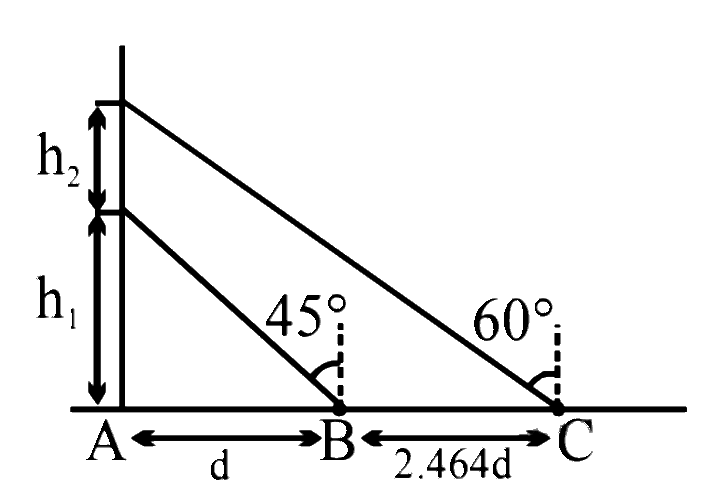
A balloon is moving up in air vertically above a point A on the ground. When it is at a height h1, a girl standing at a distance d (point B) from A (see figure) sees it at an angle 45o with respect to the vertical. When the balloon climbs up a further height h2, it is seen at an angle 60o with respect to the vertical if the girl moves further by a distance 2.464 d (point C). Then the height h2 is (given tan 30o = 0.5774)
Starting from the origin at time t = 0, with initial velocity 5j^ ms-1, a particle moves in the x-y plane with a constant acceleration of (10i^+4j^) ms-2. At time t, its coordinates are (20 m, y0 m). The values of t and y0 are, respectively:
A particle starts from the origin at t = 0 with an
initial velocity of 3.0 i^ m/s and moves in the
x-y plane with a constant acceleration (6i^+4j^) m/s2. The x-coordinate of the particle at the instant when its y-coordinate is 32 m is D meters. The value of D is :-
The x and y coordinates of the particle at any time are x = 5t − 2t2 and y = 10t respectively, where x and y are in metres and t in seconds. The acceleration of the particle at t = 2 s is
The position vector of a particle Ras a function of time is given by R = 4sin(2πt)i^ + 4cos(2πt)j^. Where R is in meters, t is in seconds and i^ and j^ denote unit vectors along x-and y-directions, respectively. Which one of the following statements is wrong for the motion of particle?
A particle is moving such that its position coordinates (x, y) are (2 m, 3 m) at time t = 0, (6 m, 7 m) at time t = 2 s and (13 m, 14 m) at time t = 5 s.
Average velocity vector (vav) from t = 0 to t = 5 s is
A body is moving with velocity 30 m/s towards east. After 10 seconds its velocity becomes 40 m/s towards north. The average acceleration of the body is
A particle starting from the origin (0, 0) moves in a straight line in the (x, y) plane. Its coordinates at a later time are (3,3). The path of the particle makes with the x-axis an angle of
A particle is moving eastwards with a velocity of 5 m/s. In 10 seconds the velocity changes to 5 m/s northwards. The average acceleration in this time is
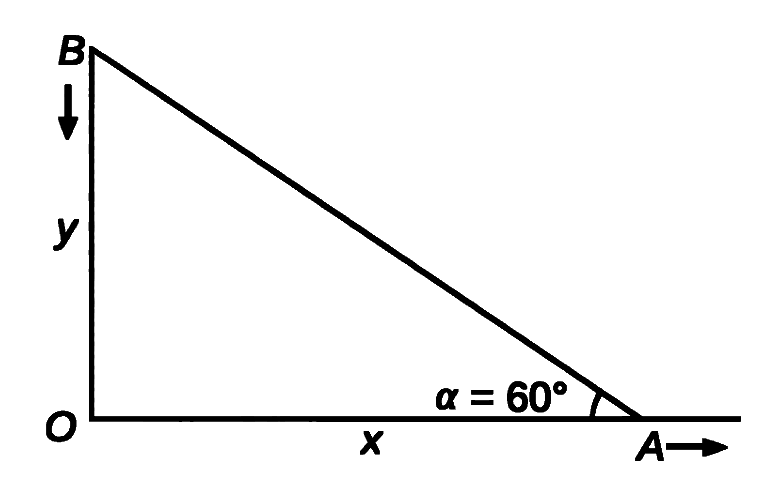
Two particles A and B are connected by a rigid rod AB. The rod slides along perpendicular rails as shown here. The velocity of A to the right is 10 m/s. What is the velocity of B when angle α=60∘?
A bus is moving on a straight road towards north with a uniform speed of 50 km/hour then it turns left through 90∘. If the speed remains unchanged after turning, the increase in the velocity of bus in the turning process is