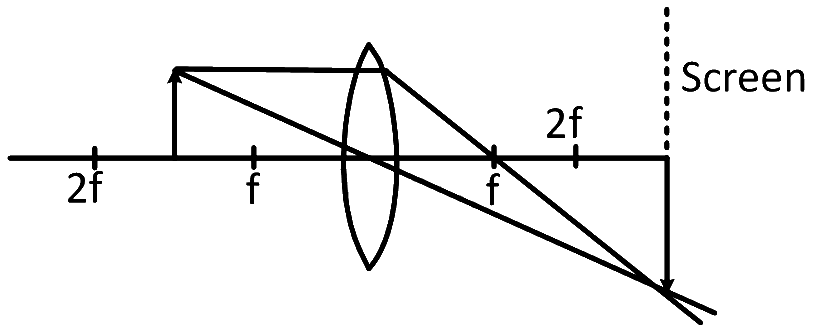
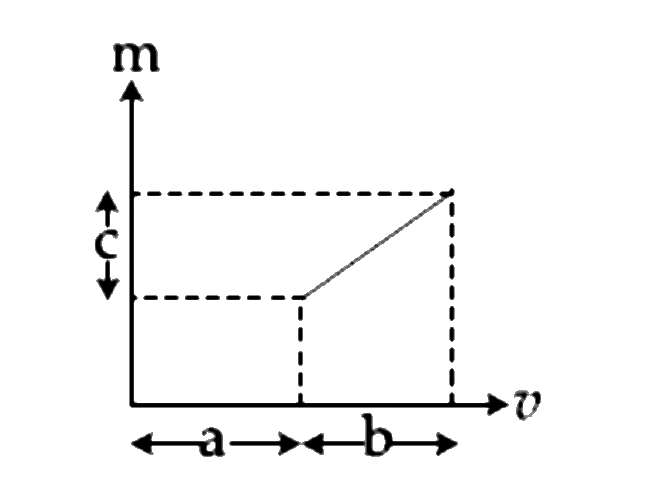
A convex lens is made from glass material having refractive index of 1.4 with same radius of curvature on both sides. The ratio of its focal length and radius of curvature is ______.
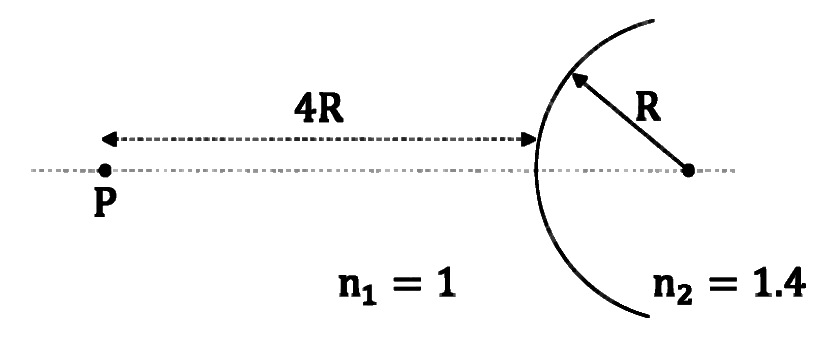
A spherical interface lens of radius R separates two media of refractive indices 1 and 1.4 respectively as shown in the figure below. A point source is placed at a distance of 4R in front of spherical interface. The magnitude of the magnification of point source image is ______.
A parallel beam of light travelling in air (refractive index 1.0) is incident on a convex spherical glass surface of radius of curvature 50 cm. Refractive index of glass is 1.5. The rays converge to a point at a distance x cm from the centre of the curvature of the spherical surface. The value of x is ______ cm.
Numerical answer type. Work it out, then open the answer.
The radii of curvature of both the surfaces of a convex lens are equal. One of the surfaces is made plane by grinding. The new focal length and power of the lens, respectively, are
A biconvex lens has radius of curvature of both the surfaces same as 61 cm. If this lens is replaced by another convex lens having different radii of curvature on both sides without change in lens power then possible combination of R1 and R2 is (R1=R2)
The magnitudes of power of a biconvex lens (refractive index 1.5) and that of a plano-concave lens (refractive index =1.7) are same. If the curvature of planoconcave lens exactly matches with the curvature of back surface of the biconvex lens, then ratio of radius of curvature of front and back surface of the biconvex lens is ______
If sunlight is focused on a paper using convex lens, it starts burning the paper in shortest time when the lens is kept at 30 cm above the paper. If the radius of curvature of the lens is 60 cm then the refractive index of the lens material is 10α. The value of α is ________.
Numerical answer type. Work it out, then open the answer.
The focal length of a glass convex lens in air is fa and that in water is fw. The refractive index from air to glass is 23 and that from air to water is 34. The ratio fa:fw is
Refractive index of a glass convex lens is 1.5. The radius of curvature of each of the two surfaces of the lens is 40 cm. The ratio of the power of the lens when immersed in a liquid of refractive index 1.25 to that when placed in air is
A lens of refractive index 'μ' has focal length 'f'. When the lens is immersed in a liquid of refractive index 'μ0', its focal length becomes 'f0'. Then 'f0' is given by
A convex lens having refractive index 1.6 has focal length 12 cm, when it is in air. The focal length of that lens when placed in water is (refractive index of water = 1.28)
A convex lens of refractive index 1.5 and focal length f=18 cm is immersed in water. The difference in focal lengths of the given lens when it is in water and in air is α×f. The value of α is ______.
(refractive index of water =4/3)
Numerical answer type. Work it out, then open the answer.
Five persons P1,P2,P3,P4 and P5 recorded object distance (u) and image distance (v) using same convex lens having power +5 D as (25,96),(30,62),(35,37),(45,35) and (50,32) respectively. Identify correct statement
The size of the images of an object, formed by a thin lens are equal when the object is placed at two different positions 8 cm and 24 cm from the lens. The focal length of the lens is ______ cm.
Numerical answer type. Work it out, then open the answer.
The radii of curvature for a thin convex lens are 10 cm and 15 cm respectively. The focal length of the lens is 12 cm. The refractive index of the lens material is
A lens having refractive index 1.6 has focal length of 12 cm, when it is in air. Find the focal length of the lens when it is placed in water. (Take refractive index of water as 1.28)
A convex lens made of glass (refractive index = 1.5) has focal length 24 cm in air. When it is totally immersed in water (refractive index = 1.33), its focal length changes to
In a long glass tube, mixture of two liquids A and B with refractive indices 1.3 and 1.4 respectively, forms a convex refractive meniscus towards A. If an object placed at 13 cm from the vertex of the meniscus in A forms an image with a magnification of −2, then the radius of curvature of meniscus is:
A spherical surface of radius of curvature R, separates air from glass (refractive index =1.5 ). The centre of curvature is in the glass medium. A point object ' O ' placed in air on the optic axis of the surface, so that its real image is formed at 'I' inside glass. The line OI intersects the spherical surface at P and PO=PI. The distance PO equals to
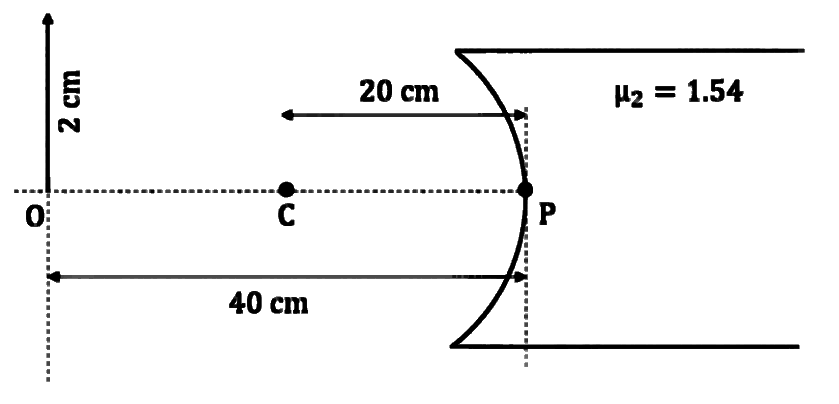
Light from a point source in air falls on a spherical glass surface (refractive index, μ=1.5 and radius of curvature =50 cm ). The image is formed at a distance of 200 cm from the glass surface inside the glass. The magnitude of distance of the light source from the glass surface is ___________m.
Numerical answer type. Work it out, then open the answer.
A bi-convex lens has radius of curvature of both the surfaces same as 1/6 cm. If this lens is required to be replaced by another convex lens having different radii of curvatures on both sides (R1=R2), without any change in lens power then possible combination of R1 and R2 is:
Refractive index of a glass convex lens is 1.5. The radius of curvature of each of the two surfaces of the lens is 40 cm. The ratio of the power of the lens when immersed in a liquid of refractive index 1.25 to that when placed in air is
A concave lens (refractive index =1.5) has both surfaces of same radius of curvature R. If it is immersed in a liquid of refractive index 1.75 it will act as a
A plano-convex lens having radius of curvature of first surface 2 cm exhibits focal length of f1 in air. Another plano-convex lens with first surface radius of curvature 3 cm has focal length of f2 when it is immersed in a liquid of refractive index 1.2. If both the lenses are made of same glass of refractive index 1.5, the ratio of f1 and f2 will be
A photograph of a landscape is captured by a drone camera at a height of 18 km. The size of the camera film is 2 cm×2 cm and the area of the landscape photographed is 400 km2. The focal length of the lens in the drone camera is:
Let u and v be the distances of the object and the image from a lens of focal length f. The correct graphical representation of u and v for a convex lens when |u| > f, is
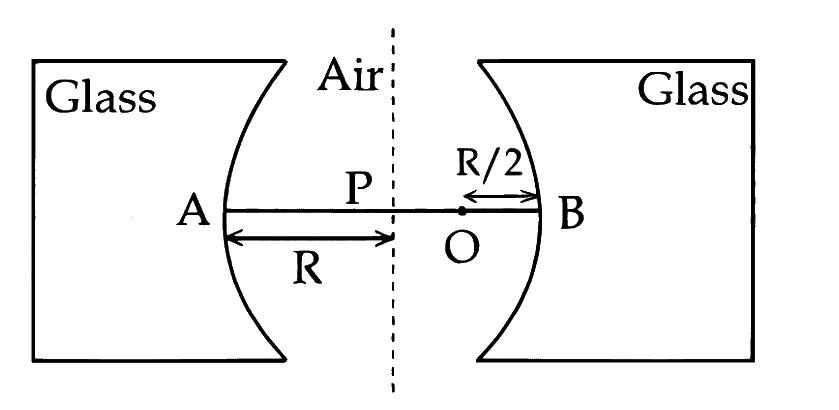
Two concave refracting surfaces of equal radii of curvature and refractive index 1.5 face each other in air as shown in figure. A point object O is placed midway, between P and B. The separation between the images of O, formed by each refracting surface is:
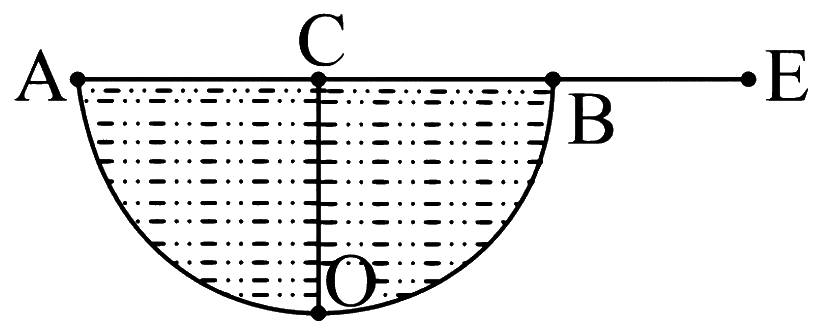
A hemispherical vessel is completely filled with a liquid of refractive index μ. A small coin is kept at the lowest point (O) of the vessel as shown in figure. The minimum value of the refractive index of the liquid so that a person can see the coin from point E (at the level of the vessel) is _________.
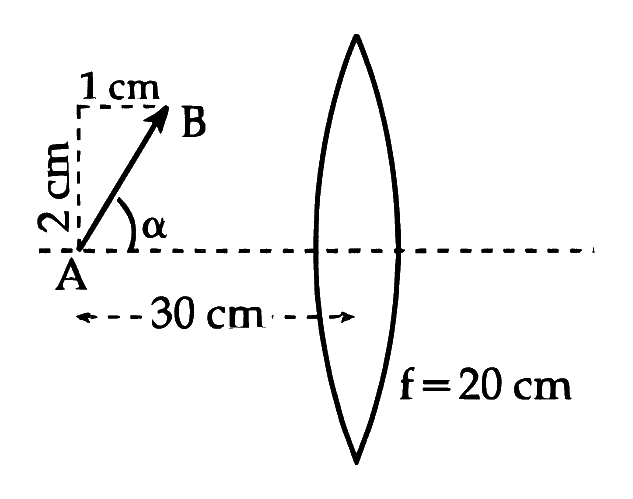
A slanted object AB is placed on one side of convex lens as shown in the diagram. The image is formed on the opposite side. Angle made by the image with principal axis is:
For the thin convex lens, the radii of curvature are at 15 cm and 30 cm respectively. The focal length of the lens is 20 cm. The refractive index of the material is:
A biconvex lens of refractive index 1.5 has a focal length of 20 cm in air. Its focal length when immersed in a liquid of refractive index 1.6 will be:
Statement (I): When an object is placed at the centre of curvature of a concave lens, image is formed at the centre of curvature of the lens on the other side.
Statement (II): Concave lens always forms a virtual and erect image.
In the light of the above statements, choose the correct answer from the options given below:
The distance between object and its two times magnified real image as produced by a convex lens is 45 cm. The focal length of the lens used is _______ cm.
Numerical answer type. Work it out, then open the answer.
Light from a point source in air falls on a convex curved surface of radius 20 cm and refractive index 1.5. If the source is located at 100 cm from the convex surface, the image will be formed at ________ cm from the object.
Numerical answer type. Work it out, then open the answer.
The distance between object and its 3 times magnified virtual image as produced by a convex lens is 20 cm. The focal length of the lens used is __________ cm.
Numerical answer type. Work it out, then open the answer.
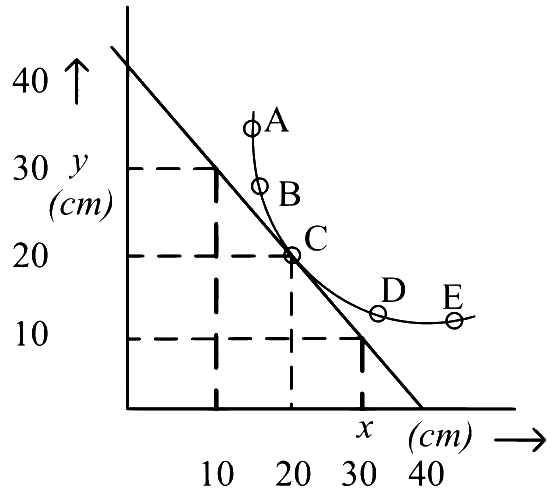
In an experiment to measure the focal length (f) of a convex lens, the magnitude of object distance (x) and the image distance (y) are measured with reference to the focal point of the lens. The y-x plot is shown in figure.
The focal length of the lens is ________ cm.
Numerical answer type. Work it out, then open the answer.
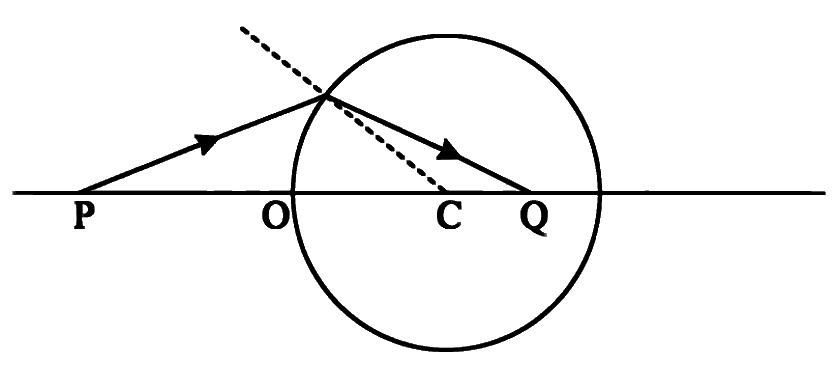
A point object kept at P in front of a glass sphere of radius ' R ' has its image formed at Q such that PO=QO. The refractive index of material of glass sphere is 1.4. The distance PO is equal to
A convex lens of focal length 40 cm forms an image of an extended source of light on a photoelectric cell. A current I is produced. The lens is replaced by another convex lens having the same diameter but focal length 20 cm. The photoelectric current now is:
A convex lens of refractive index 1.5 and focal length 18cm in air is immersed in water. The change in focal length of the lens will be ___________ cm.
(Given refractive index of water =34)
Numerical answer type. Work it out, then open the answer.
A spherical surface of radius of curvature 'R' separates air from glass of refractive index 1.5. The centre of curvature is in the glass. A point object P placed in air forms a real image Q in the glass. The line PQ cuts the surface at point 'O' and PO=OQ=x. Hence the distance 'x' is equal to
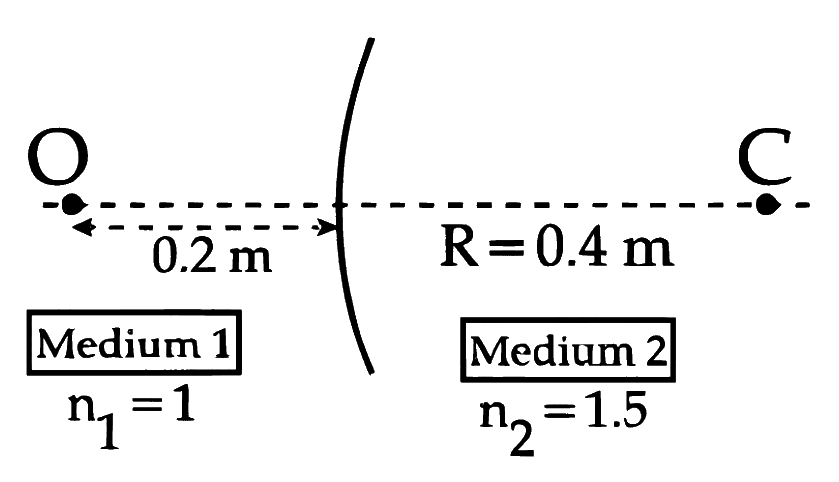
Two transparent media having refractive indices 1.0 and 1.5 are separated by a spherical refracting surface of radius of curvature 30 cm. The centre of curvature of surface is towards denser medium and a point object is placed on the principal axis in rarer medium at a distance of 15 cm from the pole of the surface. The distance of image from the pole of the surface is ____________ cm.
Numerical answer type. Work it out, then open the answer.
The radii of curvature of both the surfaces of a convex lens of focal length f and power P are equal. One of the surfaces is made by plane grinding. The new focal length and focal power of the lens is
Refractive index of a glass convex lens is 1.5. The radius of curvature of each of the two surfaces of the lens is 20 cm. The ratio of the power of the lens when immersed in a liquid of refractive index 1.25 to that when placed in air is
The radius of curvature of each surface of a convex lens having refractive index 1.8 is 20 cm. The lens is now immersed in a liquid of refractive index 1.5. The ratio of power of lens in air to its power in the liquid will be x:1. The value of x is _________.
Numerical answer type. Work it out, then open the answer.
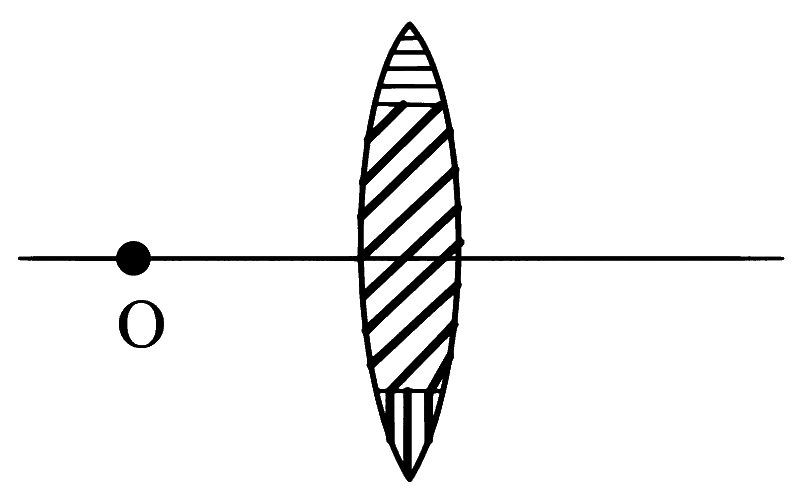
A lens is made up of 3 different transparent media as shown in figure. A point object O is placed on its axis beyond 2f. How many real images will be obtained on the other side?
An object is mounted on a wall. Its image of equal size is to be obtained on a parallel wall with the help of a convex lens placed between these walls. The lens is kept at distance x in front of the second wall. The required focal length of the lens will be:
A 2 meter long scale with least count of 0.2 cm is used to measure the locations of objects on an optical bench. While measuring the focal length of a convex lens, the object pin and the convex lens are placed at 80 cm mark and 1 m mark, respectively. The image of the object pin on the other side of lens coincides with image pin that is kept at 180 cm mark. The % error in the estimation of focal length is:
A parallel beam of light is allowed to fall on a transparent spherical globe of diameter 30 cm and refractive index 1.5. The distance from the centre of the globe at which the beam of light can converge is _____________ mm.
Numerical answer type. Work it out, then open the answer.
The power of a lens (biconvex) is 1.25 m−1 in particular medium. Refractive index of the lens is 1.5 and radii of curvature are 20 cm and 40 cm respectively. The refractive index of surrounding medium:
In an experiment with a convex lens, The plot of the image distance (v′) against the object distance (u′) measured from the focus gives a curve v′u′=225. If all the distances are measured in cm. The magnitude of the focal length of the lens is ___________ cm.
Numerical answer type. Work it out, then open the answer.
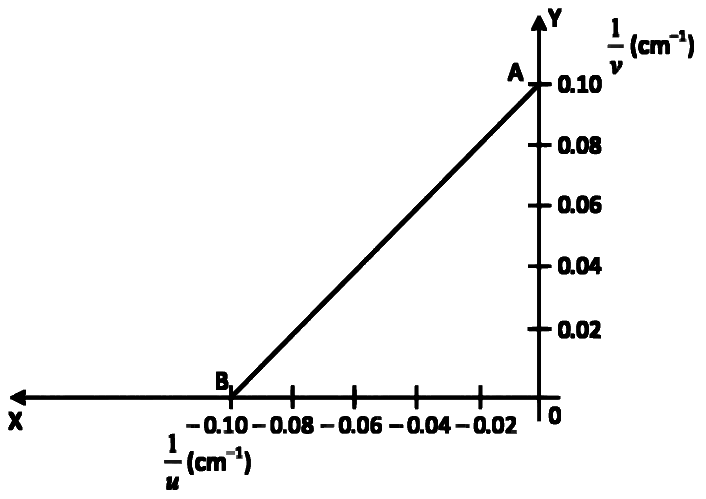
The graph between u1 and v1 for a thin convex lens in order to determine its focal length is plotted as shown in the figure. The refractive index of lens is 1.5 and its both the surfaces have same radius of curvature R. The value of R will be ____________ cm. (where u= object distance, v= image distance)
Numerical answer type. Work it out, then open the answer.
The refractive index of a converging lens is 1.4. What will be the focal length of this lens if it is placed in a medium of same refractive index? Assume the radii of curvature of the faces of lens are R1 and R2 respectively.
An object is placed at the focus of concave lens having focal length f. What is the magnification and distance of the image from the optical centre of the lens?
The same size images are formed by a convex lens when the object is placed at 20 cm or at 10 cm from the lens. The focal length of convex lens is __________ cm.
Numerical answer type. Work it out, then open the answer.
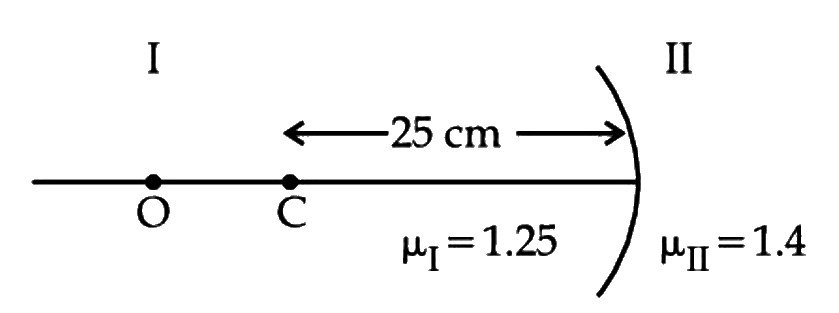
Region I and II are separated by a spherical surface of radius 25 cm. An object is kept in region I at a distance of 40 cm from the surface. The distance of the image from the surface is:
The image of an object placed in air formed by a convex refracting surface is at a distance of 10 m behind the surface. The image is real and is at 32rd of the distance of the object from the surface. The wavelength of light inside the surface is 32 times the wavelength in air. The radius of the curved surface is 13x m. The value of 'x' is ___________.
Numerical answer type. Work it out, then open the answer.
The radii of curvature of both the surfaces of a convex lens of focal length 'f' and focal power 'P' are equal. One of the surfaces is made plane by grinding. The new focal length and focal power of the lens is respectively
A biconvex lens (R1=R2=30 cm) has focal length equal to the focal length of concave mirror. The radius of curvature of concave mirror is [Refractive index of material of lens =1.6 ]
The thickness at the centre of a plano-convex lens is 3 mm and the diameter is 6 cm. If the speed of light in the material of the lens is 2 × 10⁸ ms−1, the focal length of the lens is ____________.
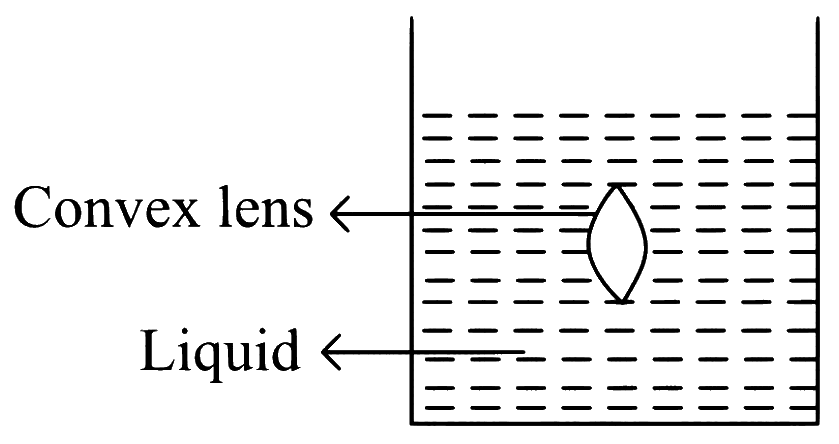
Inside a vessel filled with liquid a converging lens is placed as shown in figure. The lens has focal length 15 cm when in air and has refractive index 23. If the liquid has refractive index 59, the focal length of lens in liquid is
An object is located on a wall, its image of equal size is to be obtained on a parallel wall with the help of a convex lens. The lens is placed at a distance 'd' in front of the second wall. The required focal length of the lens is
A particle executes linear S.H.M. The mean position of oscillation is at the principal axis of a convex lens of focal length 8 cm. the mean position of oscillation is at 14 cm from the lens with amplitude 1 cm. The amplitude of oscillating image of the particle is nearly
The power of a biconvex lens is 10 dioptre and the radius of curvature of each surface is 10 cm. Then the refractive index of the material of the lens is,
A point object in air is in front of the curved surface of a plano-convex lens. The radius of curvature of the curved surface is 30 cm and the refractive index of the lens material is 1.5, then the focal length of the lens (in cm) is ______.
Numerical answer type. Work it out, then open the answer.
A double convex lens has power P and same radii of curvature R of both the surfaces. The radius of curvature of a surface of a plano-convex lens made of the same material with power 1.5 P is:
A thin lens made of glass (refractive index = 1.5) of focal length f = 16 cm is immersed in a liquid of refractive index 1.42. If its focal length in liquid is f1, then the ratio ff1 is closest to the integer:
For a concave lens of focal length f, the relation between object and image distances u and v, respectively, from its pole can best be represented by (u = v is the reference line):
The distance between an object and a screen is 100 cm. A lens can produce real image of the object on the screen for two different positions between the screen and the object. The distance between these two positions is 40 cm. If the power of the lens is close to (100N)D where N is an integer, the value of N is _________.
Numerical answer type. Work it out, then open the answer.
The eye can be regarded as a single refracting surface. The radius of curvature of this surface is equal to that of cornea (7.8 mm). This surface separateds two media of refractive indices 1 and 1.34. Calculate the distance from the refracting surface at which a parallel beam of light will come to focus -
A double convex lens has focal length 25 cm. The radius of curvature of one of the surfaces is double of the other. Find the radii if the refractive index of the material of the lens is 1.5.
A convex lens of focal length 20 cm produces images of the same magnification 2 when an object is kept at two distances x1 and x2 (x1 > x2) from the lens. The ratio of x1 and x2 is :-
An object is at a distance of 20 m from a convex lens of focal length 0.3 m. The lens forms an image of the object. If the object moves away from the lens at a speed of 5 m/s, the speed and direction of the image will be:
The refractive index of the material of a concave lens is μ. It is immersed in a medium of refractive index μ1. A parallel beam of light is incident on the lens. The path of the emergent rays when μ1 > μ is:
A thin convex lens made from crown glass (μ=23) has focal length f. When it is measured in two different liquids having refractive indices 34 and 35, it has the focal lengths f1 and f2 respectively. The correct relation between the focal lengths is:
An object is located in a fixed position in front of a screen, Sharp image is obtained on the screen for two positions of a thin lens separated by 10 cm. The size of the images in two situations are in the ratio 3: 2. What is the distance between the screen and the object?
Diameter of a plano-convex lens is 6 cm and thickness at the center is 3 mm. If speed of light in material of lens is 2×10⁸ m/s, the focal length of the lens is
The image of an illuminated square is obtained on a screen with the help of a converging lens. The distance of the square from the lens is 40 cm. The area of the image is 9 times that of the square. The focal length of the lens is:
When a biconvex lens of glass having refractive index 1.47 is dipped in a liquid, it acts as a plane sheet of glass. This implies that the liquid must have refractive index
A converging beam of rays is incident on a diverging lens. Having passed through the lens the rays intersect at a point 15 cm from the lens on the opposite side. If the lens is removed the point where the rays meet will move 5 cm closer to the lens. The focal length of the lens is
A biconvex lens has a radius of curvature of magnitude 20 cm. Which one of the following options best describes the image formed of an object of height 2 cm placed 30 cm from the lens?
A lens having focal length f and aperture of diameter d forms an image of intensity I. Aperture of diameter 2d in central region of lens is covered by a black paper. Focal length of lens and intensity of image now will be respectively
In an optics experiment, with the position of the object fixed, a student varies the position of a convex lens and for each position, the screen is adjusted to get a clear image of the object. A graph between the object distance u and the image distance v, from the lens, is plotted using the same scale for the two axes. A straight line passing through the origin and making an angle of 45∘ with the x-axis meets the experimental curve at P. The coordinates of P will be:
A boy is trying to start a fire by focusing sunlight on a piece of paper using an equiconvex lens of focal length 10 cm. The diameter of the sun is 1.39 × 10⁹ m and its mean distance from the earth is 1.5 × 10¹¹ m. What is the diameter of the sun's image on the paper?
A student measures the focal length of a convex lens by putting an object pin at a distance ′u′ from the lens and measuring the distance ′v′ of the image pin. The graph between ′u′ and ′v′ plotted by the student should look like
A bulb is located on a wall. Its image is to be obtained on a parallel wall with the help of convex lens. The lens is placed at a distance d ahead of second wall, then required focal length will be
A plano-convex lens is made of material of refractive index 1.6. The radius of curvature of the curved surface is 60 cm. The focal length of the lens is
A lens is placed between a source of light and a wall. It forms images of area A1 and A2 on the wall, for its two different positions. The area of the source of light is