Calorimetry, Latent Heat & Mechanical Equivalent of Heat · Specific heat, thermal capacity & Joule's law
A lead bullet moving with velocity 'v' strikes a wall and stops. 75% of its energy is converted into heat. If the increase in the temperature is nJsv2, then the value of n is
{s= specific heat of lead,J= mechanical equivalent of heat}
1 g of water of volume 1 cm3 at 100∘C is converted into steam of same temperature under normal atmospheric pressure (105 Pa). The volume of steam formed equals 1671 cm3. If the latent heat of vaporisation of water is 2256 J/g, the change in internal energy is
The heat extracted out of x gram of water initially at 50∘C to cool it down to 0∘C is sufficient to evaporate (1000−x) gram of water also initially at 50∘C. The value of x (closest integer) is ______. (Take latent heat of water 2256 kJ/kg, specific heat capacity of water 4200 J/kg.K)
Numerical answer type. Work it out, then open the answer.
Calorimetry, Latent Heat & Mechanical Equivalent of Heat · Principle of calorimetry: mixtures
540 gram of ice at 0∘ C is mixed with 540 gram of water at 90∘ C. The final temperature of the mixture will be [Latent heat of fusion of water = 80 cal/g]
Calorimetry, Latent Heat & Mechanical Equivalent of Heat · Principle of calorimetry: mixtures
A piece of metal of 850 K is dropped into 1 kg of water at 300 K. If equilibrium temperature of water is 350 K then the heat capacity of the metal expressed in KJ is (Sp. heat of water =1g∘Ccal)
Calorimetry, Latent Heat & Mechanical Equivalent of Heat · Principle of calorimetry: mixtures
15 g of ice at 0∘C is added to a vessel containing water at 40∘C. The mass of water and water equivalent of the vessel is 60 g. Assuming that negligible heat is taken from the surroundings, the final temperature of the mixture will be
Calorimetry, Latent Heat & Mechanical Equivalent of Heat · Principle of calorimetry: mixtures
10 kg of ice at −10∘C is added to 100 kg of water to lower its temperature from 25 ∘C. Consider no heat exchange to surroundings. The decrement to the temperature of water is ∘C. (specific heat of ice =2100 J/kg.∘C, specific heat of water =4200 J/kg.∘C, latent heat of fusion of ice =3.36×10⁵ J/kg)
Calorimetry, Latent Heat & Mechanical Equivalent of Heat · Specific heat, thermal capacity & Joule's law
Density of water at 4∘C and 20∘C are 1000 kg/m3 and 998 kg/m3 respectively. The increase in internal energy of 4 kg of water when it is heated from 4∘C to 20∘C is ______ J.
(specific heat capacity of water =4.2 kJ/kg K and 1 atmospheric pressure =105 Pa)
Calorimetry, Latent Heat & Mechanical Equivalent of Heat · Specific heat, thermal capacity & Joule's law
Water falls from a height of 200 m into a pool. Calculate the rise in temperature of the water assuming no heat dissipation from the water in the pool.
(Take g = 10 m/s2, specific heat of water = 4200 J/(kg K))
A gun fires a lead bullet of temperature 300 K into a wooden block. The bullet having melting temperature of 600 K penetrates into the block and melts down. If the total heat required for the process is 625 J, then the mass of the bullet is _______ grams. (Latent heat of fusion of lead =2.5×10⁴ J kg−1 and specific heat capacity of lead =125 J kg−1 K−1)
An amount of ice of mass 10−3 kg and temperature −10∘C is transformed to vapour of temperature 110∘C by applying heat. The total amount of work required for this conversion is, (Take, specific heat of ice =2100 J kg−1 K−1, specific heat of water =4180 J kg−1 K−1, specific heat of steam =1920 J kg−1 K−1, Latent heat of ice =3.35×10⁵ J kg−1 and Latent heat of steam =2.25×10⁶ J kg−1)
A stationary object at 4∘C and weighing 3.5 kg falls from a height of 2000 m on snow mountain at 0∘C. If the temperature of the object just before hitting the snow is 0∘C and the object comes to rest immediately then the quantity of ice that melts is (Acceleration due to gravity =10 m/s2, Latent heat of ice =3.5×10⁵ J/kg)
Calorimetry, Latent Heat & Mechanical Equivalent of Heat · Specific heat, thermal capacity & Joule's law
A lead bullet moving with velocity ' v ' strikes a wall and stops. If 50% of its energy is converted into heat, then the increase in temperature is ( s= specific heat of lead)
Calorimetry, Latent Heat & Mechanical Equivalent of Heat · Specific heat, thermal capacity & Joule's law
A water heater of power 2000 W is used to heat water. The specific heat capacity of water is 4200 J kg−1 K−1. The efficiency of heater is 70%. Time required to heat 2 kg of water from 10∘C to 60∘C is _________ s.
(Assume that the specific heat capacity of water remains constant over the temperature range of the water).
Numerical answer type. Work it out, then open the answer.
Calorimetry, Latent Heat & Mechanical Equivalent of Heat · Principle of calorimetry: mixtures
A piece of metal at 850 K is dropped into 1 kg water at 300 K. If the equilibrium temperature of water is 350 K then the heat capacity of the metal, expressed in J K−1 is (1 cal=4.2 J)
Calorimetry, Latent Heat & Mechanical Equivalent of Heat · Specific heat, thermal capacity & Joule's law
A 100 g of iron nail is hit by a 1.5 kg hammer striking at a velocity of 60 ms−1. What will be the rise in the temperature of the nail if one fourth of energy of the hammer goes into heating the nail? [Specific heat capacity of iron = 0.42 Jg−1 ∘C−1]
Calorimetry, Latent Heat & Mechanical Equivalent of Heat · Specific heat, thermal capacity & Joule's law
A geyser heats water flowing at a rate of 2.0 kg per minute from 30∘C to 70∘ C. If geyser operates on a gas burner, the rate of combustion of fuel will be ___________ g min−1.
[Heat of combustion = 8 × 10³ Jg−1, Specific heat of water = 4.2 Jg−1 ∘C−1]
Numerical answer type. Work it out, then open the answer.
A lead bullet penetrates into a solid object and melts. Assuming that 40% of its kinetic energy is used to heat it, the initial speed of bullet is:
(Given: initial temperature of the bullet = 127∘C, Melting point of the bullet = 327∘C, Latent heat of fusion of lead = 2.5 × 10⁴ J kg−1, Specific heat capacity of lead = 125 J/kg K)
A copper block of mass 5.0 kg is heated to a temperature of 500∘C and is placed on a large ice block. What is the maximum amount of ice that can melt? [Specific heat of copper: 0.39 J g−1 ∘C−1 and latent heat of fusion of water: 335 J g−1]
Calorimetry, Latent Heat & Mechanical Equivalent of Heat · Principle of calorimetry: mixtures
A block of ice of mass 120 g at temperature 0∘C is put in 300 g of water at 25∘ C. The x g of ice melts as the temperature of the water reaches 0∘ C. The value of x is _____________. [Use specific heat capacity of water = 4200 Jkg−1K−1, Latent heat of ice = 3.5 × 10⁵ Jkg−1]
Numerical answer type. Work it out, then open the answer.
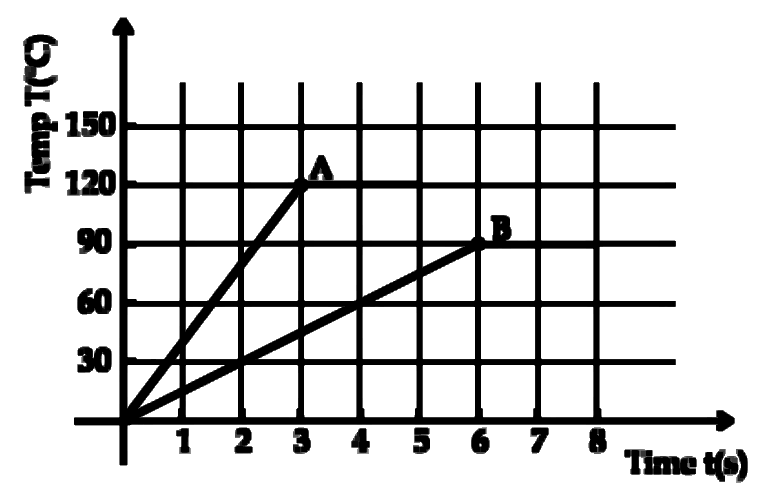
Two different metal bodies A and B of equal mass are heated at a uniform rate under similar conditions. The variation of temperature of the bodies is graphically represented as shown in the figure. The ratio of specific heat capacities is:
Calorimetry, Latent Heat & Mechanical Equivalent of Heat · Principle of calorimetry: mixtures
The temperature of equal masses of three different liquids x, y and z are 10∘C, 20∘C and 30∘C respectively. The temperature of mixture when x is mixed with y is 16∘C and that when y is mixed with z is 26∘ C. The temperature of mixture when x and z are mixed will be:
Calorimetry, Latent Heat & Mechanical Equivalent of Heat · Specific heat, thermal capacity & Joule's law
A bullet of mass 5 g, travelling with a speed of 210 m/s, strikes a fixed wooden target. One half of its kinetic energy is converted into heat in the bullet while the other half is converted into heat in the wood. The rise of temperature of the bullet if the specific heat of its material is 0.030 cal/(g –oC) (1 cal = 4.2 × 10⁷ ergs) close to:
Calorimetry, Latent Heat & Mechanical Equivalent of Heat · Principle of calorimetry: mixtures
A calorimeter of water equivalent 20 g contains 180 g of water at 25oC. ‘m’ grams of steam at 100oC is mixed in it till the temperature of the mixure is 31oC. The value of ‘m’ is close to: (Latent heat of water = 540 cal g–1, specific heat of water = 1 cal g–1oC–1)
Calorimetry, Latent Heat & Mechanical Equivalent of Heat · Principle of calorimetry: mixtures
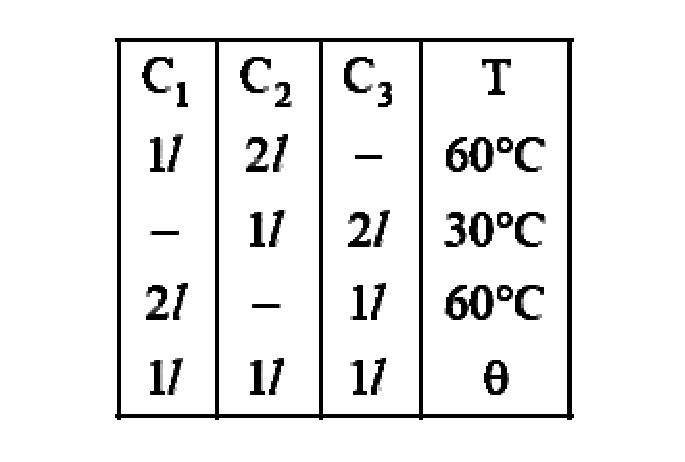
Three containers C1, C2 and C3 have water at different temperatures. The table below shows the final temperature T when different amounts of water (given in litres) are taken from each containers and mixed (assume no loss of heat during the process)
The value of θ (in °C to the nearest integer) is ..........
Numerical answer type. Work it out, then open the answer.
Calorimetry, Latent Heat & Mechanical Equivalent of Heat · Principle of calorimetry: mixtures
M grams of steam at 100oC is mixed with 200 g of ice at its melting point in a thermally insulated container. If it produced liquid water at 40oC [heat of vaporization of water is 540 cal/g and heat of fusion of ice is 80 cal/g] the value of M is ____
Numerical answer type. Work it out, then open the answer.
Calorimetry, Latent Heat & Mechanical Equivalent of Heat · Specific heat, thermal capacity & Joule's law
One kg of water, at 20oC, heated in an electric kettle whose heating element has a mean (temperature averaged) resistance of 20 Ω. The rms voltage in the mains is 200 V. Ignoring heat loss from the kettle, time taken for water to evaporate fully, is close to: [Specific heat of water = 4200 J/(kgoC), Latent heat of water = 2260 kJ/kg]
Calorimetry, Latent Heat & Mechanical Equivalent of Heat · Specific heat, thermal capacity & Joule's law
A massless spring (k = 800 N/m), attached with a mass (500 g) is completely immersed in 1 kg of water. The spring is stretched by 2 cm and released so that it starts vibrating. What would be the order of magnitude of the change in the temperature of water when the vibrations stop completely? (Assume that the water container and spring receive negligible heat and specific heat of mass = 400 J/kg K, specific heat of water = 4184 J/kg K)
Calorimetry, Latent Heat & Mechanical Equivalent of Heat · Principle of calorimetry: mixtures
When M1 gram of ice at –10oC (specific heat = 0.5 cal g–1oC–1) is added to M2 gram of water at 50°C, finally no ice is left and the water is at 0°C. The value of latent heat of ice, in cal g–1 is:
Calorimetry, Latent Heat & Mechanical Equivalent of Heat · Principle of calorimetry: mixtures
When 100 g of a liquid A at 100oC is added to 50 g of a liquid B at temperature 75oC, the temperature of the mixture becomes 90oC. The temperature of the mixture, if 100 g of liquid A at 100oC is added to 50 g of liquid B at 50oC, will be:
Calorimetry, Latent Heat & Mechanical Equivalent of Heat · Principle of calorimetry: mixtures
A metal ball of mass 0.1 kg is heated upto 500oC and dropped into a vessel of heat capacity 800 JK–1 and containing 0.5 kg water. The initial temperature of water and vessel is 30oC. What is the approximate percentage increment in the temperature of the water? [Specific Heat Capacities of water and metal are, respectively, 4200 Jkg–1 K–1 and 400 Jkg–1 K–1]
Calorimetry, Latent Heat & Mechanical Equivalent of Heat · Principle of calorimetry: mixtures
Ice at –20oC is added to 50 g of water at 40oC. When the temperature of the mixture reaches 0oC, it is found that 20 g of ice is still unmelted. The amount of ice added to the water was close to (Specific heat of water = 4.2J/g/oC Specific heat of Ice = 2.1J/g/oC Heat of fusion of water at 0oC= 334J/g)
Calorimetry, Latent Heat & Mechanical Equivalent of Heat · Principle of calorimetry: mixtures
An unknown metal of mass 192 g heated to a temperature of 100oC was immersed into a brass calorimeter of mass 128 g containing 240 g of water at a temperature of 8.4oC. Calculate the specific heat of the unknown metal if water temperature stabilizes at 21.5oC. (Specific heat of brass is 394 J kg–1 K–1)
A thermally insulated vessel contains 150g of water at 0°C. Then the air from the vessel is pumped out adiabatically. A fraction of water turns into ice and the rest evaporates at 0°C itself. The mass of evaporated water will be closest to: (Latent heat of vaporization of water = 2.10 × 10⁶ J kg–1 and Latent heat of Fusion of water = 3.36 × 10⁵ J kg–1)
Calorimetry, Latent Heat & Mechanical Equivalent of Heat · Principle of calorimetry: mixtures
In an experiment, a sphere of aluminium of mass 0.20 kg is heated upto 150oC. Immediately, it is put into water of volume 150 cc at 27oC kept in a calorimeter of water equivalent to 0.025 kg. Final temperature of the system is 40oC. The specific heat of aluminium is: (take 4.2 Joule = 1 calorie)
Calorimetry, Latent Heat & Mechanical Equivalent of Heat · Principle of calorimetry: mixtures
A copper ball of mass 100 gm is at a temperature T. It is dropped in a copper calorimeter of mass 100 gm, filled with 170 gm of water at room temperature. Subsequently, the temperature of the system is found to be 75oC. T is given by: (Given: room temperature = 30oC, specific heat of copper = 0.1 cal/gmoC)
Calorimetry, Latent Heat & Mechanical Equivalent of Heat · Specific heat, thermal capacity & Joule's law
200 g water is heated from 40oC to 60oC. Ignoring the slight expansion of water, the change in its internal energy is close to (Given specific heat of water = 4184 J/kg/K):
An experiment takes 10 minutes to raise the temperature of water in a container from 0oC to 100oC and another 55 minutes to convert it totally into steam by a heater supplying heat at a uniform rate. Neglecting the specific heat of the container and taking specific heat of water to be 1 cal/goC, the heat of vapourization according to this experiment will come out to be:
Calorimetry, Latent Heat & Mechanical Equivalent of Heat · Specific heat, thermal capacity & Joule's law
Water of volume 2 L in a closed container is heated with a coil of 1 kW. While water is heated, the container loses energy at a rate of 160J/s. In how much time will the temperature of water rise from 27oC to 77oC? (Specific heat of water is 4.2 kJ/kg K and that of the container is negligible).
Given that 1 g of water in liquid phase has volume 1 cm3 and in vapour phase 1671 cm3 at atmospheric pressure and the latent heat of vaporization of water is 2256 J/g; the change in the internal energy in joules for 1 g of water at 373 K when it changes from liquid phase to vapour phase at the same temperature is:
Calorimetry, Latent Heat & Mechanical Equivalent of Heat · Principle of calorimetry: mixtures
500 g of water and 100 g of ice at 0°C are in a calorimeter whose water equivalent is 40 g. 10 g of steam at 100°C is added to it. Then water in the calorimeter is: (Latent heat of ice = 80 cal/g, Latent heat of steam = 540 cal/g)
Calorimetry, Latent Heat & Mechanical Equivalent of Heat · Specific heat, thermal capacity & Joule's law
100 g of water is heated from 30∘C to 50∘C. Ignoring the slight expansion of the water, the change in its internal energy is (specific heat of water is 4184 J/kg/K):
Calorimetry, Latent Heat & Mechanical Equivalent of Heat · Principle of calorimetry: mixtures
10 gm of ice cubes at 0∘C are released in a tumbler (water equivalent 55 g) at 40∘C. Assuming that negligible heat is taken from the surroundings, the temperature of water in the tumbler becomes nearly (L=80 cal/g)