
Stationary Waves & Vibrating Strings · Stationary wave equation
For a stationary wave, cm, the distance between a node and the successive antinode is
Show answer and solution
Answer: (d)
Loading the solution…
Home›Practice Hub›Chapters›Wave Motion›Stationary Waves & Vibrating Strings
Wave Motion PYQs · MHT CET · JEE Main · NEET
Stationary Waves & Vibrating Strings · Stationary wave equation
For a stationary wave, cm, the distance between a node and the successive antinode is
Answer: (d)
Stationary Waves & Vibrating Strings · Stationary wave equation
The equation of a stationary wave along a stretched string is where and are in cm and in second. The separation between two adjacent nodes is
Answer: (c)
Stationary Waves & Vibrating Strings · Stationary wave equation
For stationary wave, cm, the distance between a node and the successive antinode is
Answer: (d)
Stationary Waves & Vibrating Strings · Nodes, antinodes and properties
Two waves of same frequency () approaching each other with same velocity of m/s interfere. The distance between two consecutive antinodes is
Answer: (c)
Stationary Waves & Vibrating Strings · Nodes, antinodes and properties
In case of stationary wave pattern, which of the following statement is CORRECT?
Answer: (d)
Stationary Waves & Vibrating Strings · Nodes, antinodes and properties
In a stationary wave, all the particles
Answer: (a)
Stationary Waves & Vibrating Strings · String modes: harmonics and overtones
A stretched string of length '' is fixed at both the ends, has '' nodes (). The length of the string in terms of and wavelength is
Answer: (d)
Stationary Waves & Vibrating Strings · String modes: harmonics and overtones
The fundamental frequency '' of the tuning fork is 288 Hz, it will not resonate with the frequency
Answer: (c)
Stationary Waves & Vibrating Strings · String modes: harmonics and overtones
When a sonometer wire vibrates in the third overtone, the number of antinodes and nodes formed on the wire are respectively
Answer: (a)
Stationary Waves & Vibrating Strings · String modes: harmonics and overtones
A sonometer wire is vibrating in third overtone. There are
Answer: (a)
Stationary Waves & Vibrating Strings · Laws of a vibrating string
A uniform wire of length , diameter and density is stretched under tension . The relation between its fundamental frequency , length and diameter is
Answer: (a)
Stationary Waves & Vibrating Strings · Laws of a vibrating string
To increase the frequency of transverse oscillations of a stretched string by 40%, the tension must be increased by
Answer: (c)
Stationary Waves & Vibrating Strings · Bridges, segments and composite wires
A stretched wire of length cm is divided in to 3 segments whose frequencies are in the ratio . Their respective lengths must be
Answer: (b)
Stationary Waves & Vibrating Strings · String modes: harmonics and overtones
A spring of mass kg/m has length m. It is fixed at both ends and stretched such that is has a tension N. The string vibrates in three segments with amplitude cm. The amplitude of transverse (particle) velocity is
Answer: (c)
Stationary Waves & Vibrating Strings · String modes: harmonics and overtones
In sonometer experiment, the string of length under tension vibrates in second overtone between the two bridges. The amplitude of vibration is maximum at length
Answer: (b)
Stationary Waves & Vibrating Strings · String modes: harmonics and overtones
A wire of length 'L' and linear density 'm' is stretched between two rigid supports with tension 'T'. It is observed that wire resonates in the harmonic at a frequency of 320 Hz and resonates again at next higher frequency of 400 Hz in two successive modes. The value of 'P' is
Answer: (b)
Stationary Waves & Vibrating Strings · Laws of a vibrating string
Two vibrating metal wires of the same material of length 'L' and '3L' and have radii '2r' and 'r' respectively. They are stretched under same tension. Both the wires vibrate in their fundamental modes. The ratio is [ and are the frequencies of first and second wire respectively]
Answer: (b)
Stationary Waves & Vibrating Strings · Laws of a vibrating string
Two uniform strings A and B made of steel are vibrating under the same tension. If the first overtone of A is equal to the second overtone of B and if the radius of A is twice that of B, the ratio of the lengths of the strings is
Answer: (d)
Stationary Waves & Vibrating Strings · Laws of a vibrating string
A wire of length '', diameter '', density of material '' is under tension '' has fundamental frequency of vibration ''. Another wire of length '', diameter '', density of material '' is vibrated under tension '', the fundamental frequency of vibration becomes ''. The ratio is
Answer: (c)
Stationary Waves & Vibrating Strings · Laws of a vibrating string
The fundamental frequency of sonometer wire is Hz for some length and tension. If the length is increased by by keeping the tension same, then the frequency change of second harmonic is
Answer: (b)
Stationary Waves & Vibrating Strings · Laws of a vibrating string
Two uniform wires of same material are vibrating under the same tension. If the first overtone of the first wire is equal to the second overtone of the second wire and radius of first wire is twice the radius of second wire then the ratio of length of first to second wire is
Answer: (b)
Stationary Waves & Vibrating Strings · Sonometer: load and immersed bob
A sonometer wire resonates with a given tuning fork, forming standing waves with five antinodes between the two bridges, when a mass of kg is suspended from the wire. When this mass is replaced by mass , the wire resonates with the same tuning fork, forming three antinodes for the same positions of the bridges. The value of (in kg) is
Answer: (d)
Stationary Waves & Vibrating Strings · Sonometer: load and immersed bob
A sonometer wire resonates with a given tuning fork forming standing wave with antinodes between two bridges when mass of kg is suspended from the wire. When mass is suspended from the wire with same fork and same length between two bridges, antinodes are formed. Mass is
Answer: (d)
Stationary Waves & Vibrating Strings · Sonometer: load and immersed bob
In a sonometer experiment, the fundamental frequency of vibration of wire is '' when wire is stretched by hanging a metal bob. If the bob is completely immersed in water, the frequency of vibration of wire becomes ''. The relative density of the metal of the bob is
Answer: (c)
Stationary Waves & Vibrating Strings · Sonometer: load and immersed bob
A sonometer wire resonates with antinodes between the two bridges for a given tuning fork when kg mass is suspended from the wire. Using same fork, when mass M is suspended, the wire resonates producing antinodes between the two bridges. (Distance between the bridges as before) The value of M is
Answer: (c)
Stationary Waves & Vibrating Strings · Nodes, antinodes and properties
Two waves of same frequency ( n) are approaching each other with same velocity along the same linear path and interfere. The distance between two consecutive nodes is
Answer: (d)
Stationary Waves & Vibrating Strings · String modes: harmonics and overtones
In Sonometer experiment, the frequency of a tuning fork used is 288 Hz. Harmonics will 'NOT' be produced at the frequency
Answer: (c)
Stationary Waves & Vibrating Strings · String modes: harmonics and overtones
The frequency of a tuning fork is 256 Hz. It will not resonate with the tuning fork of frequency
Answer: (c)
Stationary Waves & Vibrating Strings · Laws of a vibrating string
Fundamental frequency of sonometer wire is ' '. If the tension and length are increased 3 times and diameter is increased twice, the new frequency will be
Answer: (c)
Stationary Waves & Vibrating Strings · Laws of a vibrating string
The fundamental frequency of sonometer wire is ' '. If the tension and length are increased 3 times and diameter is increased twice, the new frequency will be
Answer: (c)
Stationary Waves & Vibrating Strings · String modes: harmonics and overtones
A string of mass per unit length has length 0.9 m. It is fixed at both ends and stretched such that it has a tension of 40 N. The string vibrates in three segments with amplitude 0.3 cm. The amplitude (maximum) of the particle velocity is (in )
Answer: (c)
Stationary Waves & Vibrating Strings · Laws of a vibrating string
The fundamental frequency of a sonometer wire is 50 Hz for some length and tension. If the length is increased by by keeping tension same then frequency change of second harmonic is
Answer: (b)
Stationary Waves & Vibrating Strings · Laws of a vibrating string
Two uniform wires of same material are vibrating under the same tension. If the st overtone of st wire is equal to the nd overtone of nd wire and radius of st wire is twice the radius of nd wire, the ratio of length of st wire to that nd wire is
Answer: (a)
Stationary Waves & Vibrating Strings · Laws of a vibrating string
A wire of length L, diameter ' d ' density of material ' e ' is under tension ' T ', having fundamental frequency of vibration . Another wire of length 2 L, tension 2 T, density 2 e and diameter 3 d has fundamental frequency of vibration . The ratio is
Answer: (c)
Stationary Waves & Vibrating Strings · Sonometer: load and immersed bob
At poles, a stretched wire of a given length vibrates in unison with a tuning fork. At the equator, for same setting, to produce resonance with same fork, the vibrating length of wire
Answer: (a)
Stationary Waves & Vibrating Strings · Stationary wave equation
A stationery wave is represented by , where are in cm and in second. The distance between two successive antinodes is
Answer: (c)
Stationary Waves & Vibrating Strings · Nodes, antinodes and properties
When the string is stretched between two rigid supports, under certain tension and vibrated
Answer: (b)
Stationary Waves & Vibrating Strings · Nodes, antinodes and properties
In a vibrating string with fixed ends the waves are of type
Answer: (b)
Stationary Waves & Vibrating Strings · String modes: harmonics and overtones
When a sonometer wire vibrates in third overtone there are
Answer: (c)
Stationary Waves & Vibrating Strings · String modes: harmonics and overtones
Stationary wave is produced along the stretched string of length 80 cm. The resonant frequencies of string are and 210 Hz. The speed of transverse wave in the string is
Answer: (c)
Stationary Waves & Vibrating Strings · String modes: harmonics and overtones
A stationary wave is formed having 3 nodes along the length of the string 90 cm. The wavelength of the wave is
Answer: (c)
Stationary Waves & Vibrating Strings · String modes: harmonics and overtones
A stretched string is fixed at both ends. It is made to vibrate so that the total number of nodes formed in it is ' '. The length of the string in terms of the wavelength of waves formed in it is ( wavelength
Answer: (d)
Stationary Waves & Vibrating Strings · Laws of a vibrating string
When the tension in string is increased by , the frequency of the fundamental mode increases in the ratio . The initial tension in the string is
Answer: (c)
Stationary Waves & Vibrating Strings · Laws of a vibrating string
A violin emits sound waves of frequency ' ' under tension T. When tension is increased by , keeping the length and mass per unit length constant, frequency of sound waves becomes ' '. The ratio of frequency ' ' to frequency ' ' is
Answer: (c)
Stationary Waves & Vibrating Strings · Laws of a vibrating string
A sonometer wire of resonating length has a fundamental frequency of when kept under some tension. The resonating length of the wire with fundamental frequency of under same tension _______ .
Numerical answer type. Work it out, then open the answer.
Answer: 60
Stationary Waves & Vibrating Strings · Bridges, segments and composite wires
The length of a sonometer wire 'AB' is 110 cm. Where should the two bridges be placed from end ' ' to divide the wire in three segments whose fundamental frequencies are in the ratio ?
Answer: (a)
Stationary Waves & Vibrating Strings · Stationary wave equation
Two progressive waves and superpose to form a standing wave. ' ' and ' ' are in SI system. Amplitude of the particle at is
Answer: (c)
Stationary Waves & Vibrating Strings · String modes: harmonics and overtones
A string is under tension of 180 N and mass per unit length . It produces two consecutive resonant frequencies with a tuning fork, which are 375 Hz and 450 Hz. The mass of the string is
Answer: (d)
Stationary Waves & Vibrating Strings · String modes: harmonics and overtones
A wire of length ' ' and linear density ' ' is stretched between two rigid supports with tension ' '. It is observed that wire resonates in the th harmonic at a frequency of 320 Hz and resonates again at next higher frequency of 400 Hz. The value of ' ' is
Answer: (b)
Stationary Waves & Vibrating Strings · Laws of a vibrating string
Two uniform strings A and B made of steel are made to vibrate under the same tension. If first overtone of A is equal to the second overtone of and if the radius of is twice that of , the ratio of the length of string to that of is
Answer: (d)
Stationary Waves & Vibrating Strings · Laws of a vibrating string
A string A has twice the length, twice the diameter, twice the tension and twice the density of another string B. The overtone of A which will have the same fundamental frequency as that of is
Answer: (c)
Stationary Waves & Vibrating Strings · Sonometer: load and immersed bob
At the poles of earth, a stretched wire of a given length vibrates in unison with a tuning fork. At the equator of earth, for same setting, to produce resonance with same fork, the vibrating length of wire
Answer: (a)
Stationary Waves & Vibrating Strings · Sonometer: load and immersed bob
A sonometer wire is in unison with a tuning fork of frequency ' ' when it is stretched by a weight of specific gravity ' '. When the weight is completely immersed in water, ' ' beats are produced per second, then
Answer: (b)
Stationary Waves & Vibrating Strings · Sonometer: load and immersed bob
A sonometer wire is stretched by hanging a metal bob, the fundamental frequency of the wire is ' '. When the bob is completely immersed in water, the frequency of vibration of wire becomes ' '. The relative density of the metal of the bob is
Answer: (c)
Stationary Waves & Vibrating Strings · Sonometer: load and immersed bob
A sonometer wire is stretched by hanging a metal bob. The fundamental frequency of vibration of wire is ' '. When the bob is completely immersed in water, the frequency of vibration of wire becomes ' '. The relative density of the metal of the bob is
Answer: (c)
Stationary Waves & Vibrating Strings · Nodes, antinodes and properties
Two progressive waves are travelling towards each other with velocity and frequency . The distance between the two consecutive antinodes is
Answer: (a)
Stationary Waves & Vibrating Strings · Nodes, antinodes and properties
A string fixed at both the ends forms standing wave with node separation of . If the velocity of the wave on the string is , then the frequency of vibration of the string is
Answer: (c)
Stationary Waves & Vibrating Strings · Nodes, antinodes and properties
In case of a stationary wave pattern which of the following statements is CORRECT?
Answer: (d)
Stationary Waves & Vibrating Strings · Nodes, antinodes and properties
Stationary waves can be produced in
Answer: (d)
Stationary Waves & Vibrating Strings · Laws of a vibrating string
A guitar string of length 90 cm vibrates with a fundamental frequency of 120 Hz. The length of the string producing a fundamental frequency of 180 Hz will be _________ cm.
Numerical answer type. Work it out, then open the answer.
Answer: 60
Stationary Waves & Vibrating Strings · Bridges, segments and composite wires
When a string of length '' is divided into three segments of length and . The fundamental frequencies of three segments are and respectively. The original fundamental frequency '' of the string is
Answer: (c)
Stationary Waves & Vibrating Strings · Nodes, antinodes and properties
Sound waves of frequency fall normally on a perfectly reflecting wall. The shortest distance from the wall at which all particles will have maximum amplitude of vibration is (speed of sound )
Answer: (b)
Stationary Waves & Vibrating Strings · String modes: harmonics and overtones
A string is stretched between two rigid supports separated by . There are no resonant frequencies between and . The lowest resonant frequency for the string is
Answer: (c)
Stationary Waves & Vibrating Strings · String modes: harmonics and overtones
The fundamental frequency of vibration of a string stretched between two rigid supports is . The mass of the string is and its linear mass density is . The speed of the transverse waves so produced in the string is ___________
Numerical answer type. Work it out, then open the answer.
Answer: 90
Stationary Waves & Vibrating Strings · Laws of a vibrating string
A uniform string is vibrating with a fundamental frequency ''. If radius and length of string both are doubled keeping tension constant then the new frequency of vibration is
Answer: (c)
Stationary Waves & Vibrating Strings · Laws of a vibrating string
A sonometer wire '' of diameter '' under tension '' having density '' vibrates with fundamental frequency ''. If we use another wire '' which vibrates with same frequency under tension '' and diameter '' then density ' ' of wire '' will be
Answer: (c)
Stationary Waves & Vibrating Strings · Laws of a vibrating string
Two uniform wires of same material are vibrating under the same tension. If the first overtone of first wire is equal to the nd overtone of nd wire and radius of the first wire is twice the radius of the nd wire then the ratio of length of first wire to nd wire is
Answer: (a)
Stationary Waves & Vibrating Strings · Laws of a vibrating string
If the length of stretched string is reduced by and tension is increased by then the ratio of final to initial frequencies of stretched string is
Answer: (a)
Stationary Waves & Vibrating Strings · Laws of a vibrating string
A wire of density is stretched between two clamps apart. The extension developed in the wire is . If , the fundamental frequency of vibration in the wire will be ___________ .
Numerical answer type. Work it out, then open the answer.
Answer: 80
Stationary Waves & Vibrating Strings · Sonometer: load and immersed bob
In an experiment with sonometer when a mass of is attached to the string, it vibrates with fundamental frequency of . When a mass is attached, the string vibrates with fundamental frequency of . The value of is ___________ g.
Numerical answer type. Work it out, then open the answer.
Answer: 500
Stationary Waves & Vibrating Strings · Stationary wave equation
A stationary wave is represented by where and are in and in second. The distance between two consecutive nodes is
Answer: (c)
Stationary Waves & Vibrating Strings · Stationary wave equation
Two travelling waves of equal amplitudes and equal frequencies move in opposite directions along a string. They interfere to produce a stationary wave whose equation is given by cm
The amplitude of the particle at cm will be ___________ cm.
Numerical answer type. Work it out, then open the answer.
Answer: 5
Stationary Waves & Vibrating Strings · Nodes, antinodes and properties
Consider the following statements about stationary waves.
A. The distance between two adjacent nodes or antinodes is equal to wavelength of the wave)
B. A node is always formed at the open end of the open organ pipe.
Choose the correct option from the following.
Answer: (c)
Stationary Waves & Vibrating Strings · String modes: harmonics and overtones
A wire of length 30 cm, stretched between rigid supports, has it's nth and (n + 1)th harmonics at 400 Hz and 450 Hz, respectively. If tension in the string is 2700 N, it's linear mass density is ____________ kg/m.
Numerical answer type. Work it out, then open the answer.
Answer: 3
Stationary Waves & Vibrating Strings · Stationary wave equation
Two travelling waves produce a standing wave represented by equation,
y = 1.0 mm cos(1.57 cm) x sin(78.5 s)t.
The node closest to the origin in the region x > 0 will be at x = .............. cm.
Numerical answer type. Work it out, then open the answer.
Answer: 1
Stationary Waves & Vibrating Strings · String modes: harmonics and overtones
A wire having a linear mass density 9.0 104 kg/m is stretched between two rigid supports with a tension of 900 N. The wire resonates at a frequency of 500 Hz. The next higher frequency at which the same wire resonates is 550 Hz. The length of the wire is ____________ m.
Numerical answer type. Work it out, then open the answer.
Answer: 10
Stationary Waves & Vibrating Strings · Laws of a vibrating string
The length and diameter of a metal wire used in sonometer is doubled. The fundamental frequency will change from 'n' to
Answer: (a)
Stationary Waves & Vibrating Strings · Sonometer: load and immersed bob
A sonometer wire resonates with a given tuning fork forming standing waves with five antinodes between the two bridges when a mass of is suspended from the wire. When this mass is replaced by a mass , the wire resonates with the same tuning fork forming three antinodes for the same positions of the bridges. The value of '' is
Answer: (d)
Stationary Waves & Vibrating Strings · Sonometer: load and immersed bob
A sonometer wire resonates with 4 antinodes between two bridges for a given tuning fork, when 1 kg mass is suspended from the wire. Using same fork, when mass M is suspended, the wire resonates producing 2 antinodes between the two bridges (distance between two bridges is as before). The value of M is
Answer: (c)
Stationary Waves & Vibrating Strings · Bridges, segments and composite wires
Two wires of same material of radius 'r' and '2r' respectively are welded together end to end. The combination is then used as a sonometer wire under tension 'T'. The joint is kept midway between the two bridges. The ratio of the number of loops formed in the wires such that the joint is a node is
Answer: (b)
Stationary Waves & Vibrating Strings · Laws of a vibrating string
The length of the string of a musical instrument is 90 cm and has a fundamental frequency of 120 Hz. Where should it be pressed to produce fundamental frequency of 180 Hz?
Answer: (c)
Stationary Waves & Vibrating Strings · Laws of a vibrating string
Two identical strings X and Z made of same material have tension TX and TZ in them. If their fundamental frequencies are 450 Hz and 300 Hz, respectively, then the ratio TX/TZ is
Answer: (a)
Stationary Waves & Vibrating Strings · String modes: harmonics and overtones
A wire of length L and mass per unit length 6.0 × 10⁻³ kgm–1 is put under tension of 540 N. Two consecutive frequencies that it resonates at are: 420 Hz and 490 Hz. Then L in meters is:
Answer: (b)
Stationary Waves & Vibrating Strings · Laws of a vibrating string
Two identical strings of length and vibrate with fundamental frequencies and Hz, respectively. The ratio of tensions for smaller length to large length is
Answer: (b)
Stationary Waves & Vibrating Strings · Laws of a vibrating string
A wire of density 9 10–3 kg cm–3 is stretched between two clamps 1 m apart. The resulting strain in the wire is 4.9 10–4. The lowest frequency of the transverse vibrations in the wire is: (Young’s modulus of wire Y = 9 1010 Nm–2), (to the nearest integer), _________
Numerical answer type. Work it out, then open the answer.
Answer: 35
Stationary Waves & Vibrating Strings · Sonometer: load and immersed bob
At the poles, a stretched wire of a given length vibrates in unison with a tuning fork. At the equator, for same setting to produce resonance with same fork, the vibrating length of wire
Answer: (c)
Stationary Waves & Vibrating Strings · Sonometer: load and immersed bob
A sonometer wire under suitable tension having specific gravity , vibrates with frequency in air. If the load is completely immersed in water the frequency of vibration of wire will become
Answer: (b)
Stationary Waves & Vibrating Strings · Sonometer: load and immersed bob
When tension is applied to a sonometer wire of length , it vibrates with the fundamental frequency . Keeping the experimental setup same, when the tension is increased by 8 N, the fundamental frequency becomes three times the earlier fundamental frequency . The initial tension applied to the wire (in newton) was
Answer: (d)
Stationary Waves & Vibrating Strings · Stationary wave equation
Find the wrong statement from the following about the equation of stationary wave given by where is in second. Then for the stationary wave.
Answer: (a)
Stationary Waves & Vibrating Strings · String modes: harmonics and overtones
A stretched string fixed at both ends has ' ' nodes, then the length of the string will be
Answer: (a)
Stationary Waves & Vibrating Strings · String modes: harmonics and overtones
A string 2.0 m long and fixed at its ends is driven by a 240 Hz vibrator. The string vibrates in its third harmonic mode. The speed of the wave and its fundamental frequency is :-
Answer: (d)
Stationary Waves & Vibrating Strings · Bridges, segments and composite wires
A stretched wire of length 260 cm is set into vibrations. It is divided into three segments whose frequencies are in the ratio . Their lengths must be
Answer: (b)
Stationary Waves & Vibrating Strings · Stationary wave equation
A string is clamped at both the ends and it is vibrating in its 4th harmonic. The equation of the stationary wave is Y = 0.3 sin(0.157x) cos(200t). The length of the string is: (All quantities are in SI units.)
Answer: (c)
Stationary Waves & Vibrating Strings · String modes: harmonics and overtones
A string of length 1 m and mass 5 g is fixed at both ends. The tension in the string is 8.0 N. The string is set into vibration using an external vibrator of frequency 100 Hz. The separation between successive nodes on the string is close to -
Answer: (c)
Stationary Waves & Vibrating Strings · Laws of a vibrating string
The fundamental frequency of sonometer wire increases by 9 Hz, if its tension is increased by , keeping the length constant. The frequency of the wire is
Answer: (c)
Stationary Waves & Vibrating Strings · Sonometer: load and immersed bob
A sonometer wire is in unison with a tuning fork, when it is stretched by weight and the corresponding resonating length is . If the weight is reduced to , the corresponding resonating length becomes . The ratio is
Answer: (d)
Stationary Waves & Vibrating Strings · Bridges, segments and composite wires
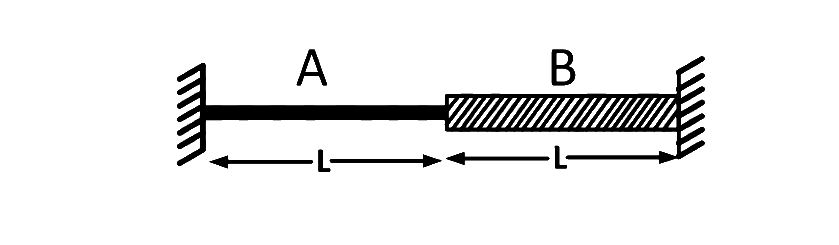
A wire of length 2L, is made by joining two wires A and B of same length but different radii r and 2r and made of the same material. It is vibrating at a frequency such that the joint of the two wires forms a node. If the number of antinodes in wire A is p and that in B is q then the ratio p: q is:
Answer: (c)
Stationary Waves & Vibrating Strings · Stationary wave equation
A standing wave is formed by the superposition of two waves travelling in opposite directions. The transverse displacement is given by
y(x, t) = 0.5 sin cos(200 t).
What is the speed of the travelling wave moving in the positive x direction?
(x and t are in meter and second, respectively.)
Answer: (a)
Stationary Waves & Vibrating Strings · Bridges, segments and composite wires
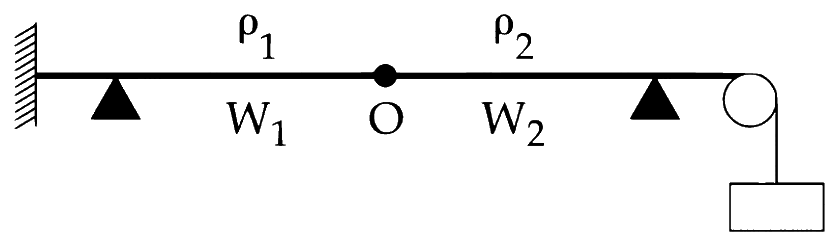
Two wires W1 and W2 have the same radius r and respective densities 1 and 2 such that ρ2 = 41. They are joined together at the point O, as shown in the figure. The combination is used as a sonometer wire and kept under tension T. The point O is midway between the two bridges. When a stationary wave is set up in the composite wire, the joint is found to be a node. The ratio of the number of antinodes formed in W1 to W2 is:
Answer: (b)
Stationary Waves & Vibrating Strings · String modes: harmonics and overtones
A string is stretched between fixed points separated by 75.0 cm. It is observed to have resonant frequencies of 420 Hz and 315 Hz. There are no other resonant frequencies between these two. The lowest resonant frequency for this string is
Answer: (b)
Stationary Waves & Vibrating Strings · Bridges, segments and composite wires
If n1, n2 and n3 are the fundamental frequencies of three segments into which a string is divided, then the original fundamental frequency n of the string is given by
Answer: (a)
Stationary Waves & Vibrating Strings · Bridges, segments and composite wires
The total length of a sonometer wire between fixed ends is 110 cm. Two bridges are placed to divide the length of wire in ratio 6: 3: 2. The tension in the wire is 400 N and the mass per unit length is 0.01 kg/m. What is the minimum common frequency with which three parts can vibrate?
Answer: (b)
Stationary Waves & Vibrating Strings · Bridges, segments and composite wires
The length of the wire between two ends of a sonometer is 100 cm. What should be the positions of two bridges below the wire so that the three segments of the wire have their fundamental frequencies in the ratio 1: 3: 5.
Answer: (d)
Stationary Waves & Vibrating Strings · Bridges, segments and composite wires
A sonometer wire of length 114 cm is fixed at both the ends. Where should the two bridges be placed so as to divide the wire into three segments whose fundamental frequencies are in the ratio 1: 3: 4?
Answer: (d)
Stationary Waves & Vibrating Strings · Laws of a vibrating string
A sonometer wire of length is made of steel. The tension in it produces an elastic strain of . What is the fundamental frequency of steel if density and elasticity of steel are and respectively?
Answer: (b)
Stationary Waves & Vibrating Strings · Bridges, segments and composite wires
When a string is divided into three segments of length 1, 2 and 3 the fundamental frequencies of these three segments are and respectively. The original fundamental frequency () of the string is
Answer: (c)
Stationary Waves & Vibrating Strings · String modes: harmonics and overtones
A string is stretched between fixed points separated by It is observed to have resonant frequencies of and . There are no other resonant frequencies between these two. Then, the lowest resonant frequency for this string is
Answer: (a)
Stationary Waves & Vibrating Strings · String modes: harmonics and overtones
A metal wire of linear mass density of is stretched with a tension of between two rigid supports metre apart. The wire passes at its middle point between the poles of a permanent magnet, and it vibrates in resonance when carrying an alternating current of frequency The frequency of the alternating source is
Answer: (a)
Stationary Waves & Vibrating Strings · String modes: harmonics and overtones
length of a string tied to two rigid supports is . Maximum length (wavelength in ) of a stationary wave produced on it is
Answer: (b)
Stationary Waves & Vibrating Strings · Stationary wave equation
A wave on a string meets with another wave producing a node at Then the equation of the unknown wave is
Answer: (b)
Stationary Waves & Vibrating Strings · Laws of a vibrating string
If the tension and diameter of a sonometer wire of fundamental frequency n is doubled and density is halved then its fundamental frequency will become
Answer: (c)
Stationary Waves & Vibrating Strings · Bridges, segments and composite wires
A string is cut into three parts, having fundamental frequencies n1, n2, n3 respectively. Then original fundamental frequency n related by the expression as
Answer: (a)
Stationary Waves & Vibrating Strings · Nodes, antinodes and properties
A standing wave having 3 nodes and 2 antinodes is formed between two atoms having a distance Å between them. The wavelength of the standing wave is
Answer: (a)
Stationary Waves & Vibrating Strings · String modes: harmonics and overtones
Standing waves are produced in long stretched string. If the string vibrates in 5 segments and wave velocity is , the frequency is
Answer: (a)
Stationary Waves & Vibrating Strings · Bridges, segments and composite wires
The length of a sonometer wire is . Where should the two bridges be placed from to divide the wire in 3 segments whose fundamental frequencies are in the ratio of ?
Answer: (a)
Stationary Waves & Vibrating Strings · Nodes, antinodes and properties
A wave of frequency travels along a string towards its fixed end. When this wave travels back, after reflection, a node is formed at a distance of from the fixed end. The speed of the wave (incident and reflected) is
Answer: (a)
Stationary Waves & Vibrating Strings · Stationary wave equation
A stationary wave is represented by , where and are in millimetres, is in seconds and is in metres. The velocity of the wave is
Answer: (a)
Stationary Waves & Vibrating Strings · Laws of a vibrating string
A stretched string resonates with tuning fork frequency when length of the string is . The length of the string required to vibrate resonantly with a tuning fork of frequency would be
Answer: (c)
No questions match these filters.