0 of 73 attemptedPick an answer to see the solution
Q1MHT CET 2026 · 14 MAY · SHIFT 1Easy
YDSE: Film, Medium & Two Wavelengths · Optical path & phase
The thickness of a plate (refractive index μ) which will produce a change in optical path equal to half the wavelength λ of the light passing through it normally, is
YDSE: Film, Medium & Two Wavelengths · YDSE in a medium
A double slit experiment is immersed in water of refractive index 1.33. The slit separation is 1 mm, distance between slit and screen is 1.33 m. The slits are illuminated by a light of wavelength 6300 \AA. The fringewidth is x×10−4 m. The value of ′x′ is
YDSE: Film, Medium & Two Wavelengths · YDSE in a medium
A double slit experiment is immersed in water of refractive index 1.33. The slit separation is 1 mm, distance between slit and screen is 1.33 m. The slits are illuminated by light of wavelength 6300 \AA. The fringe width is
YDSE: Film, Medium & Two Wavelengths · YDSE in a medium
In Young's double slit experiment, the angular width of a fringe is found to be 0.2∘ on a screen placed 1m away. The wavelength of light used in 600 nm. If the entire apparatus is immersed in water of refractive index 4/3. the angular width of the fringe will be
YDSE: Film, Medium & Two Wavelengths · YDSE in a medium
In Young's double slit experiment, the fringe width of the interference pattern produced on the screen is 2.4μm. If the experiment is carried out in another medium having refractive index 1.2, the fringe width will be μm.
YDSE: Film, Medium & Two Wavelengths · Fringe shift by a film
In the Young's double slit experiment, when a glass plate of thickness 't' is introduced in the path of one of the slits, the intensity at the position where the central maximum occurred previously remains unchanged. The minimum thickness of glass plate is [refractive index of glass plate = 1.5, wavelength of light in vacuum is λ]
YDSE: Film, Medium & Two Wavelengths · Fringe shift by a film
In Young's experiment, one of the slit is covered with a transparent sheet of thickness 3.6×10⁻³ cm due to which position of central image shifts to a position originally occupied by 30th bright fringe. The refractive index of the sheet is (λ=6000 \AA)
YDSE: Film, Medium & Two Wavelengths · Fringe shift by a film
A double slit experiment is performed with light of wavelength 500 nm. A thin film of thickness 2μm and refractive index 1.5 is introduced in the path of the upper beam. The location of the central maximum
YDSE: Film, Medium & Two Wavelengths · Fringe shift by a film
In Young's double slit experiment, the slit width is 1 mm and screen is at a distance 2 m from slits. Light of 600 nm is used. If a thin glass plate of refractive index 1.5 of thickness 0.06 mm is placed over one of the slits then there will be a lateral displacement of the fringes by
YDSE: Film, Medium & Two Wavelengths · Fringe shift by a film
When a glass plate of refractive index 1.44 is introduced in the path of one of the interfering beams, the fringes are displaced by a distance 'y'. If this plate is replaced by another plate of same thickness but of refractive index 1.66, the fringes will be displaced by a distance
YDSE: Film, Medium & Two Wavelengths · Fringe shift by a film
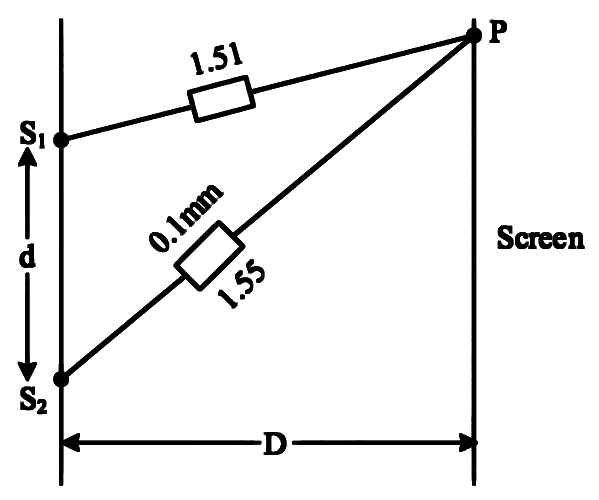
In Young's double slit experiment, two slits S1 and S2 are 'd' distance apart and the separation from slits to screen is D. Now if two transparent slabs of equal thickness 0.1 mm but refractive index 1.51 and 1.55 are introduced in the path of beam (λ=4000 Å) from S1 and S2 respectively. The central bright fringe spot will shift by ___ number of fringes.
YDSE: Film, Medium & Two Wavelengths · Fringe shift by a film
In a double slit experiment the distance between the slits is 0.1 cm and the screen is placed at 50 cm from the slits plane. When one slit is covered with a transparent sheet having thickness t and refractive index n(=1.5), the central fringe shifts by 0.2 cm. The value of t is
YDSE: Film, Medium & Two Wavelengths · Fringe shift by a film
In a double slit experiment, when one of the slits is covered by a transparent mica sheet of refractive index 1.56, the central fringe shifts to the position of 7th bright fringe, obtained with both slits uncovered. If the light source wavelength is 450 nm, the thickness of mica sheet is α×10−9 m. The value of α is
______.
Numerical answer type. Work it out, then open the answer.
YDSE: Film, Medium & Two Wavelengths · Fringe shift by a film
In a Young's double slit experiment set up, the two slits are kept 0.4 mm apart and screen is placed at 1 m from slits. If a thin transparent sheet of thickness 20μm is introduced in front of one of the slits then center bright fringe shifts by 20 mm on the screen.
The refractive index of transparent sheet is given by 10α, where α is ______.
Numerical answer type. Work it out, then open the answer.
YDSE: Film, Medium & Two Wavelengths · Two wavelengths: coincidence & overlap
In an interference experiment, the mth bright fringe for light of wavelength λ1 coincides with the nth dark fringe for light of wavelength λ2. The ratio λ1λ2 is
YDSE: Film, Medium & Two Wavelengths · Two wavelengths: coincidence & overlap
In Young's double slit experiment, the distance between the slits is 3 mm and the slits are 2m away from the screen. Two interference patterns can be obtained on the screen due to light of wavelength 480 nm and 600 nm respectively. The separation on the screen between the 5th order bright fringes on two interference patterns is
YDSE: Film, Medium & Two Wavelengths · Two wavelengths: coincidence & overlap
A beam of light consisting of wavelengths 650 nm and 550 nm illuminates the Young's double slits with separation of 2 mm such that the interference fringes are formed on a screen, placed at a distance of 1.2 m from the slits. The least distance of a point from the central maximum, where the bright fringes due to both the wavelengths coincide, is ________ ×10−5 m.
Numerical answer type. Work it out, then open the answer.
YDSE: Film, Medium & Two Wavelengths · Dark fringe opposite a slit
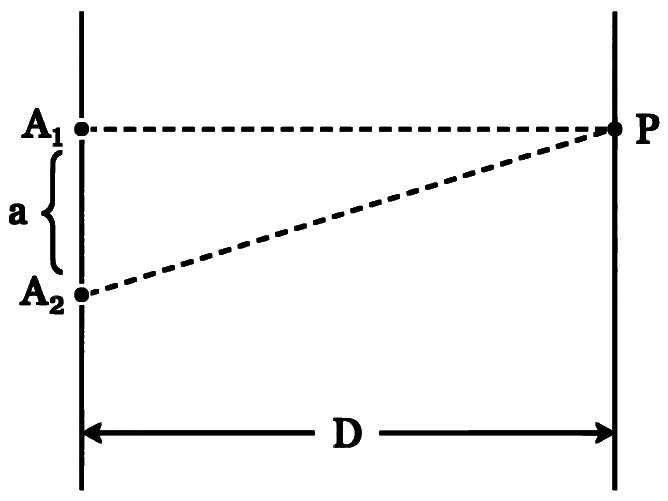
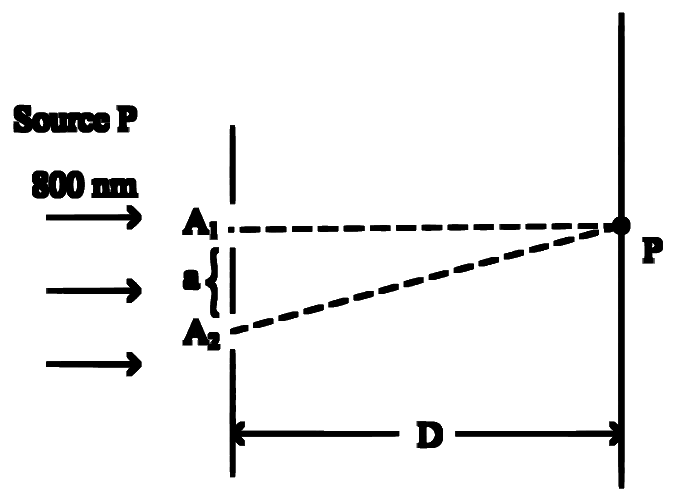
In Young's double slit experiment, two slits are illuminated with a light of wavelength λ. The line joining A1P is perpendicular to A1A2 as shown in figure. If the first minimum is detected at P, the value of slits separation 'a' will be
YDSE: Film, Medium & Two Wavelengths · Dark fringe opposite a slit
In Young's double slit experiment, in an interference pattern, a minimum is observed exactly in front of one slit. The distance between the two coherent sources is 'd' and 'D' is the distance between source and screen. The possible wavelengths used are inversely proportional to
YDSE: Film, Medium & Two Wavelengths · Dark fringe opposite a slit
The maximum intensity in a Young's double slit experiment is I0. Distance between the slits (d) is 5λ, where λ is the wavelength of light used. The intensity of the fringe, exactly opposite to one of the slits on the screen, placed at D=10d is ______.
YDSE: Film, Medium & Two Wavelengths · Optical path & phase
A ray of light from a monochromatic point source of light is incident at a point on the screen. If a thin mica film of thickness ' t ' and refractive index ' n ' is introduced in its path, then the optical path
YDSE: Film, Medium & Two Wavelengths · Fringe shift by a film
In Young's double slit experiment, the distance between screen and aperture is 1 m. The slit width is 2 mm. Light of 6000A˚ is used. If a thin glass plate ( μ=1.5) of thickness 0.04 mm is placed over one of the slits, then there will be a lateral displacement of the fringes by
YDSE: Film, Medium & Two Wavelengths · YDSE in a medium
Young's double slit interference apparatus is immersed in a liquid of refractive index 1.44. It has slit separation of 1.5 mm. The slits are illuminated by a parallel beam of light whose wavelength in air is 690 nm. The fringe-width on a screen placed behind the plane of slits at a distance of 0.72 m, will be:
YDSE: Film, Medium & Two Wavelengths · Two wavelengths: coincidence & overlap
In Young's double slit experiment, the distance between the slits is 2 mm and the slits are 1 m away, from the screen. Two interference patterns can be obtained on the screen due to light of wavelength ' λ1 ' and ' λ2 ' respectively. The separation on the screen between the 3rd order bright fringes on the two interference patterns is ( λ2=1.5λ1)
YDSE: Film, Medium & Two Wavelengths · Two wavelengths: coincidence & overlap
The Young's double slit interference experiment is performed using light consisting of 480 nm and 600 nm wavelengths to form interference patterns. The least number of the bright fringes of 480 nm light that are required for the first coincidence with the bright fringes formed by 600 nm light is
YDSE: Film, Medium & Two Wavelengths · Dark fringe opposite a slit
In Young's double slit experiment, in an interference pattern second minimum is observed exactly in front of one slit. The distance between the two coherent sources is ' d ' and the distance between source and screen is ' D '. The wavelength of light source used is
YDSE: Film, Medium & Two Wavelengths · Dark fringe opposite a slit
In Young's double slit experiment, in an interference pattern, a minimum is observed exactly in front of one slit. The distance between the two coherent sources is d and D is the distance between source and screen. The possible wavelengths used are proportional to
YDSE: Film, Medium & Two Wavelengths · Dark fringe opposite a slit
In Young's double slit experiment let 'd' be the distance between two slits and 'D' be the distance between the slits and the screen. Using a monochromatic source of wavelength ' λ ', in an interference pattern, third minimum is observed exactly in front of one of the slits. If at the same point on the screen first minimum is to be obtained, the required change in the wavelength is [ d&D are not changed].
YDSE: Film, Medium & Two Wavelengths · Optical path & phase
Two light rays having the same wavelength ' λ ' in vacuum are in phase initially. Then, the first ray travels a path ' L1 ' through a medium of refractive index ' μ1 ' while the second ray travels a path of length ' L2 ' through a medium of refractive index ' μ2 '. The two waves are then combined to observe interference. The phase difference between the two waves is
YDSE: Film, Medium & Two Wavelengths · Fringe shift by a film
Monochromatic light of wavelength 500 nm is used in Young's double slit experiment. An interference pattern is obtained on a screen. When one of the slits is covered with a very thin glass plate (refractive index =1.5), the central maximum is shifted to a position previously occupied by the 4th bright fringe. The thickness of the glass-plate is __________ μm.
Numerical answer type. Work it out, then open the answer.
YDSE: Film, Medium & Two Wavelengths · Two wavelengths: coincidence & overlap
In an interference experiment, the nth bright fringe for light of wavelength λ1(n=0,1,2,3…) coincides with the mth dark fringe for light of wavelength λ2(m=1,2,3…). The ratio λ2λ1 is
YDSE: Film, Medium & Two Wavelengths · Two wavelengths: coincidence & overlap
Two wavelengths λ1 and λ2 are used in Young's double slit experiment. λ1=450 nm and λ2=650 nm. The minimum order of fringe produced by λ2 which overlaps with the fringe produced by λ1 is n. The value of n is _______.
Numerical answer type. Work it out, then open the answer.
YDSE: Film, Medium & Two Wavelengths · Dark fringe opposite a slit
In Young's double slit experiment, the distance between the two coherent sources is ' d ' and the distance between the source and screen is ' D '. When the wavelength (λ) of light source used is 3Dd2, then nth dark fringe is observed on the screen, exactly in front of one of the slits. The value of ' n ' is
YDSE: Film, Medium & Two Wavelengths · Dark fringe opposite a slit
In Young's double slit experiment, in an interference pattern, second minimum is observed exactly in front of one slit. The distance between the two coherent sources is ' d ' and the distance between the source and screen is ' D '. The wave length of light (λ) used is
YDSE: Film, Medium & Two Wavelengths · Dark fringe opposite a slit
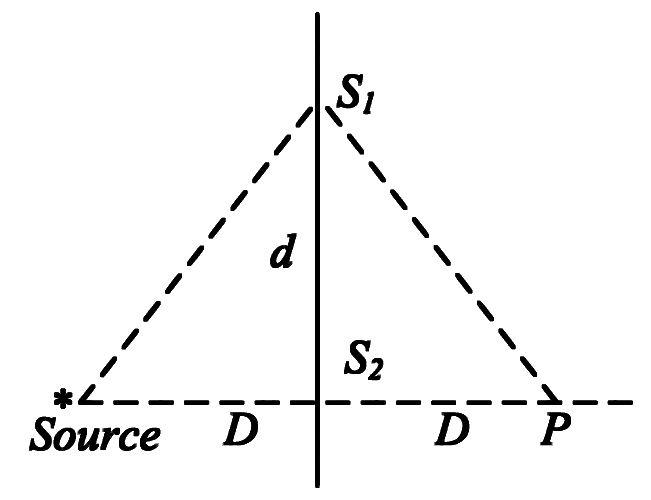
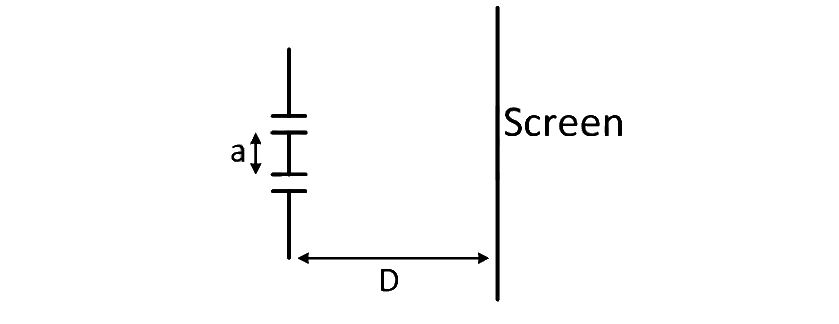
In a double slit experiment shown in figure, when light of wavelength 400 nm is used, dark fringe is observed at P. If D=0.2 m, the minimum distance between the slits S1 and S2 is _________ mm.
Numerical answer type. Work it out, then open the answer.
YDSE: Film, Medium & Two Wavelengths · YDSE in a medium
A double slit experiment is immersed in water of refractive index 1.33. The slit separation is 1 mm, distance between slit and screen is 1.33 m The slits are illuminated by a light of wavelength 6300A˚. The fringe width is
YDSE: Film, Medium & Two Wavelengths · Fringe shift by a film
On placing a thin film of mica of thickness 12×10−5 cm in the path of one of the interfering beams in Young's double slit experiment using monochromatic light, the fringe pattern shifts through a distance equal to the width of bright fringe. If λ=6×10⁻⁵ cm, the refractive index of mica is
YDSE: Film, Medium & Two Wavelengths · Fringe shift by a film
In Young's double slit experiment when a glass plate of refractive index 1.44 is introduced in the path of one of the interfering beams, the fringes are displaced by a distance 'y'. If this plate is replaced by another plate of same thickness but of refractive index 1.66, the fringes will be displaced by a distance
YDSE: Film, Medium & Two Wavelengths · Fringe shift by a film
One of the slits in Young's double slit experiment is covered with a transparent sheet of thickness 2.9×10⁻³ cm. The central fringe shifts to a position originally occupied by the 25th bright fringe. If λ=5800A˚, the refractive index of the sheet is
YDSE: Film, Medium & Two Wavelengths · Fringe shift by a film
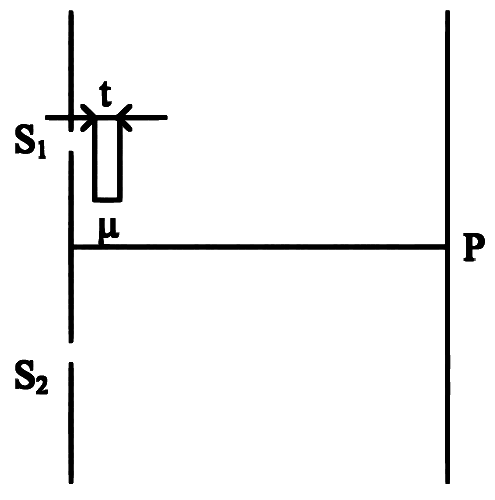
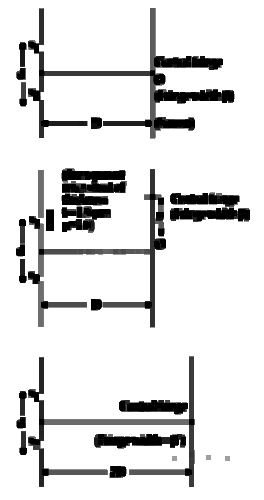
As shown in the figure, in Young's double slit experiment, a thin plate of thickness t=10μm and refractive index μ=1.2 is inserted in front of slit S1. The experiment is conducted in air (μ=1) and uses a monochromatic light of wavelength λ=500 nm. Due to the insertion of the plate, central maxima is shifted by a distance of xβ0.β0 is the fringe-width before the insertion of the plate. The value of the x is _____________.
Numerical answer type. Work it out, then open the answer.
YDSE: Film, Medium & Two Wavelengths · Fringe shift by a film
In Young's double slit experiment, two slits S1 and S2 are 'd' distance apart and the separation from slits to screen is D (as shown in figure). Now if two transparent slabs of equal thickness 0.1 mm but refractive index 1.51 and 1.55 are introduced in the path of beam (λ=4000A˚) from S1 and S2 respectively. The central bright fringe spot will shift by ___________ number of fringes.
Numerical answer type. Work it out, then open the answer.
YDSE: Film, Medium & Two Wavelengths · Two wavelengths: coincidence & overlap
A beam of light consisting of two wavelengths 7000A˚ and 5500A˚ is used to obtain interference pattern in Young's double slit experiment. The distance between the slits is 2.5 mm and the distance between the plane of slits and the screen is 150 cm. The least distance from the central fringe, where the bright fringes due to both the wavelengths coincide, is n×10−5 m. The value of n is __________.
Numerical answer type. Work it out, then open the answer.
YDSE: Film, Medium & Two Wavelengths · Dark fringe opposite a slit
In Young's double slit experiment, the two slits are 'd' distance apart. Interference pattern is observed on a screen at a distance 'D' from the slits. A dark fringe is observed on a screen directly opposite to one of the slits. The wavelength of light is
YDSE: Film, Medium & Two Wavelengths · Dark fringe opposite a slit
In a Young's double slit experiment, two slits are illuminated with a light of wavelength 800 nm. The line joining A1P is perpendicular to A1A2 as shown in the figure. If the first minimum is detected at P, the value of slits separation 'a' will be:
YDSE: Film, Medium & Two Wavelengths · Two wavelengths: coincidence & overlap
Two light waves of wavelengths 800 and 600 nm are used in Young's double slit experiment to obtain interference fringes on a screen placed 7 m away from plane of slits. If the two slits are separated by 0.35 mm, then shortest distance from the central bright maximum to the point where the bright fringes of the two wavelength coincide will be ______ mm.
Numerical answer type. Work it out, then open the answer.
YDSE: Film, Medium & Two Wavelengths · YDSE in a medium
In Young's double slit experiment, the fringe width is 12 mm. If the entire arrangement is placed in water of refractive index 34, then the fringe width becomes (in mm):
YDSE: Film, Medium & Two Wavelengths · YDSE in a medium
In a Young's double slit experiment, an angular width of the fringe is 0.35∘ on a screen placed at 2 m away for particular wavelength of 450 nm. The angular width of the fringe, when whole system is immersed in a medium of refractive index 7/5, is α1. The value of α is ___________.
Numerical answer type. Work it out, then open the answer.
YDSE: Film, Medium & Two Wavelengths · Fringe shift by a film
In Young's double slit experiment performed using a monochromatic light of wavelength λ, when a glass plate (μ = 1.5) of thickness xλ is introduced in the path of the one of the interfering beams, the intensity at the position where the central maximum occurred previously remains unchanged. The value of x will be:
YDSE: Film, Medium & Two Wavelengths · Dark fringe opposite a slit
In Young's double slit experiment the two slits are 0.6 mm distance apart. Interference pattern is observed on a screen at a distance 80 cm from the slits. The first dark fringe is observed on the screen directly opposite to one of the slits. The wavelength of light will be ____________ nm.
Numerical answer type. Work it out, then open the answer.
YDSE: Film, Medium & Two Wavelengths · YDSE in a medium
A double slit experiment is immersed in water of refractive index 1.33. The slit separationis 1 mm and the distance between slit and screen is 1.33 m. The slits are illuminated by a light of wavelength 6300A˚. The fringewidth is
YDSE: Film, Medium & Two Wavelengths · Optical path & phase
The difference in the number of waves when yellow light propagates through air and vacuum columns of the same thickness is one. The thickness of the air column is ___________ mm. [Refractive index of air = 1.0003, wavelength of yellow light in vacuum = 6000 A˚]
Numerical answer type. Work it out, then open the answer.
YDSE: Film, Medium & Two Wavelengths · Dark fringe opposite a slit
In Young's double slit experiment, in an interference pattern, a minimum is observed exactly in front of one slit. The distance between the two coherent sources is 'd' and 'D' is the distance between the source and screen. The possible wavelengths used are inversely proportional to
YDSE: Film, Medium & Two Wavelengths · Optical path & phase
Two light waves having the same wavelength λ in vacuum are in phase initially. Then the first wave travels a path L1 through a medium of refractive index n1 while the second wave travels a path of length L2 through a medium of refractive index n2. After this the phase difference between the two waves is:
YDSE: Film, Medium & Two Wavelengths · YDSE in a medium
In a double slit experiment, when light of wavelength 400 nm was used, the angular width of the first minima formed on a screen placed 1m away, was found to be 0.2°. What will be the angular width of the first minima, (μwater = 4/3) if the entire experimental apparatus is immersed in water?
YDSE: Film, Medium & Two Wavelengths · Fringe shift by a film
In a double slit experiment, when a thin film of thickness t having refractive index μ. is introduced in front of one of the slits, the maximum at the centre of the fringe pattern shifts by one fringe width. The value of t is (λ is the wavelength of the light used):
YDSE: Film, Medium & Two Wavelengths · Fringe shift by a film
The figure shows a Young's double slit experimental setup. It is observed that when a thin transparent sheet of thickness t and refractive index μ is put in front of one of the slits, the central maximum gets shifted by a distance equal to n fringe widths. If the wavelength of light used is λ, t will be:
YDSE: Film, Medium & Two Wavelengths · Dark fringe opposite a slit
In Young's double slit experiment fifth dark fringe is formed opposite to one of the slits. D is the distance between the slits and the screen and d is the separation between the slits, then the wavelength of light used is
YDSE: Film, Medium & Two Wavelengths · Dark fringe opposite a slit
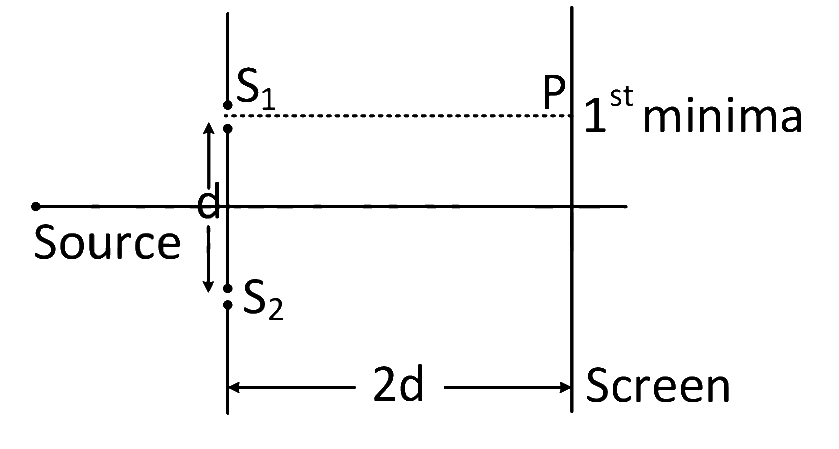
Consider a Young’s double slit experiment as shown in figure. What should be the slit separation d in terms of wavelength λ such that the first minima occurs directly in front of the slit (S1)?
YDSE: Film, Medium & Two Wavelengths · Number of maxima
In a Young's double slit experiment, the slits are placed 0.320 mm apart. Light of wavelength λ = 500 nm is incident on the slits. The total number of bright fringes that are observed in the angular range − 30°≤θ≤30° is:
YDSE: Film, Medium & Two Wavelengths · YDSE in a medium
Young's double slit experiment is first performed in air and then in a medium other than air. It is found that 8th bright fringe in the medium lies where 5th dark fringe lies in air. The refractive index of the medium is nearly
YDSE: Film, Medium & Two Wavelengths · Two wavelengths: coincidence & overlap
In a Young’s double slit experiment, slits are separated by 0.5 mm, and the screen is placed 150 cm away. A beam of light consisting of two wavelengths, 650 nm and 520 nm, is used to obtain interference fringes on the screen. The least distance from the common central maximum to the point where the bright fringes due to both the wavelengths coincide is
YDSE: Film, Medium & Two Wavelengths · Dark fringe opposite a slit
The intensity at the maximum in a Young's double slit experiment is I0. Distance between two slits is d = 5λ, where λ is the wavelength of light used in the expreriment. What will be the intensity in front of one of the slits on the screen placed at a distance D = 10d?
YDSE: Film, Medium & Two Wavelengths · Fringe shift by a film
A thin glass plate of thickness 32500λ (λ is wavelength of light used) and refractive index μ=1.5 is inserted between one of the slits and the screen in Young's double slit experiment. At a point on the screen equidistant from the slits, the ratio of the intensities before and after the introduction of the glass plate is:
YDSE: Film, Medium & Two Wavelengths · Two wavelengths: coincidence & overlap
In Young's double slit experiment, the slits are 2 mm apart and are illuminated by photons of two ∘∘
wavelengths λ1 = 12000 A˚ and λ2 = 10000 A˚. At what minimum distance from the common central bright fringe on the screen 2 m from the slit will a bright fringe from one interference pattern coincide with a bright fringe from the other?
YDSE: Film, Medium & Two Wavelengths · Two wavelengths: coincidence & overlap
The source that illuminates the double-slit in 'double-slit interference experiment' emits two distinct monochromatic waves of wavelength 500 nm and 600 nm, each of them producing its own pattern on the screen. At the central point of the pattern when path difference is zero, maxima of both the patterns coincide and the resulting interference pattern is most distinct at the region of zero path difference. But as one moves out of this central region, the two fringe systems are gradually out of step such that maximum due to one wavelength coincides with the minimum due to the other and the combined fringe system becomes completely indistinct. This may happen when path difference in nm is:
YDSE: Film, Medium & Two Wavelengths · Two wavelengths: coincidence & overlap
A mixture of light, consisting of wavelength 590 nm and an unknown wavelength, illuminates Young's double slit and gives rise to two overlapping interference patterns on the screen. The central maximum of both lights coincide. Further, it is observed that the third bright fringe of known light coincides with the 4th bright fringe of the unknown light. From this data, the wavelength of the unknown light is:
YDSE: Film, Medium & Two Wavelengths · YDSE in a medium
Interference was observed in interference chamber where air was present, now the chamber is evacuated, and if the same light is used, a careful observer will see
YDSE: Film, Medium & Two Wavelengths · YDSE in a medium
In Young's double slit experiment, the fringe width is found to be 0.4 mm. If the whole apparatus is immersed in water of refractive index 34, without disturbing the geometrical arrangement, the new fringe width will be