A capacitor of unknown capacitance is connected across a battery of ′V′ volt. The charge stored in it is ′Q′ C. When potential across the capacitor is reduced by ′V1′ volt, the charge stored in it becomes ′Q1′ C. The potential ′V′ is
Consider the earth to be a sphere, having charge Q. Let R,V and A be its radius, volume and area respectively. The capacitance of the earth is [ε0 = permittivity of free space]
The earth is assumed to be a charged conducting sphere having volume 'V' and surface area 'A'. The capacitance of the earth in free space is (ϵ0 = permittivity of free space)
A capacitor of unknown capacity is connected across a battery of V volt. The charge stored in it is Q coulomb. When potential across the capacitor is reduced by V1 volt, the charge stored in it becomes Q1 coulomb. The potential V is
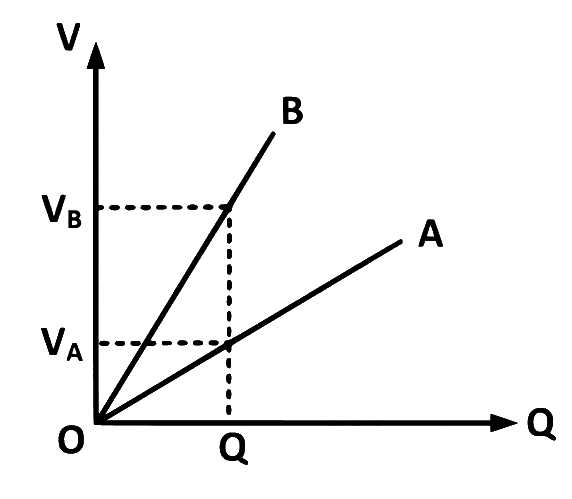
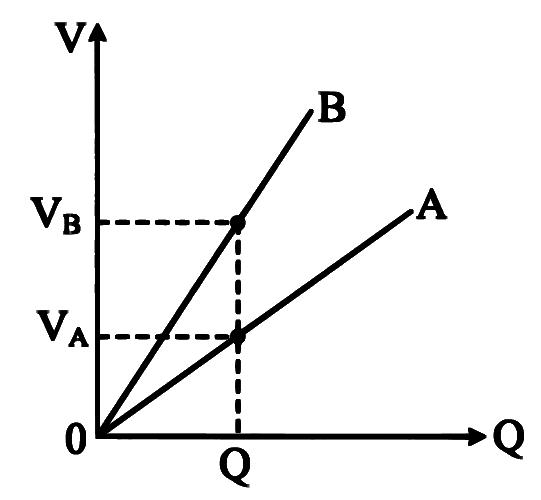
The graph shows the variation of voltage (v) across the plates of two parallel plate capacitos A and B versus increase of charge Q stored in them. Then
Given below are two statements: One is labeled as Assertion A and the other is labeled as Reason R.
Assertion A: Two metallic spheres are charged to the same potential. One of them is hollow and another is solid, and both have the same radii. Solid sphere will have lower charge than the hollow one.
Reason R: Capacitance of metallic spheres depends on the radii of spheres
In light of the above statements, choose the correct answer from the options given below.
Two spherical conductors of capacities 3μF and 2μF are charged to same potential having radii 3 cm and 2 cm respectively. If 'σ1 ' and 'σ2' represent surface density of charge on respective conductors then σ2σ1 is
A condenser of 2μF capacitance is charged steadily from 0 to 5 C. Which of the following graph represents correctly the variation of potential difference (V) across it's plates with respect to the charge (Q) on the condenser?
Capacitance of an isolated conducting sphere of radius R1 becomes n times when it is enclosed by a concentric conducting sphere of radius R2 connected to earth. The ratio of their radii (R1R2) is: