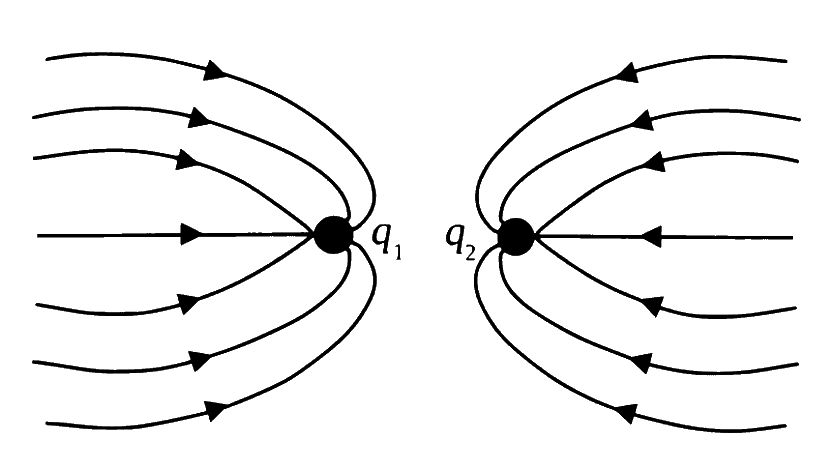
B. The electric field lines point radially outward when charge is greater than zero. C. The Gauss - Law is valid only for inverse-square force.
D. The work done in moving a charged particle in a static electric field around a closed path is zero. E. The motion of a particle under Coulomb's force must take place in a plane.
Choose the correct answer from the options given below:
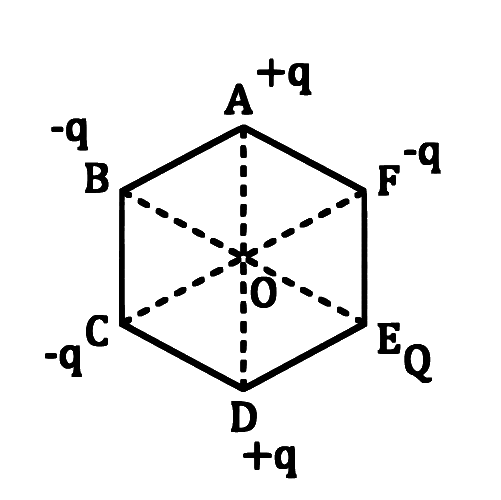
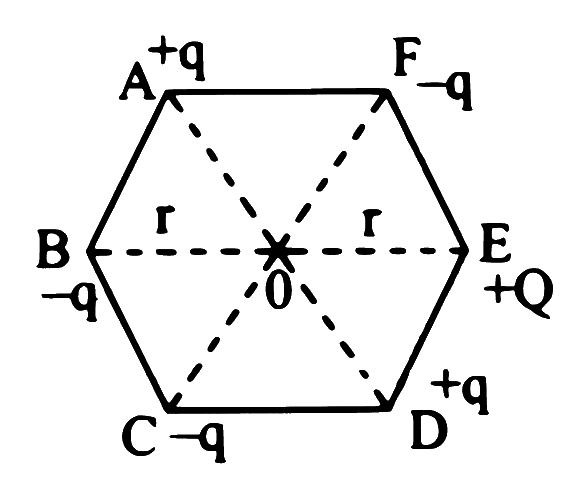
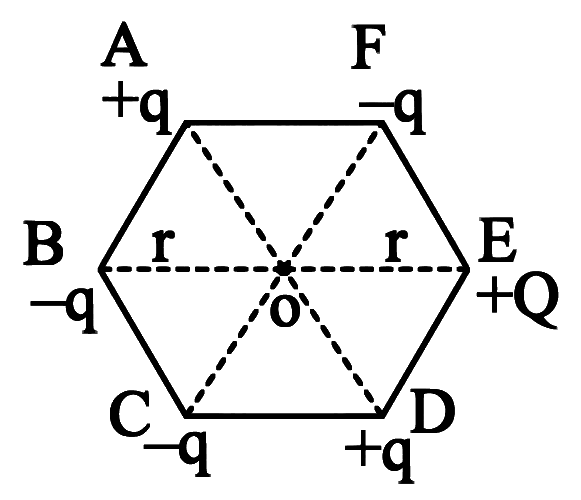
The point charges +q,−q,−q,+q,+Q and −q are placed at the vertices of a regular hexagon ABCDEF as shown in the figure.
The electric field at the centre of the hexagon 'O' due to the five charges at A, B, C, D and F is thrice the electric field at centre 'O' due to charge +Q at E alone. The value of Q is
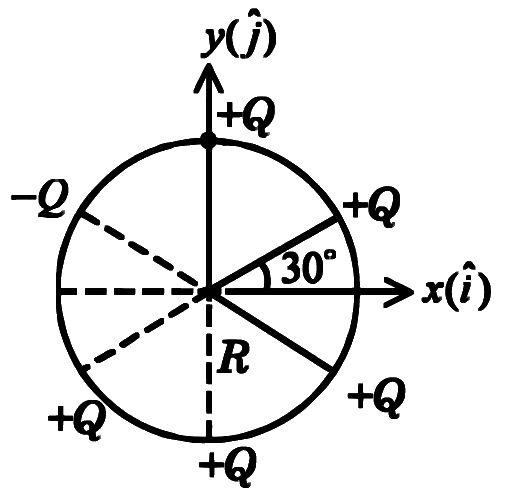
Six point charges are kept 60∘ apart from each other on the circumference of a circle of radius R as shown in figure. The net electric field at the center of the circle is ______.
A thin half ring of radius 35 cm is uniformly charged with a total charge of Q coulomb. If the magnitude of the electric field at centre of the half ring is 100 V/m, then the value of Q is ______ nC. (ϵ0=8.85×10⁻¹² C2/N m2 and π=3.14)
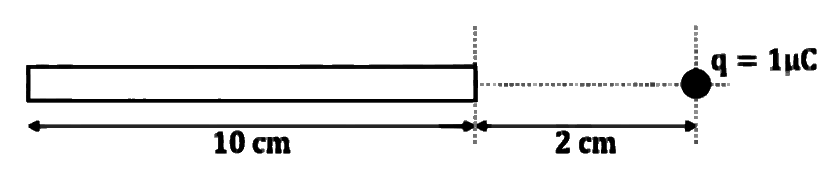
A point charge q=1μC is located at a distance 2 cm from one end of a thin insulating wire of length 10 cm having a charge Q=24μC, distributed uniformly along its length, as shown in figure. Force between q and wire is ______ N.
(Use: 4πϵ01=9×10⁹ N m2/C2)
Numerical answer type. Work it out, then open the answer.
A point charge +q is placed at the origin. A second point charge +9q is placed at (d,0,0) in Cartesian coordinate system. The point in between them where the electric field vanishes is:
The point charges +q,−q,−q,+q,+Q and -q are placed at the vertices of a regular hexagon ABCDEF as shown in figure. The electric field at the centre of hexagon ' O ' due to the five charges at A,B,C,D and F is twice the electric field at centre ' O ' due to charge +Q at E alone. The value of Q is
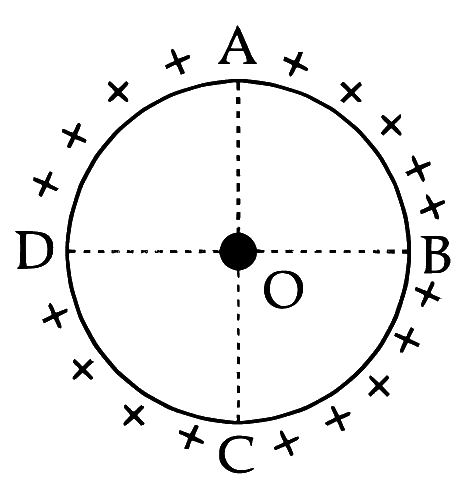
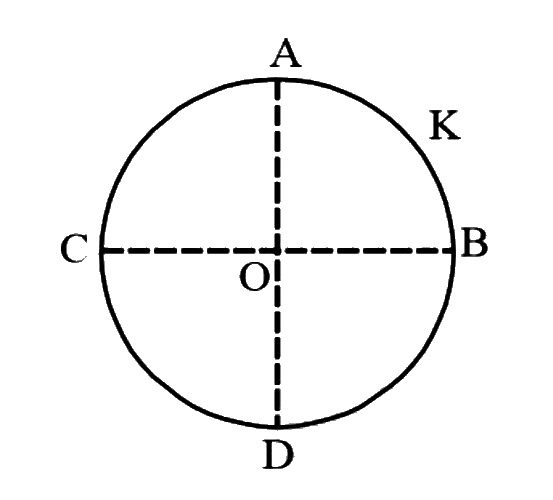
A metallic ring is uniformly charged as shown in figure. AC and BD are two mutually perpendicular diameters. Electric field due to arc AB at ' O ' is ' E ' in magnitude. What would be the magnitude of electric field at ' O ' due to arc ABC?
Consider a circular loop that is uniformly charged and has a radius a2. Find the position along the positive z-axis of the cartesian coordinate system where the electric field is maximum if the ring was assumed to be placed in xy plane at the origin:
A sphere ' A ' of radius ' R ' has a charge ' Q ' on it. The field at point B outside the sphere is ' E '. Now another sphere of radius ' 2R ' having a charge ' −2Q ' is placed at B. The total field at the point midway between A and B due to both the spheres is
The point charges +q,−q,−q,+q,+Q and -q are placed at the vertices of a regular hexagon ABCDEF as shown in figure. The electric field at the centre of hexagon ' O ' due to the five charges at A,B,C,D and F is thrice the electric field at centre ' O ' due to charge +Q at E alone. The value of Q is
Two point charges +8q and −2q are located at x=0 and x=L respectively. The location of a point on the x-axis from the origin, at which the net electric field due to these two point charges is zero is
Two point charges +8q and −2q are located at X=0 (origin) and X=L respectively. The net electric field due to these two charges is zero at point P on X-axis. The location of point P from the origin is
Two point charges +10 q and -4 q are located at x=0 and x=L respectively. What is the location of a point on the x-axis from the origin, which the net electric field due to these two point charges is zero?( r= required distance)
Two equal positive point charges are separated by a distance 2a. The distance of a point from the centre of the line joining two charges on the equatorial line (perpendicular bisector) at which force experienced by a test charge q0 becomes maximum is xa. The value of x is __________.
Numerical answer type. Work it out, then open the answer.
A point charge of 10 μC is placed at the origin. At what location on the X-axis should a point charge of 40 μC be placed so that the net electric field is zero at x=2cm on the X-axis?
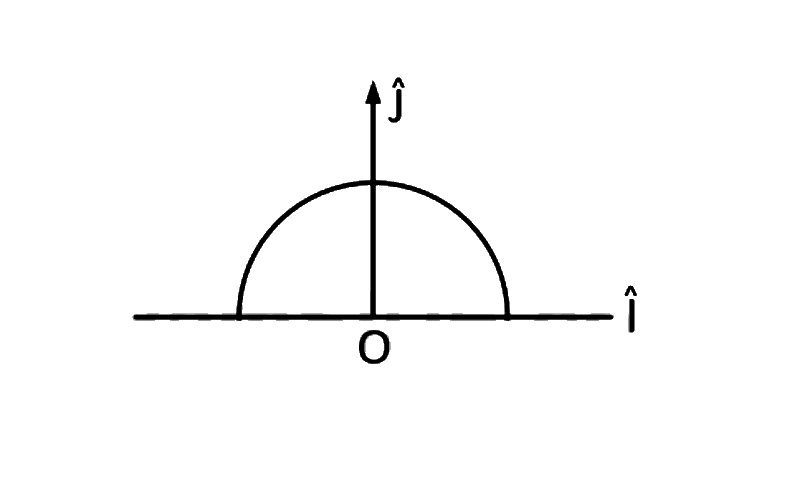
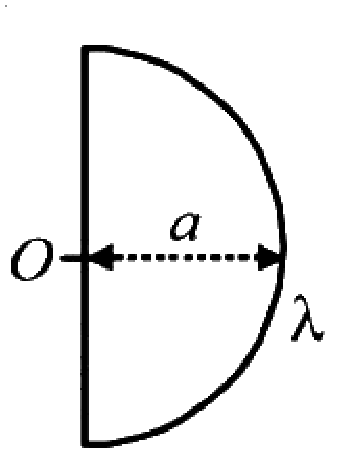
A uniformly charged semicircular arc of radius 'r' has linear charge density 'λ'. The electric field at its centre is ( ε0= permittivity of free space)
Two point charges A and B of magnitude +8 × 10⁻⁶ C and −8 × 10⁻⁶ C respectively are placed at a distance d apart. The electric field at the middle point O between the charges is 6.4 × 10⁴ NC−1. The distance 'd' between the point charges A and B is:
Two point charges Q each are placed at a distance d apart. A third point charge q is placed at a distance x from mid-point on the perpendicular bisector. The value of x at which charge q will experience the maximum Coulomb's force is:
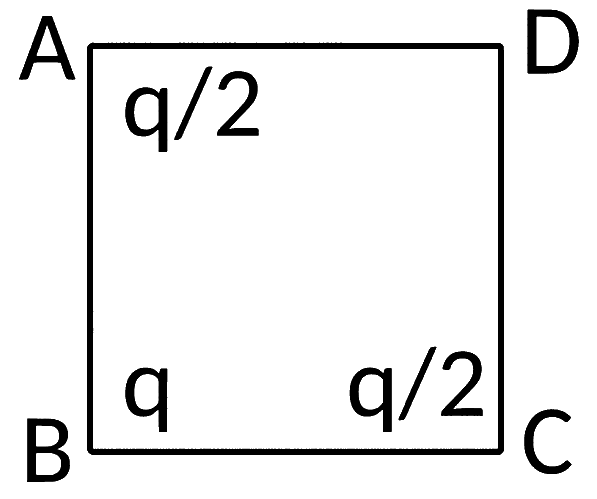
The three charges q/2, q and q/2 are placed at the corners A, B and C of a square of side 'a' as shown in figure. The magnitude of electric field (E) at the corner D of the square, is:
Statement I: A point charge is brought in an electric field. The value of electric field at a point near to the charge may increase if the charge is positive.
Statement II: An electric dipole is placed in a non-uniform electric field. The net electric force on the dipole will not be zero.
Choose the correct answer from the options given below:
A charge q is uniformly distributed along the length L of a rod. It is then bent in the shape of a semicircle. The magnitude of electric field at the centre of semicircle will be:
In hydrogen atom an electron revolves around a proton (in nucleus) at a distance 'r' m. the intensity of electric field due to the proton at distance 'r' is 5×10¹¹ NC−1, the magnitude of force between the electron and proton is [charge on electron =1.6×10⁻¹⁹ C]
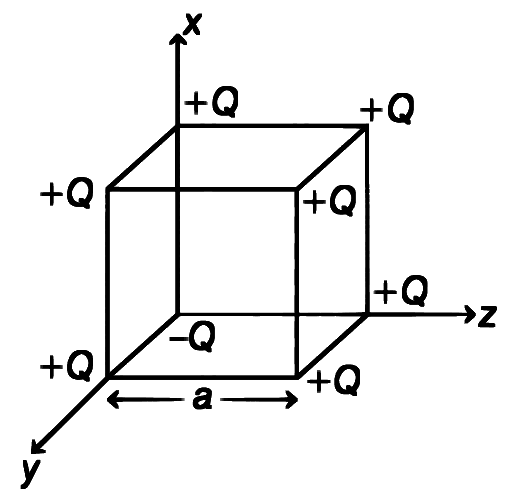
A cube of side 'a' has point charges +Q located at each of its vertices except at the origin where the charge is − Q. The electric field at the centre of cube is:
A uniformly charged semicircular arc of radius 'r' has linear charge density (λ). What is the electric field at its centre? ( ε0= permittivity of free space)
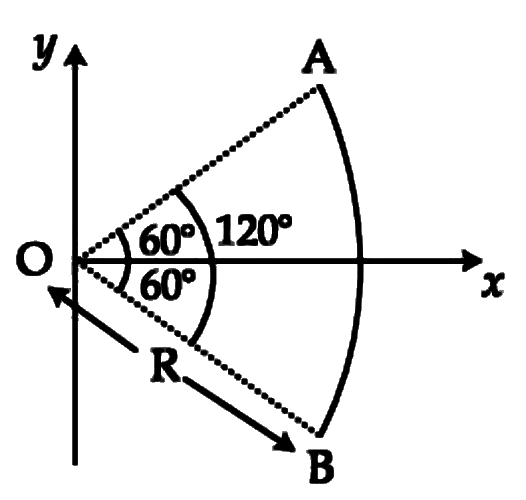
Figure shows a rod AB, which is bent in a 120∘ circular arc of radius R. A charge (−Q) is uniformly distributed over rod AB. What is the electric field Eat the centre of curvature O?
A uniformly charged disc of radius R having surface charge density σ is placed in the xy plane with its center at the origin. Find the electric field intensity along the z-axis at a distance Z from origin :-
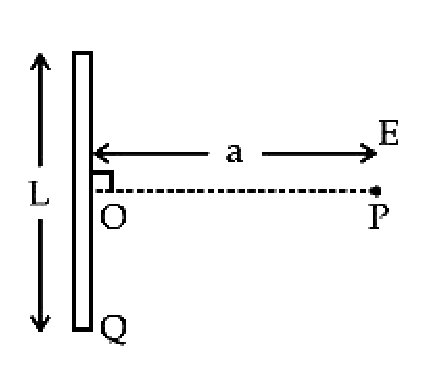
Find the electric field at point P (as shown in figure) on the perpendicular bisector of a uniformly charged thin wire of length L carrying a charge Q. The distance of the point P from the centre of the wire is a = 23L.
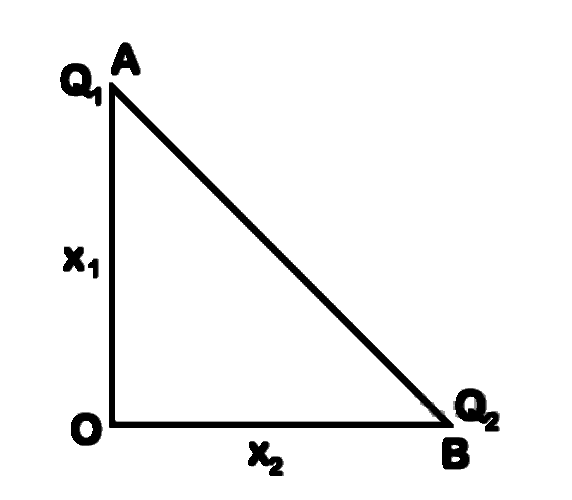
Charges Q1 and Q2 are at points A and B of a right angle triangle OAB (see figure). The resultant electric field at point O is perpendicular to the hypotenuse, then
Ten charges are placed on the circumference of a circle of radius R with constant angular separation between successive charges. Alternate charges 1, 3, 5, 7, 9 have charge (+q) each, while 2, 4, 6, 8, 10 have charge (–q) each. The potential V and the electric field E at the centre of the circle are respectively.
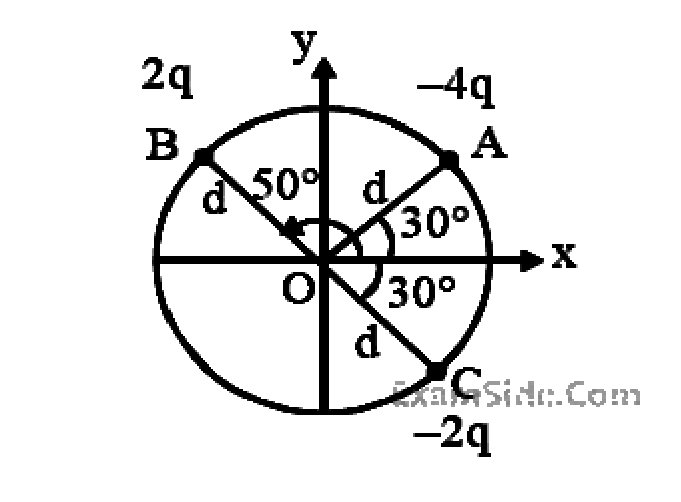
Three charged particles A, B and C with charges –4q, 2q and –2q are present on the circumference of a circle of radius d. The charged particles A, C and centre O of the circle form an equilateral triangle as shown in figure. Electric field at O along x-direction is:
Two point charges q1 (10μC) and q2(− 25 μC) are placed on the x-axis at x = 1 m and x = 4 m respectively. The electric field (in V/m) at a point y = 3 m on y-axis is,
For a uniformly charged ring of radius R, the electric field on its axis has the largest magnitude at a distance h from its center. Then value of h is:
Four point charges –q, +q, +q and –q are placed on y-axis at y = –2d, y = –d, y = +d and y = +2d, respectively. The magnitude of the electric field E at a point on the x-axis at x = D, with D >> d, will behave as :-
A long cylindrical shell carries positive surface charge σ in the upper half and negative surface charge - σ in the lower half. The electric field lines around the cylinder will look like figure given in: (figures are schematic and not drawn to scale)
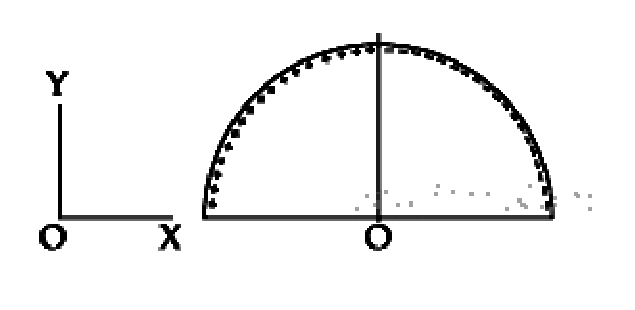
A wire, of length L(=20 cm), is bent into a semi-circular arc. If the two equal halves, of the arc, were each to be uniformly charged with charges ±Q, [ ∣Q∣ = 103 ε0 Coulomb where ε0 is the permittivity (in SI units) of free space ] the net electric field at the center O of the semi-circular arc would be:
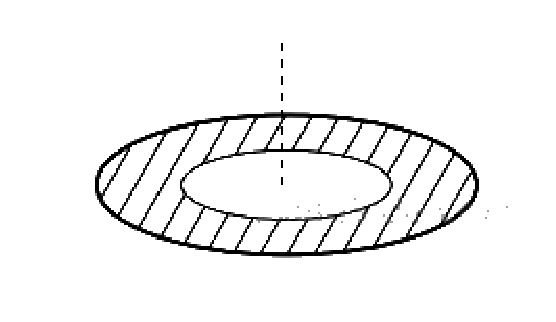
A thin disc of radius b = 2a has a concentric hole of radius 'a' in it (see figure). It carries uniform surface charge 'σ' on it. If the electric field on its axis at height 'h' (h < < a) from its centre is given as 'Ch' then value of 'C' is:
The surface charge density of a thin charged disc of radius R is σ. The value of the electric field at the centre of the disc is 2ϵ0σ. With respect to the field at the centre, the electric field along the axis at a distance R from the centre of the disc:
(This question contains Statement-1 and Statement-2. Of the four choices given after the statements, choose the one that best describes the two statements.)
Statement-1: For a charged particle moving from point P to point Q, the net work done by an electrostatic field on the particle is independent of the path connecting point P to point Q. Statement-2: The net work done by a conservative force on an object moving along a closed loop is zero.
A thin conducting ring of radius R is given a charge +Q. The electric field at the centre O of the ring due to the charge on the part AKB of the ring is E. The electric field at the centre due to the charge on the part ACDB of the ring is
Three point charges +q, − 2q and + q are placed at points (x = 0, y = a, z = 0), (x = 0, y = 0, z = 0) and (x = a, y = 0, z = 0) respectively. The magnitude and direction of the electric dipole moment vector of this charge assembly are
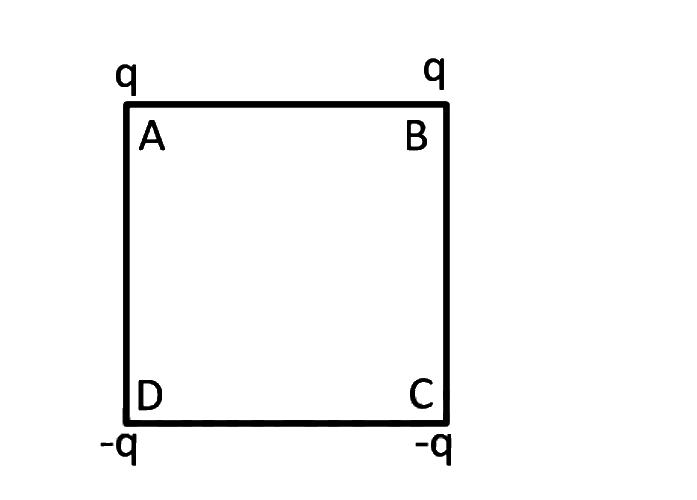
Charges are placed on the vertices of a square as shown. Let Ebe the electric field and V the potential at the center. If the charges on A and B are interchanged with those on D and C respectively, then
Two point charges +8q and −2q are located at x=0 and x=L respectively. The location of a point on the x axis at which the net electric field due to these two point charges is zero is