Electric Potential & Equipotentials · Potential of point charges
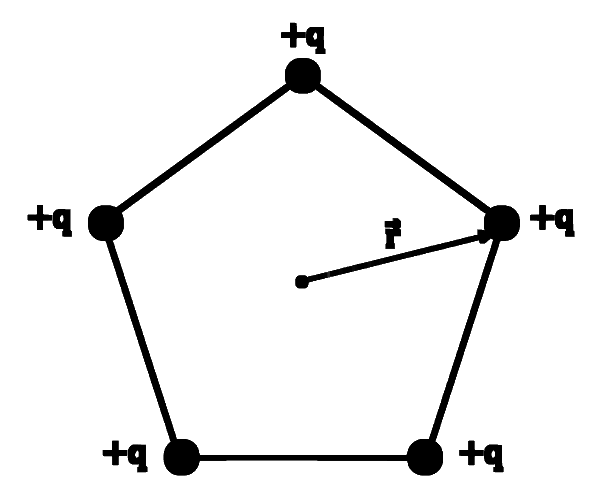
Five positive charges each having charge q are placed at the vertices of a pentagon as shown in the figure. The electric potential (V) and the electric field (E) at the center O of the pentagon due to these five positive charges are:
Electric Potential & Equipotentials · Spheres: concentric, connected & drops
Three small identical bubbles of water having same charge on each coalesce to form a bigger bubble. Then the ratio of the potentials on one initial bubble and that on the resultant bigger bubble is:
Electric Potential & Equipotentials · Equipotential surfaces
Which of the following statements is NOT TRUE?
a. Work done to move a charge on an equipotential surface is not zero.
b. Equipotential surfaces are the surfaces where the potential is constant.
c. Equipotential surfaces for a uniform electric field are parallel and equidistant from each other. d. Electric field is always perpendicular to an equipotential surface.
Electric Potential & Equipotentials · Potential of point charges
Four electric charges +q,+q,−q, and −q are placed in order at the corners of a square of side '2r'. The electric potential at a point midway between the two negative charges is
Electric Potential & Equipotentials · Potential of ring, sphere & shell
A semicircular arc of radius 'R' is charged uniformly and has charge per unit length as λ. The electric potential V at the centre of curvature is [ε0 = permittivity of vacuum]
Electric Potential & Equipotentials · Potential of ring, sphere & shell
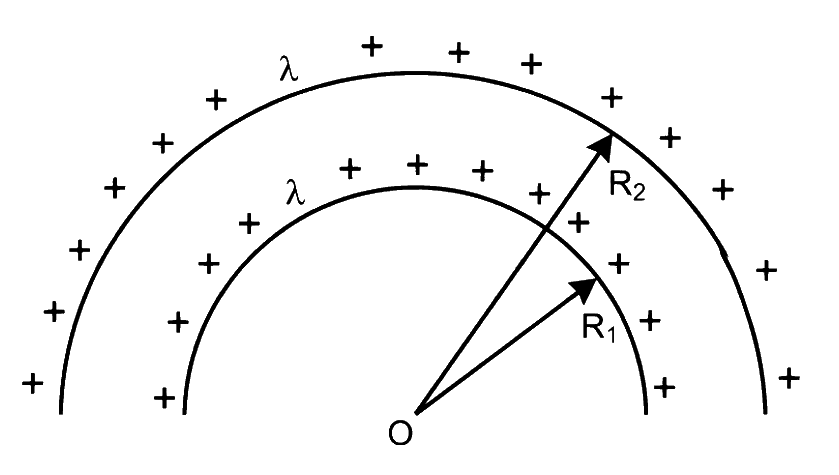
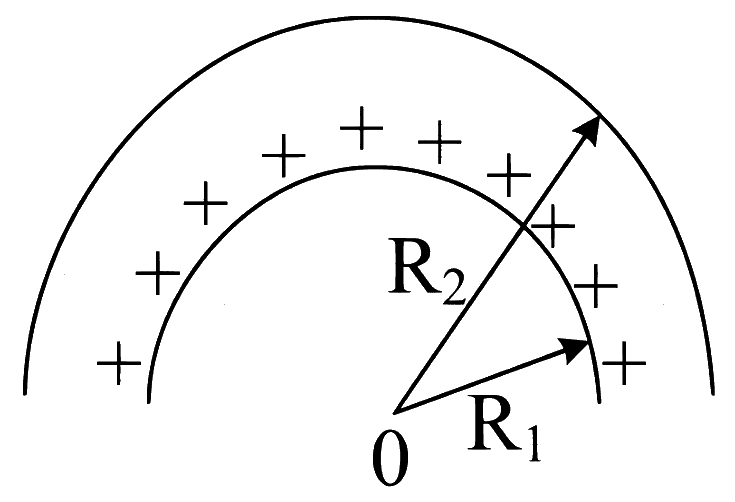
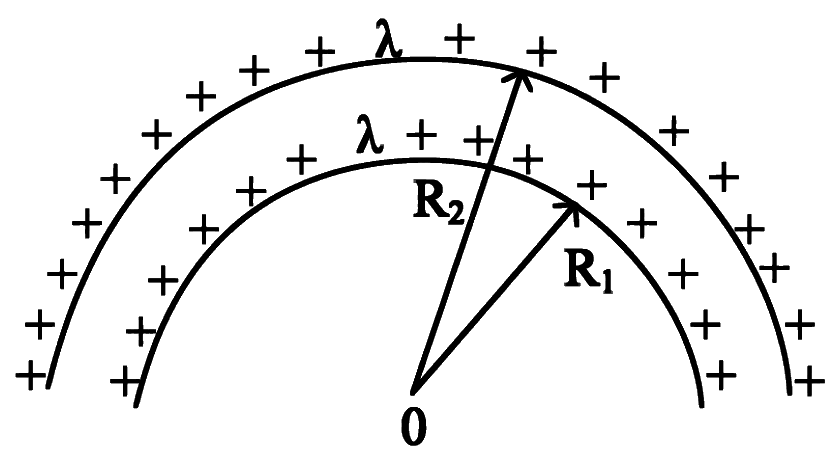
The electric potential at the center of two concentric half rings of radii R1 and R2, having same linear charge density λ is (ϵ0 = permittivity of free space)
Electric Potential & Equipotentials · Potential of ring, sphere & shell
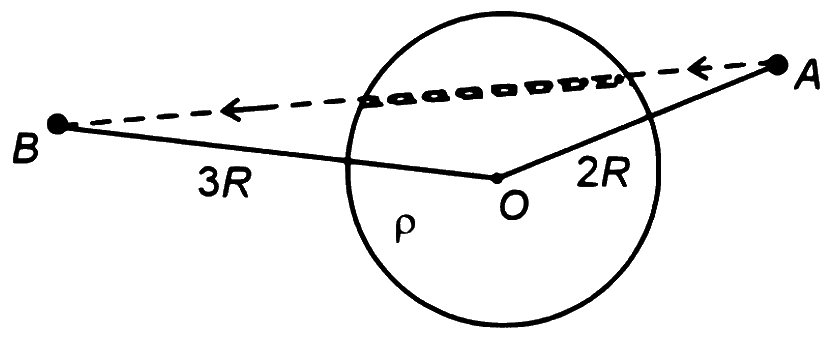
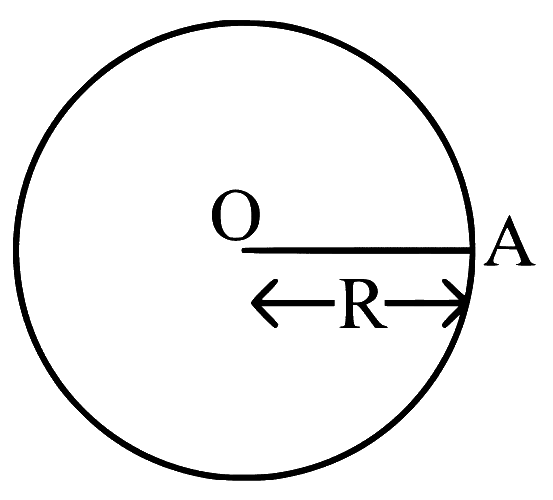
A unit positive point charge is taken slowly through an infinitesimally thin tube that is inside a charged dielectric sphere of radius R, having uniform positive charge density ρ, as shown in the figure. The initial and final positions of the charge are marked by A and B at distance 2R and 3R respectively, from the centre of the sphere. In this process, the magnitude of the total work done on the point charge is nε0ρR2. The value of n is: ( ε0 is the permittivity of vacuum)
Electric Potential & Equipotentials · Spheres: concentric, connected & drops
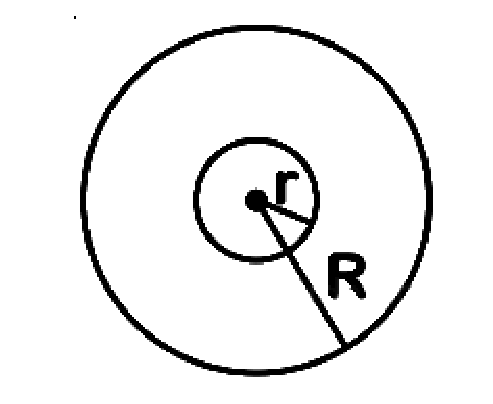
Two concentric spheres kept in air have radii R and r. They have similar charge and equal surface charge density σ. The electric potential at their common centre is (ϵ0 = permittivity of free space)
Electric Potential & Equipotentials · Spheres: concentric, connected & drops
A large insulated sphere of radius r, charged with Q C is placed in contact with a small insulated uncharged sphere of radius r1 and is then separated. The charge on the smaller sphere will now be
Electric Potential & Equipotentials · Spheres: concentric, connected & drops
Two isolated metallic spheres of radii R and 2R are charged such that both have the same charge density σ. The spheres are then connected by a thin conducting wire. If the new charge density of the larger sphere is σ1. The ratio σ1 to σ is
Electric Potential & Equipotentials · Spheres: concentric, connected & drops
Two metal sphere of radius R and 3R have same surface charge density σ. If they are brought in contact and then separated, the surface charge density on smaller and bigger sphere becomes σ1 and σ2, respectively. The ratio σ2σ1 is.
Electric Potential & Equipotentials · Spheres: concentric, connected & drops
Two charged conducting spheres S1 and S2 of radii 8 cm and 18 cm are connected to each other by a wire. After equilibrium is established, the ratio of electric fields on S1 and S2 spheres are ES1 and ES2 respectively. The value of ES2ES1 is ________.
Electric Potential & Equipotentials · Relation between E and V
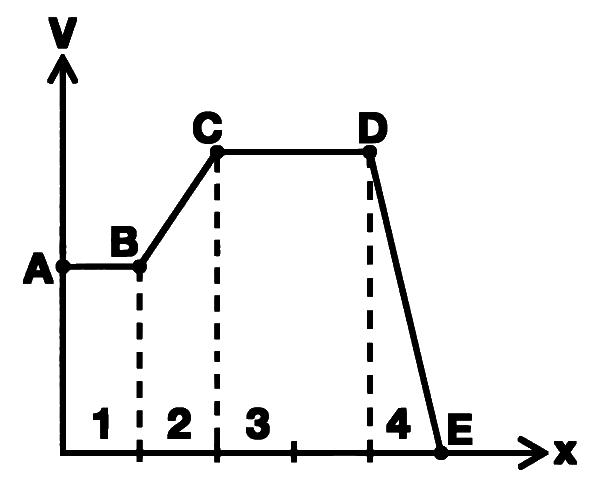
Following figure indicates the electric potential V as a function through 4 regions on x-axis. Which of the following is correct for the electric field E in these regions?
Electric Potential & Equipotentials · Relation between E and V
Electric field in a region is given by E=Axi^+Byj^, where A=10 V/m2 and B=5 V/m2. If the electric potential at a point (10,20) is 500 V, then the electric potential at origin is ______ V.
Electric Potential & Equipotentials · Spheres: concentric, connected & drops
Three concentric metallic spherical shells of radii R,3R and 9R are given charges Q1,Q2 and Q3, respectively. It is found that surface charge densities on the outer surfaces of the shells are equal. Then the ratio of charges given to shells Q1:Q2:Q3, is (Neglect the induction effects)
Electric Potential & Equipotentials · Spheres: concentric, connected & drops
There are three concentric conducting spherical shells A,B and C of radii a,b and c respectively ( c>b>a) and they are charged with charge q1,q2 and q3 respectively. The potentials of the spheres A,B and C respectively, are:
Electric Potential & Equipotentials · Relation between E and V
The electrostatic potential in a charged spherical region of radius r varies as V=ar3+b, where a and b are constants. The total charge in the sphere of unit radius is α×πaϵ0. The value of α is ______. (permittivity of vacuum is ϵ0)
Electric Potential & Equipotentials · Potential of ring, sphere & shell
A conducting sphere of radius ' R ' is given a charge ' Q ' uniformly. The electric field and the electric potential at the centre of the sphere are respectively [ ε0= permittivity of free space]
Electric Potential & Equipotentials · Potential of ring, sphere & shell
The electrostatic potential on the surface of uniformly charged spherical shell of radius R=10 cm is 120 V. The potential at the centre of shell, at a distance r=5 cm from centre, and at a distance r=15 cm from the centre of the shell respectively, are:
Electric Potential & Equipotentials · Spheres: concentric, connected & drops
Assuming the drops to be spherical, 27 identical drops of mercury are charged simultaneously to the same potential of 20 volt. If all the charged drops are made to combine to form one big drop, then potential of big drop will be
Electric Potential & Equipotentials · Spheres: concentric, connected & drops
' n ' identical small spherical drops of water, each of radius ' r ' and charged to the same potential ' v ' are combined to form a big drop. The potential of a big drop is
Electric Potential & Equipotentials · Potential of point charges
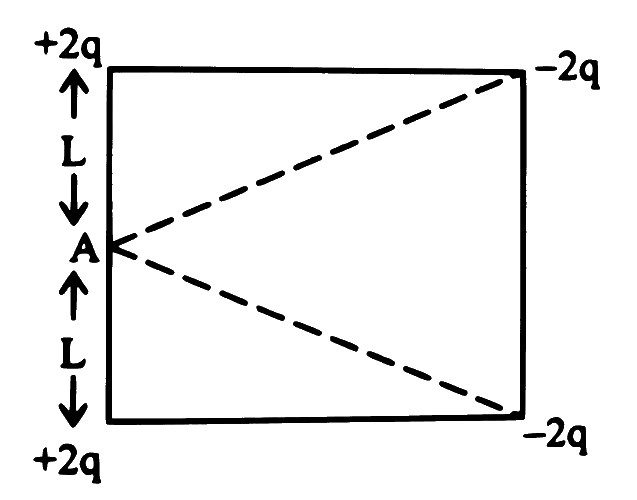
The electric charges ' +2q ', ' +2q ', ' −2q ' and ' −2q ' are placed at the corners of square of side ' 2 L ' as shown in figure. The electric potential at point 'A', midway between the two charges ' +2q ' and ' +2q ' is
Electric Potential & Equipotentials · Spheres: concentric, connected & drops
Two metal spheres of radius R and 3R have same surface charge density σ. If they are brought in contact and then separated, the surface charge density on smaller and bigger sphere becomes σ1 and σ2, respectively. The ratio σ2σ1 is
Electric Potential & Equipotentials · Relation between E and V
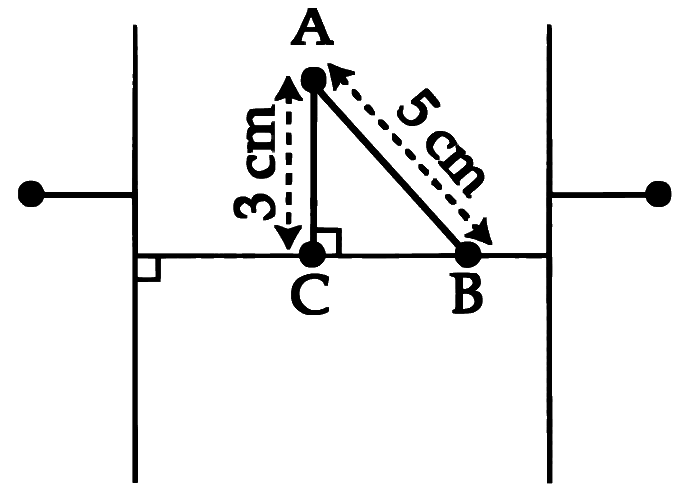
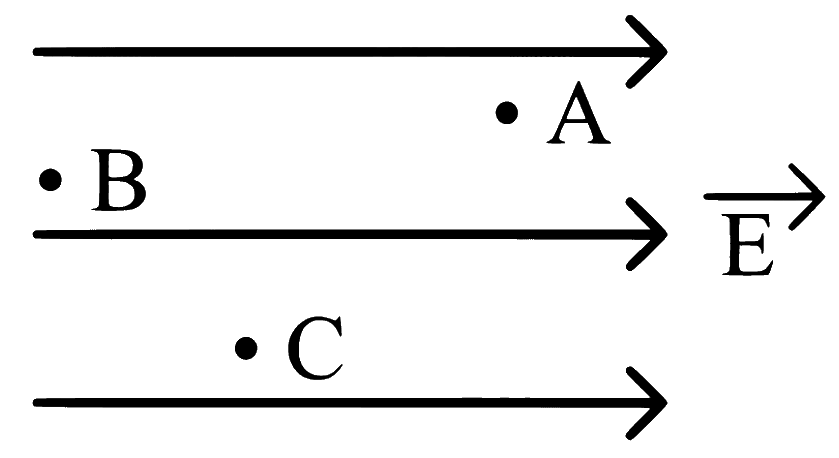
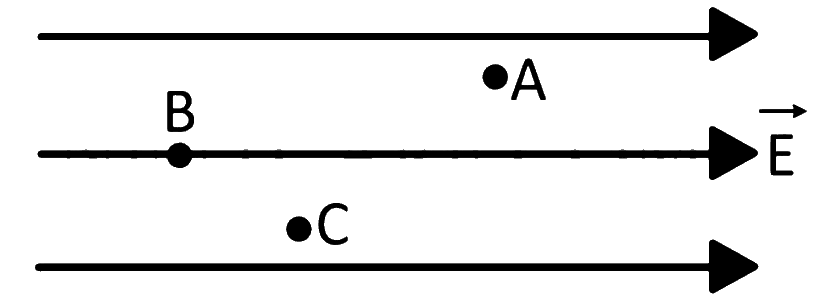
Two large plane parallel conducting plates are kept 10 cm apart as shown in figure. The potential difference between them is V. The potential difference between the points A and B (shown in the figure) is:
Electric Potential & Equipotentials · Equipotential surfaces
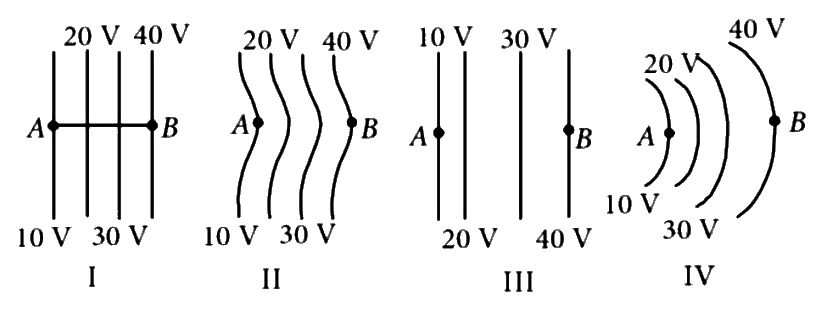
Three infinitely long wires with linear charge density λ are placed along the x-axis,y-axis and z- axis respectively. Which of the following denotes an equipotential surface?
Electric Potential & Equipotentials · Spheres: concentric, connected & drops
Three concentric charged metallic spherical sheets A,B and C have radii a,b,c potentials VA,VB,VC and charge densities +σ,−σ and +σ respectively. The value of potential VA is ( ε0= permittivity of free space)
Electric Potential & Equipotentials · Potential of point charges
Four point charges each +q is placed on the circumference of a circle of diameter 2 d in such a way that they form a square. The potential at the centre is proportional to
Electric Potential & Equipotentials · Potential of point charges
An electric charge 10−6μC is placed at origin (0,0) m of X−Y co-ordinate system. Two points P and Q are situated at (3,3) m and (6,0) m respectively. The potential difference between the points P and Q will be:
Electric Potential & Equipotentials · Spheres: concentric, connected & drops
Two charged conducting spheres of radii a and b are connected to each other by a conducting wire. The ratio of charges of the two spheres respectively is:
Electric Potential & Equipotentials · Equipotential surfaces
Given below are two statements: one is labelled as Assertion (A) and the other is labelled as Reason (R).
Assertion (A): Work done by electric field on moving a positive charge on an equipotential surface is always zero.
Reason (R): Electric lines of forces are always perpendicular to equipotential surfaces. In the light of the above statements, choose the most appropriate answer from the options given below:
Electric Potential & Equipotentials · Potential of point charges
Four electric charges +q,+q,−q and -q are placed in order at the corners of a square of side 2 L. The electric potential at point midway between the two positive charges is
Electric Potential & Equipotentials · Potential of ring, sphere & shell
The electric potential at the centre of two concentric half rings of radii R1 and R2, having same linear charge density ' λ ' is (ε0= permittivity of free space)
Electric Potential & Equipotentials · Spheres: concentric, connected & drops
A metallic sphere ' A ' isolated from ground is charged to +50μC. This sphere is brought in contact with other isolated metallic sphere ' B ' of half the radius of sphere ' A '. Then the charge on the two isolated spheres A \& B are in the ratio
Electric Potential & Equipotentials · Relation between E and V
The electrostatic potential inside a charged spherical ball is given by V=ar2+b where ' r ' is the distance from its centre and ' a ' and ' b ' are constants. The volume charge density of the ball is [ ε0= permittivity of free space ]
Electric Potential & Equipotentials · Potential of ring, sphere & shell
If a conducting sphere of radius R is charged. Then the electric field at a distance r(r>R) from the centre of the sphere would be, (V= potential on the surface of the sphere)
Electric Potential & Equipotentials · Potential of ring, sphere & shell
For a uniformly charged thin spherical shell, the electric potential (V) radially away from the centre (O) of shell can be graphically represented as -
Electric Potential & Equipotentials · Potential of ring, sphere & shell
Which of the following correctly represents the variation of electric potential (V) of a charged spherical conductor of radius (R) with radial distance (r) from the center?
Electric Potential & Equipotentials · Relation between E and V
When a charge of 3 C is placed in uniform electric field, it experiences a force of 3000 N. Within this field, potential difference between two points separated by a distance of 1 cm is
Electric Potential & Equipotentials · Potential of ring, sphere & shell
For a charged spherical ball, electrostatic potential inside the ball varies with r as V=2ar2+b. Here, a and b are constant and r is the distance from the center. The volume charge density inside the ball is −λaε. The value of λ is ____________.
ε = permittivity of the medium
Numerical answer type. Work it out, then open the answer.
Electric Potential & Equipotentials · Spheres: concentric, connected & drops
A charged spherical conductor of radius 'R' is connected momentarily to another uncharged spherical conductor of radius 'r' by means of a thin conducting wire, then the ratio of the surface charge density of the first to the second conductor is
Electric Potential & Equipotentials · Spheres: concentric, connected & drops
Two isolated metallic solid spheres of radii R and 2R are charged such that both have same charge density σ. The spheres are then connected by a thin conducting wire. If the new charge density of the bigger sphere is σ′. The ratio σσ′ is:
Electric Potential & Equipotentials · Relation between E and V
Assume that an electric field E=30x2i^ exists in space. If 'V0' is the potential at the origin and 'VA' is the potential at x=2 m, then the potential difference (VA−V0) is
Electric Potential & Equipotentials · Spheres: concentric, connected & drops
Three concentric spherical metallic shells X, Y and Z of radius a, b and c respectively [a < b < c] have surface charge densities σ,−σ and σ respectively. The shells X and Z are at same potential. If the radii of X & Y are 2 cm and 3 cm, respectively. The radius of shell Z is _________ cm.
Numerical answer type. Work it out, then open the answer.
Electric Potential & Equipotentials · Spheres: concentric, connected & drops
Two uniformly charged spherical conductors A and B of radii 5 mm and 10 mm are separated by a distance of 2 cm. If the spheres are connected by a conducting wire, then in equilibrium condition, the ratio of the magnitudes of the electric fields at the surface of the sphere A and B will be:
Electric Potential & Equipotentials · Spheres: concentric, connected & drops
Sixty four conducting drops each of radius 0.02 m and each carrying a charge of 5 μC are combined to form a bigger drop. The ratio of surface charge density of bigger drop to the smaller drop will be:
Electric Potential & Equipotentials · Spheres: concentric, connected & drops
512 identical drops of mercury are charged to a potential of 2V each. The drops are joined to form a single drop. The potential of this drop is ________ V.
Numerical answer type. Work it out, then open the answer.
Electric Potential & Equipotentials · Zero-potential points
Four electric charges +q,+q,−q and −q are placed in order at the corners of a square of side 2L. The electric potential at point midway between the two positive charges is
Electric Potential & Equipotentials · Potential of ring, sphere & shell
A uniformly charged half ring of a radius ' R ' has linear charge density 'σ'. The electric potential at the centre of the half ring is ( ϵ0= permittivity of free space)
Electric Potential & Equipotentials · Potential of ring, sphere & shell
The two thin coaxial rings, each of radius 'a' and having charges +Q and −Q respectively are separated by a distance of 's'. The potential difference between the centres of the two rings is:
Electric Potential & Equipotentials · Spheres: concentric, connected & drops
Two charged metallic spheres are joined by a very thin metal wire. If the radius of the larger sphere is four times that of the smaller sphere, the electric field near the larger sphere is
Electric Potential & Equipotentials · Spheres: concentric, connected & drops
Two spherical conductors of radii 4 cm and 5 cm are charged to the same potential. If 'σ1' and 'σ2' be the respective values of the surface density of charge on the two conductors then the ratio σ1:σ2 is
Electric Potential & Equipotentials · Spheres: concentric, connected & drops
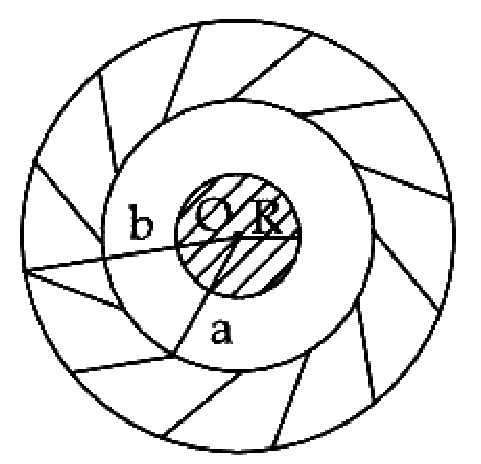
A solid metal sphere of radius R having charge q is enclosed inside the concentric spherical shell of inner radius a and outer radius b as shown in the figure. The approximate variation of electric field E as a function of distance r from centre O is given by
Electric Potential & Equipotentials · Relation between E and V
A charged spherical conductor has radius 'r'. The potential difference between its surface and 3 point at a distance '3r' from the centre is 'v' The electric intensity at a distance '3r' from the centre of the conductor is
Electric Potential & Equipotentials · Relation between E and V
A hollow metal sphere has a radius 'r'. The potential difference between a point on its surface and at a point at a distance '3r' from its centre is 'V'. The electric intensity at the distance '3r' from the centre of the sphere will be:
Electric Potential & Equipotentials · Relation between E and V
A hollow charged metal sphere has radius 'R'. If the potential difference between its surface and a point at a distance '5 R' from the centre is V, then magnitude of electric field Intensity at a distance '5R' from the centre of sphere is
Electric Potential & Equipotentials · Potential of ring, sphere & shell
The variation of electrostatic potential with radial distance r from the centre of a positively charged metallic thin shell of radius R is given by the graph
Electric Potential & Equipotentials · Relation between E and V
In a certain region of space with volume 0.2 m3, the electric potential is found to be 5 V throughout. The magnitude of electric field in this region is:
Electric Potential & Equipotentials · Spheres: concentric, connected & drops
Concentric metallic hollow spheres of radii R and 4R hold charges Q1 and Q2 respectively. Given that surface charge densities of the concentric spheres are equal, the potential difference V(R) – V(4R) is:
Electric Potential & Equipotentials · Spheres: concentric, connected & drops
Two isolated conducting spheres S1 and S2 of radius 32R and 31R have 12 μC and –3 μC charges, respectively, and are at a large distance from each other. They are now connected by a conducting wire. A long time after this is done the charges on S1 and S2 are respectively:
Electric Potential & Equipotentials · Spheres: concentric, connected & drops
A charge Q is distributed over two concentric conducting thin spherical shells radii r and R (R > r). If the surface charge densities on the two shells are equal, the electric potential at the common centre is:
Electric Potential & Equipotentials · Spheres: concentric, connected & drops
Consider two charged metallic spheres S1 and S2 of radii R1 and R2, respectively. The electric fields E1 (on S1) and E2 (on S2) on their surfaces are such that E1/E2 = R1/R2. Then the ratio V1 (on S1) / V2 (on S2) of the electrostatic potentials on each sphere is:
Electric Potential & Equipotentials · Potential of ring, sphere & shell
A solid conducting sphere, having a charge Q, is surrounded by an uncharged conducting hollow spherical shell. Let the potential difference between the surface of the solid sphere and that of the outer surface of the hollow shell be V. If the shell is now given a charge of –4 Q, the new potential difference between the same two surfaces is:
Electric Potential & Equipotentials · Spheres: concentric, connected & drops
Two metal spheres, one of radius R and the other of radius 2R respectively have the same surface charge density σ. They are brought in contact and separated. What will be the new surface charge densities on them?
Electric Potential & Equipotentials · Spheres: concentric, connected & drops
A charge Q is distributed over three concentric spherical shells of radii a, b, c (a < b < c) such that their surface charge densities are equal to one another. The total potential at a point at distance r from their common centre, where r < a, would be -
Electric Potential & Equipotentials · Relation between E and V
The electric field in a region is given by E=(Ax+B)i^, where E is in NC–1 and x is in metres. The values of constants are A = 20 SI unit and B = 10 SI unit. If the potential at x = 1 is V1 and that at x = –5 is V2, then V1 – V2 is :-
Electric Potential & Equipotentials · Spheres: concentric, connected & drops
Three concentric metal shells A, B and C of respective radii a, b and c (a < b < c) have surface charge densities +σ,−σ and +σ respectively. The potential of shell B is:
Electric Potential & Equipotentials · Relation between E and V
There is a uniform electrostatic field in a region. The potential at various points on a small sphere centred at P, in the region, is found to vary between the limits 589.0 V to 589.8 V. What is the potential at a point on the sphere whose radius vector makes an angle of 60o with the direction of the field?
Electric Potential & Equipotentials · Relation between E and V
The potential (in volts) of a charge distribution is given by.
V(z) = 30 − 5z2 for ∣z∣≤ 1 m.
V(z) = 35 − 10 ∣z∣ for ∣z∣≥1 m.
V(z) does not depend on x and y. If this potential is generated by a constant charge per unit volume ρ0 (in units of ε0) which is spread over a certain region, then choose the correct statement.
Electric Potential & Equipotentials · Equipotential surfaces
Within a spherical charge distribution of charge density ρ(r), N equipotential surfaces of potential V0, V0 + ΔV, V0 + 2ΔV, .......... V0 + NΔV (Δ V > 0), are drawn and have increasing radii r0, r1, r2,..........rN, respectively. If the difference in the radii of the surfaces is constant for all values of V0 and ΔV then:
Q105JEE Main 2015 · (One or more correct)Difficult
Electric Potential & Equipotentials · Equipotential surfaces
A uniformly charged solid sphere of radius R has potential V0 (measured with respect to ∞) on its surface. For this sphere the equipotential surfaces with potentials 23V0,45V0,43V0 and 4V0 have radius R1,R2,R3 and R4 respectively. Then
Electric Potential & Equipotentials · Relation between E and V
In a region, the potential is represented by V(x, y, z) = 6x − 8xy − 8y + 6yz, where V is in volts and x, y, z are in metres. The electric force experienced by a charge of 2 coulomb situated at point (1, 1, 1) is
Electric Potential & Equipotentials · Relation between E and V
Assume that an electric field E=30x2i^ exists in space. Then the potential difference VA−VO, where VO is the potential at the origin and VA the potential at x=2 m is:
Electric Potential & Equipotentials · Potential of ring, sphere & shell
A point charge of magnitude +1μC is fixed at (0, 0, 0). An isolated uncharged spherical conductor, is fixed with its center at (4, 0, 0). The potential and the induced electric field at the centre of the sphere is:
Electric Potential & Equipotentials · Potential of ring, sphere & shell
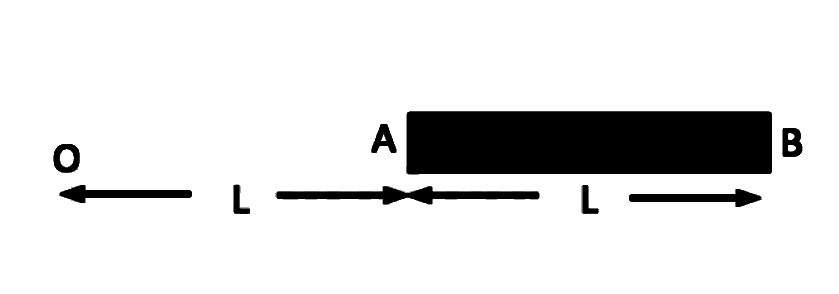
A charge Q is uniformly distributed over a long rod AB of length L as shown in the figure. The electric potential at the point O lying at distance L from the end A is
Electric Potential & Equipotentials · Zero-potential points
Four point charges −Q, −q, 2q and 2Q are placed, one at each corner of the square. The relation between Q and q for which the potential at the centre of the square is zero is
Electric Potential & Equipotentials · Spheres: concentric, connected & drops
Two metallic spheres of radii 1 cm and 3 cm are given charges of−1× 10⁻² C and 5 × 10⁻² C, respectively. If these are connected by a conducting wire, the final charge on the bigger sphere is
Electric Potential & Equipotentials · Relation between E and V
The electric potential V at any point (x, y, z), all in metres in space is given by V = 4x2 volt. The electric field at the point (1, 0, 2) in volt/meter, is
Electric Potential & Equipotentials · Potential of point charges
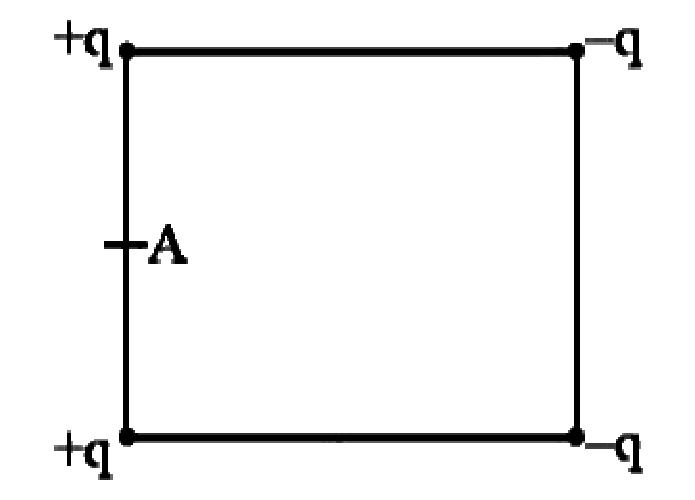
Four electric charges +q, +q, − q and − q are placed at the corners of a square of side 2L (see figure). The electric potential at point A, midway between the two charges + q and +q, is
Electric Potential & Equipotentials · Relation between E and V
The electrostatic potential inside a charged spherical ball is given by ϕ=ar2+b where r is the distance from the center and a,b are constants. Then the charge density inside the ball is:
Electric Potential & Equipotentials · Spheres: concentric, connected & drops
Three concentric spherical shells have radii a, b and c (a < b < c) and have surface charge densities σ,−σ and σ respectively. If VA, VB and VC denote the potentials of the three shells, then, for c = a + b, we have
Electric Potential & Equipotentials · Potential of point charges
An electric charge 10−3μC is placed at the origin (0,0) of X−Y co-ordinate system. Two points A and B are situated at (2,2) and (2,0) respectively. The potential difference between the points A and B will be
Electric Potential & Equipotentials · Spheres: concentric, connected & drops
Two spherical conductors A and B of radii 1 mm and 2 mm are separated by a distance of 5 cm and are uniformly charged. If the spheres are connected by a conducting wire then in equilibrium condition, the ratio of the magnitude of the electric fields at the surfaces of spheres A and B is
Electric Potential & Equipotentials · Potential of ring, sphere & shell
Two thin wire rings each having a radius R are placed at a distance d apart with their axes coinciding. The charges on the two rings are +q and −q. The potential difference between the centres of the two rings is
Electric Potential & Equipotentials · Potential of ring, sphere & shell
A thin spherical conducting shell of radius R has a charge q. Another charge Q is placed at the center of the shell. The electrostatic potential at a point P at a distance 2R from the center of the shell is
Electric Potential & Equipotentials · Spheres: concentric, connected & drops
Two metallic spheres of radii 1 cm and 2 cm are given charges 10−2 C and 5×10⁻² C respectively. If they are connected by a conducting wire, the final charge on the smaller sphere is