
Gas Laws & Ideal Gas Equation · Gas laws & ideal gas equation
At constant temperature, the volume of a gas is to be decreased by 4%. The pressure must be increased by
Show answer and solution
Answer: (b)
Loading the solution…
Home›Practice Hub›Chapters›Thermodynamics›Gas Laws & Ideal Gas Equation
Thermodynamics PYQs · MHT CET · JEE Main · NEET
Gas Laws & Ideal Gas Equation · Gas laws & ideal gas equation
At constant temperature, the volume of a gas is to be decreased by 4%. The pressure must be increased by
Answer: (b)
Gas Laws & Ideal Gas Equation · Gas laws & ideal gas equation
A balloon contains m of He at C and atmospheric pressure. Then, volume of He at C and atmospheric pressure will be
Answer: (b)
Gas Laws & Ideal Gas Equation · Gas laws & ideal gas equation
The pressure of a given mass of a gas is decreased by at constant temperature, then its volume will
Answer: (d)
Gas Laws & Ideal Gas Equation · Gas laws & ideal gas equation
An ideal gas is heated from C to C at constant pressure. If initial volume of gas is m, then the new volume of the gas will be
Answer: (a)
Gas Laws & Ideal Gas Equation · Gas laws & ideal gas equation
A gas of certain mass filled in a closed cylinder at a pressure of 3.23 kPa has temperature . The gas is now heated to double its temperature. The modified pressure is ______ Pa.
Numerical answer type. Work it out, then open the answer.
Answer: 3730
Gas Laws & Ideal Gas Equation · Gas laws & ideal gas equation
The gas in a vessel is subjected to a pressure of atm. at C. Now half of the gas is released from the vessel and the temperature is raised by C. The pressure of a gas in a vessel is nearly
Answer: (c)
Gas Laws & Ideal Gas Equation · Gas laws & ideal gas equation
At a pressure P and temperature T, 7 gram of oxygen occupies a volume V. The equation of state will be (Molecular weight of Oxygen )
Answer: (d)
Gas Laws & Ideal Gas Equation · Gas laws & ideal gas equation
A vessel has gram of hydrogen at pressure and temperature K. A small hole is made in it so that hydrogen leaks out. How much hydrogen leaks out if the final pressure is and the temperature falls to K?
Answer: (d)
Gas Laws & Ideal Gas Equation · Gas laws & ideal gas equation
When 300 J of heat given to an ideal gas with its temperature raises from to keeping its volume constant. The mass of the gas is (approximately) ______ g.
Numerical answer type. Work it out, then open the answer.
Answer: 481
Gas Laws & Ideal Gas Equation · Gas laws & ideal gas equation
An insulated cylinder of volume is filled with a gas at and 2 atmospheric pressure. Then the gas is compressed making the final volume as while allowing the temperature to rise to . The final pressure is ______ atmospheric pressure.
Numerical answer type. Work it out, then open the answer.
Answer: 7
Gas Laws & Ideal Gas Equation · Number of molecules & density
At C, the value of density of a fixed mass of a gas (ideal) divided by its pressure is . At C this ratio is
Answer: (d)
Gas Laws & Ideal Gas Equation · Number of molecules & density
Gas at pressure P, temperature T, and volume V is filled in jar A. Another jar B is filled with gas having parameters . The ratio of number of molecules of jar B to those of jar A is
Answer: (b)
Gas Laws & Ideal Gas Equation · Number of molecules & density
An ideal gas at pressure 'P' and temperature 'T' is enclosed in a vessel of volume 'V'. Some gas leaks through a hole from the vessel and the pressure of the enclosed gas falls to . Assuming that the temperature of the gas remains constant during the leakage, the number of moles of the gas that have leaked is
Answer: (b)
Gas Laws & Ideal Gas Equation · Number of molecules & density
An air bubble of volume rises from the bottom of a swimming pool of 5 m deep. At the bottom of the pool water temperature is . The volume of the bubble when it reaches the surface, where the water temperature is , is .
( , density of water , and 1 atm pressure is )
Answer: (d)
Gas Laws & Ideal Gas Equation · Gas mixtures & connected vessels
A mixture of carbon dioxide and oxygen has volume 8310 cm3, temperature 300 K, pressure 100 kPa and mass 13.2 g. The number of moles of carbon dioxide and oxygen gases in the mixture respectively are ______.
(Assume both carbon dioxide and oxygen gases behave like ideal gases) [R = 8.31 J/mol K]
Answer: (c)
Gas Laws & Ideal Gas Equation · Gas laws & ideal gas equation
Two closed vessels of same volume are joined through a narrow tube and both vessels are filled with air of pressure 90 kPa and temperature 400 K. Keeping the temperature of one vessel constant at 400 K the second vessel temperature is raised to 500 K. The final pressure in the vessels is ______ kPa.
Answer: (a)
Gas Laws & Ideal Gas Equation · Gas laws & ideal gas equation
A balloon is filled at and 1 atmospheric pressure by volume helium gas. At and 0.5 atmospheric pressure, the volume of helium gas will be
Answer: (c)
Gas Laws & Ideal Gas Equation · Gas laws & ideal gas equation
The volume of given mass of a gas is decreased by at constant temperature. The pressure should be increased by
Answer: (c)
Gas Laws & Ideal Gas Equation · Gas laws & ideal gas equation
How much should the pressure be increased in order to reduce the volume of a given mass of gas by at the constant temperature?
Answer: (c)
Gas Laws & Ideal Gas Equation · Gas laws & ideal gas equation
A tyre of a vehicle is filled with air having pressure 270 kPa at . The air pressure in the tyre when the temperature increases to is
Answer: (d)
Gas Laws & Ideal Gas Equation · Gas laws & ideal gas equation
The helium and argon are put in the flask at the same room temperature (300 K). The ratio of average kinetic energies (per molecule) of helium and argon is:
(Give: Molar mass of helium = 4 g/mol, Molar mass of argon = 40 g/mol)
Answer: (d)
Gas Laws & Ideal Gas Equation · Gas laws & ideal gas equation
Pressure of an ideal gas, contained in a closed vessel, is increased by when heated by . Its initial temperature must be:
Answer: (d)
Gas Laws & Ideal Gas Equation · Gas laws & ideal gas equation
A container of fixed volume contains a gas at 27°C. To double the pressure of the gas, the temperature of gas should be raised to _____ °C.
Numerical answer type. Work it out, then open the answer.
Answer: 327
Gas Laws & Ideal Gas Equation · Gas laws & ideal gas equation
When the pressure of the gas contained in a closed vessel is increased by , the temperature of the gas increases by 4 K. The initial temperature of the gas is
Answer: (c)
Gas Laws & Ideal Gas Equation · Gas laws & ideal gas equation
An oxygen cylinder of volume 30 litre has 18.20 moles of oxygen. After some oxygen is withdrawn from the cylinder, its gauge pressure drops to 11 atmospheric pressures at temperature . The mass of the oxygen withdrawn from the cylinder is nearly equal to:
[Given, , and molecular mass of atm pressure ]
Answer: (a)
Gas Laws & Ideal Gas Equation · Number of molecules & density
The pressure ' P ', volume ' V ' and temperature ' T ' of a gas in a jar ' ' and the gas in other jar ' ' is at pressure ' 2 P ', volume ' ' and temperature ' '. Then the ratio of the number of molecules in jar A and jar B will be
Answer: (b)
Gas Laws & Ideal Gas Equation · Number of molecules & density
For an ideal gas, the density of the gas is when temperature and pressure of the gas are and respectively. when the temperature of the gas is , its pressure becomes . The new density will be
Answer: (d)
Gas Laws & Ideal Gas Equation · Number of molecules & density
An ideal gas at pressure ' P ' and temperature ' T ' is enclosed in a vessel of volume ' '. Some gas leaks through a hole from the vessel and the pressure of the enclosed gas falls to ' '. Assuming that the temperature of the gas remains constant during the leakage, the number of moles of the gas that have leaked is
Answer: (b)
Gas Laws & Ideal Gas Equation · Gas mixtures & connected vessels
A container has two chambers of volumes litres and litres separated by a partition made of a thermal insulator. The chambers contain and moles of ideal gas at pressures and , respectively. When the partition is removed, the mixture attains an equilibrium pressure of
Answer: (d)
Gas Laws & Ideal Gas Equation · Gas mixtures & connected vessels
There are two vessels filled with an ideal gas where volume of one is double the volume of other. The large vessel contains the gas at 8 kPa at 1000 K while the smaller vessel contains the gas at 7 kPa at 500 K. If the vessels are connected to each other by a thin tube allowing the gas to flow and the temperature of both vessels is maintained at 600 K, at steady state the pressure in the vessels will be (in kPa ).
Answer: (d)
Gas Laws & Ideal Gas Equation · Gas laws & ideal gas equation
Temperature remaining constant, the pressure of gas is decreased by . The percentage change in volume is
Answer: (c)
Gas Laws & Ideal Gas Equation · Gas laws & ideal gas equation
A gas is contained in closed vessel. The initial temperature of the gas is . If the pressure of the gas is increased by , the increase in the temperature of the gas is
Answer: (a)
Gas Laws & Ideal Gas Equation · Gas laws & ideal gas equation
A sample of oxygen gas and a sample of hydrogen gas both have the same mass, same volume and the same pressure. The ratio of their absolute temperature is (Molecular wt. of is 32 and 2 respectively)
Answer: (c)
Gas Laws & Ideal Gas Equation · Gas laws & ideal gas equation
The following graph represents the curves of an ideal gas (where is the temperature and the volume) at three pressures and compared with those of Charles's law represented as dotted lines.
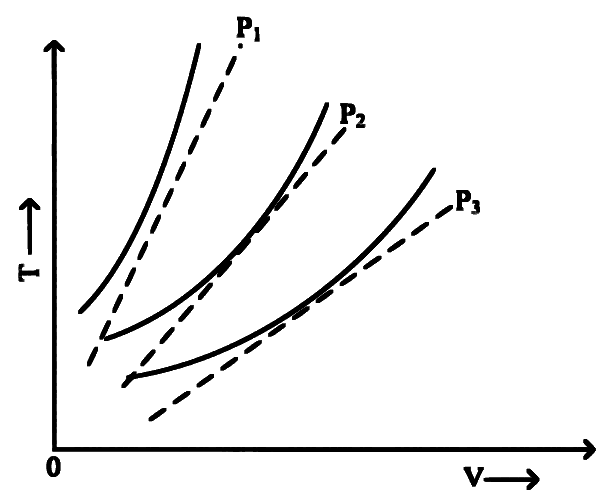
Then the correct relation is:
Answer: (d)
Gas Laws & Ideal Gas Equation · Gas laws & ideal gas equation
P-T diagram of an ideal gas having three different densities (in three different cases) is shown in the figure. Which of the following is correct:
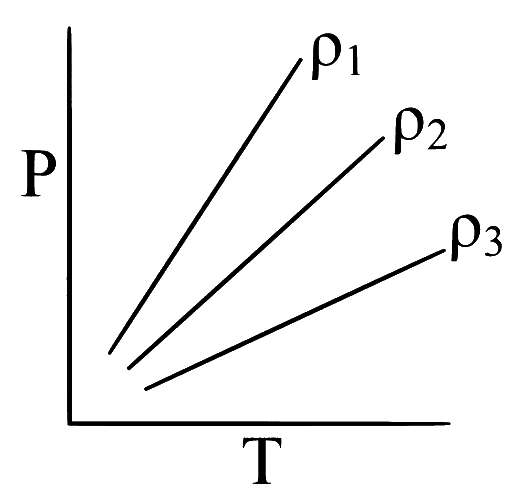
Answer: (a)
Gas Laws & Ideal Gas Equation · Number of molecules & density
The temperature of a gas having molecules per cubic meter at (Given, ) is:
Answer: (a)
Gas Laws & Ideal Gas Equation · Gas mixtures & connected vessels
Two vessels separately contain two ideal gases A and B at the same temperature, pressure of A being twice that of B. Under such conditions, the density of A is found to be 1.5 times the density of . The ratio of molecular weights of and is
Answer: (c)
Gas Laws & Ideal Gas Equation · Gas mixtures & connected vessels
Two vessels and are of the same size and are at same temperature. A contains of hydrogen and contains of oxygen. and are the pressures of the gases in and respectively, then is:
Answer: (d)
Gas Laws & Ideal Gas Equation · Gas laws & ideal gas equation
At constant temperature, increasing the pressure of a gas by its volume will decrease by
Answer: (d)
Gas Laws & Ideal Gas Equation · Gas laws & ideal gas equation
Which one of the following represents correctly the variation of volume (V) of an ideal gas with temperature under constant pressure conditions?
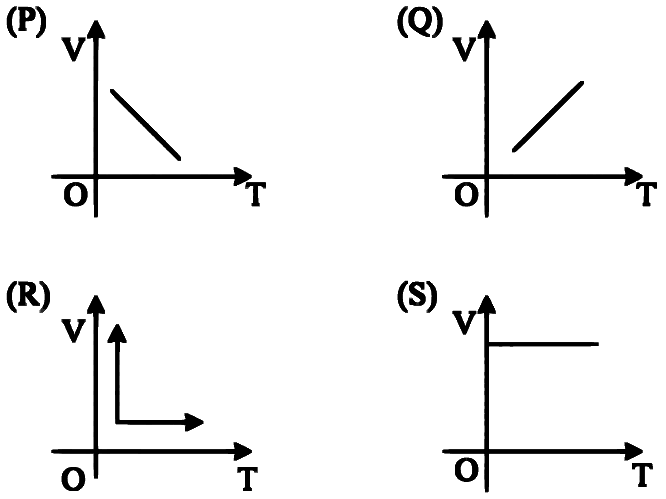
Answer: (b)
Gas Laws & Ideal Gas Equation · Gas laws & ideal gas equation
According to Boyle's law, the product PV remains constant. The unit of is same as that of
Answer: (a)
Gas Laws & Ideal Gas Equation · Gas laws & ideal gas equation
A bicycle tyre is filled with air having pressure of at . The approximate pressure of the air in the tyre when the temperature increases to is
Answer: (d)
Gas Laws & Ideal Gas Equation · Number of molecules & density
For three low density gases A, B, C pressure versus temperature graphs are plotted while keeping them at constant volume, as shown in the figure.
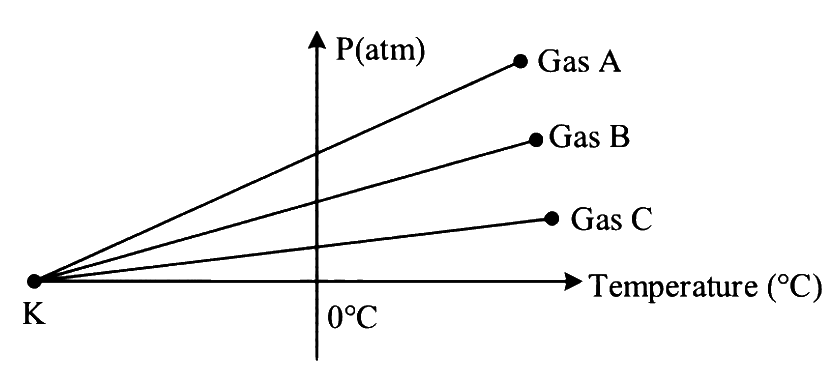
The temperature corresponding to the point '' is:
Answer: (a)
Gas Laws & Ideal Gas Equation · Gas laws & ideal gas equation
A sample of oxygen gas and a sample of hydrogen gas both have the same mass, same volume and the same pressure. The ratio of their absolute temperature is
Answer: (d)
Gas Laws & Ideal Gas Equation · Gas laws & ideal gas equation
A container of volume contains 0.2 mole of hydrogen gas and 0.3 mole of argon gas. The pressure of the system at temperature () will be :-
Answer: (d)
Gas Laws & Ideal Gas Equation · Gas laws & ideal gas equation
The correct relation between and temperature T is:
Answer: (d)
Gas Laws & Ideal Gas Equation · Gas laws & ideal gas equation
The pressure and temperature ( relationship of an ideal gas obeys the equation constant. The volume expansion coefficient of the gas will be:
Answer: (d)
Gas Laws & Ideal Gas Equation · Number of molecules & density
For an ideal gas the density of the gas is when temperature and pressure of the gas are and respectively. When the temperature of the gas is , its pressure will be . The new density will be
Answer: (a)
Gas Laws & Ideal Gas Equation · Number of molecules & density
We have a jar filled with gas characterized by parameters and another jar B filled with gas having parameters , where symbols have their usual meaning. The ratio of number of molecules in jar A to those in jar B is
Answer: (d)
Gas Laws & Ideal Gas Equation · Number of molecules & density
A jar '' is filled with gas having pressure, volume and temperature respectively. Another gas jar filled with a gas having pressure , volume and temperature . The ratio of the number of molecules in jar to those in jar is
Answer: (d)
Gas Laws & Ideal Gas Equation · Gas laws & ideal gas equation
When a gas filled in a closed vessel is heated by raising the temperature by 1C, its pressure increases by 0.4%. The initial temperature of the gas is ___________ K.
Numerical answer type. Work it out, then open the answer.
Answer: 250
Gas Laws & Ideal Gas Equation · Gas laws & ideal gas equation
The volume occupied by the molecules contained in 4.5 kg water at STP, if the intermolecular forces vanish away is
Answer: (d)
Gas Laws & Ideal Gas Equation · Gas laws & ideal gas equation
A vessel contains 16g of hydrogen and 128g of oxygen at standard temperature and pressure. The volume of the vessel in cm3 is:
Answer: (c)
Gas Laws & Ideal Gas Equation · Gas laws & ideal gas equation
A cylinder of fixed capacity of 44.8 litres contains helium gas at standard temperature and pressure. The amount of heat needed to raise the temperature of gas in the cylinder by 20.0C will be: (Given gas constant R = 8.3 JK-mol)
Answer: (c)
Gas Laws & Ideal Gas Equation · Gas laws & ideal gas equation
For a perfect gas, two pressures P1 and P2 are shown in figure. The graph shows:
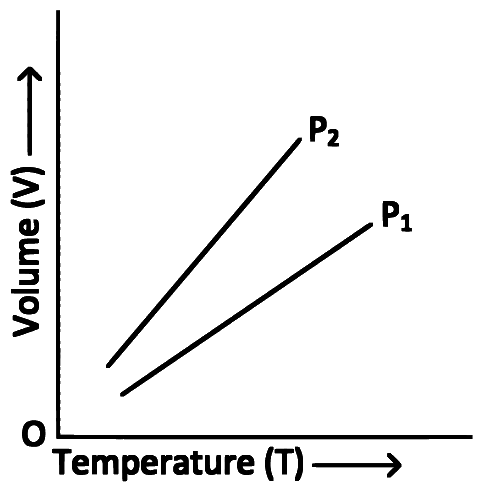
Answer: (a)
Gas Laws & Ideal Gas Equation · Gas mixtures & connected vessels
A mixture of hydrogen and oxygen has volume 2000 cm3, temperature 300 K, pressure 100 kPa and mass 0.76 g. The ratio of number of moles of hydrogen to number of moles of oxygen in the mixture will be:
[Take gas constant R = 8.3 JKmol]
Answer: (b)
Gas Laws & Ideal Gas Equation · Gas laws & ideal gas equation
A balloon carries a total load of 185 kg at normal pressure and temperature of 27C. What load will the balloon carry on rising to a height at which the barometric pressure is 45 cm of Hg and the temperature is C. Assuming the volume constant?
Answer: (d)
Gas Laws & Ideal Gas Equation · Gas laws & ideal gas equation
An ideal gas is expanding such that PT3 = constant. The coefficient of volume expansion of the gas is:
Answer: (c)
Gas Laws & Ideal Gas Equation · Gas laws & ideal gas equation
Which of the following graphs represent the behavior of an ideal gas? Symbols have their usual meaning.
Answer: (c)
Gas Laws & Ideal Gas Equation · Gas mixtures & connected vessels
A mixture of hydrogen and oxygen has volume 500 cm3, temperature 300 K, pressure 400 kPa and mass 0.76 g. The ratio of masses of oxygen to hydrogen will be :-
Answer: (c)
Gas Laws & Ideal Gas Equation · Gas mixtures & connected vessels
A cylindrical container of volume 4.0 103 m3 contains one mole of hydrogen and two moles of carbon dioxide. Assume the temperature of the mixture is 400 K. The pressure of the mixture of gases is:
[Take gas constant as 8.3 J mol K]
Answer: (c)
Gas Laws & Ideal Gas Equation · Gas mixtures & connected vessels
A container is divided into two chambers by a partition. The volume of first chamber is 4.5 litre and second chamber is 5.5 litre. The first chamber contain 3.0 moles of gas at pressure 2.0 atm and second chamber contain 4.0 moles of gas at pressure 3.0 atm. After the partition is removed and the mixture attains equilibrium, then, the common equilibrium pressure existing in the mixture is x 101 atm. Value of x is ________.
Numerical answer type. Work it out, then open the answer.
Answer: 25
Gas Laws & Ideal Gas Equation · Gas laws & ideal gas equation
For an ideal gas the instantaneous change in pressure 'p' with volume 'v' is given by the equation . If p = p0 at v =0 is the given boundary condition, then the maximum temperature one mole of gas can attain is: (Here R is the gas constant)
Answer: (a)
Gas Laws & Ideal Gas Equation · Gas laws & ideal gas equation
The average thermal energy for a mono-atomic gas is: (kB is Boltzmann constant and T absolute temperature)
Answer: (a)
Gas Laws & Ideal Gas Equation · Gas laws & ideal gas equation
An ideal gas equation can be written as
where and are respectively,
Answer: (d)
Gas Laws & Ideal Gas Equation · Number of molecules & density
A cylinder contains hydrogen gas at pressure 249 kPa and temperature 27C
Its density is: (R = 8.3 J mol-1 K-1)
Answer: (a)
Gas Laws & Ideal Gas Equation · Gas laws & ideal gas equation
The change in the magnitude of the volume of an ideal gas when a small additional pressure P is applied at a constant temperature, is the same as the change when the temperature is reduced by a small quantity T at constant pressure. The initial temperature and pressure of the gas were 300 K and 2 atm. respectively.
If |T| = C|P| then value of C in (K/atm.) is _________.
Numerical answer type. Work it out, then open the answer.
Answer: 150
Gas Laws & Ideal Gas Equation · Gas laws & ideal gas equation
The equation of state for 2 g of oxygen at a pressure ' ' and temperature ' , when occupying a volume ' ' will be
Answer: (c)
Gas Laws & Ideal Gas Equation · Gas laws & ideal gas equation
A cylinder with fixed capacity of 67.2 lit contains helium gas at STP. The amount of heat needed to raise the temperature of the gas by 20°C is: [Given that R = 8.31 J mol–1 K–1]
Answer: (c)
Gas Laws & Ideal Gas Equation · Gas laws & ideal gas equation
An ideal gas occupies a volume of 2m3 at a pressure of 3 106 Pa. The energy of the gas is:
Answer: (b)
Gas Laws & Ideal Gas Equation · Number of molecules & density
The temperature of an open room of volume 30 m3 increases from 17oC to 27oC due to the sunshine. The atmospheric pressure in the room remains 1 105 Pa. If Ni and Nf are the number of molecules in the room before and after heating, then Nf – Ni will be:
Answer: (d)
Gas Laws & Ideal Gas Equation · Number of molecules & density
A given sample of an ideal gas occupies a volume V at a pressure P and absolute temperature T. The mass of each molecule of the gas is m. Which of the following gives the density of the gas?
Answer: (b)
Gas Laws & Ideal Gas Equation · Number of molecules & density
Which of the following shows the correct relationship between the pressure ‘P’ and density of an ideal gas at constant temperature?
Answer: (d)
Gas Laws & Ideal Gas Equation · Gas mixtures & connected vessels
Two vessels separately contain two ideal gases A and B at the same temperature, the pressure of A being twice that of B. Under such conditions, the density of A is found to be 1.5 times the density of B. The ratio of molecular weight of A and B is
Answer: (d)
Gas Laws & Ideal Gas Equation · Number of molecules & density
Modern vacuum pumps can evacuate a vessel down to a pressure of 4.0 1015 atm. at room temperature (300 K). Taking R = 8.3 JK mole, 1 atm = 105 Pa and NAvogadro = 6 1023 mole, the mean distance between molecules of gas in an evacuated vessel will be of the order of:
Answer: (b)
Gas Laws & Ideal Gas Equation · Gas laws & ideal gas equation
In the given (V T) diagram, what is the relation between pressure P1 and P2?
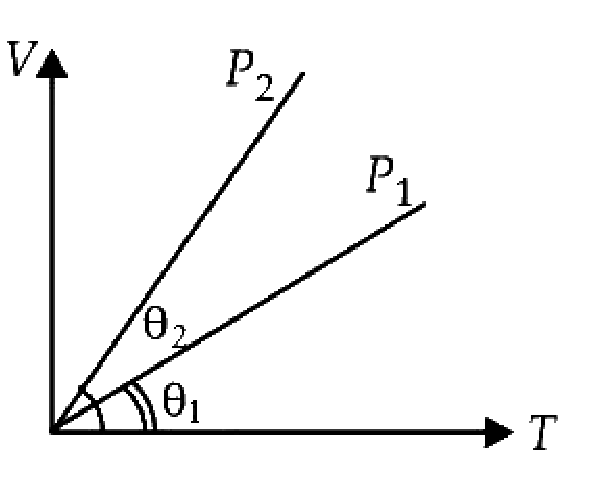
Answer: (a)
Gas Laws & Ideal Gas Equation · Gas laws & ideal gas equation
The amount of heat energy required to raise the temperature of 1 g of Helium at NTP, from T1K to T2K is
Answer: (c)
Gas Laws & Ideal Gas Equation · Gas laws & ideal gas equation
A thin tube sealed at both ends is 100 cm long. It lies horizontally, the middle 20 cm containing mercury and two equal ends containing air at standard atmospheric pressure. If the tube is now turned to a vertical position, by what amount will the mercury be displaced?
(Given: cross-section of the tube can be assumed to be uniform)
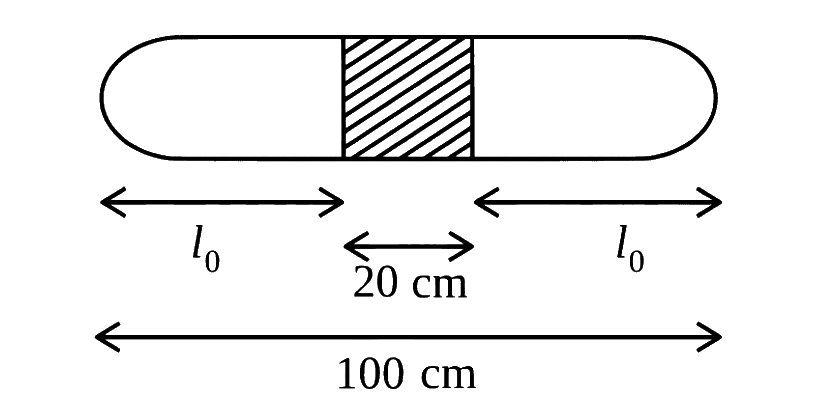
Answer: (b)
Gas Laws & Ideal Gas Equation · Number of molecules & density
At 10oC the value of the density of a fixed mass of an ideal gas divided by its pressure is x. At 110oC this ratio is
Answer: (b)
Gas Laws & Ideal Gas Equation · Gas mixtures & connected vessels
An insulated container of gas has two chambers separated by an insulating partition. One of the chambers has volume and contains ideal gas at pressure and temperature . The other chamber has volume and contains ideal gas at pressure and temperature . If the partition is removed without doing any work on the gas, the final equilibrium temperature of the gas in the container will be
Answer: (a)
Gas Laws & Ideal Gas Equation · Gas laws & ideal gas equation
The equation of state for 5 g of oxygen at a pressure P and temperature T, when occupying a volume V, will be
(where R is the gas constant)
Answer: (a)
Gas Laws & Ideal Gas Equation · Gas mixtures & connected vessels
Two thermally insulated vessels and are filled with air at temperatures volume and pressure respectively. If the valve joining the two vessels is opened, the temperature inside the vessel at equilibrium will be
Answer: (a)
Gas Laws & Ideal Gas Equation · Gas laws & ideal gas equation
The gases carbon-monoxide (CO) and nitrogen at the same temperature have kinetic energies and respectively. Then
Answer: (a)
Gas Laws & Ideal Gas Equation · Gas laws & ideal gas equation
Relation between pressure () and energy () of a gas is
Answer: (a)
Gas Laws & Ideal Gas Equation · Gas laws & ideal gas equation
For hydrogen gas and for oxygen gas , so the relation between and is given by
Answer: (d)
Gas Laws & Ideal Gas Equation · Gas mixtures & connected vessels
Two containers and are partly filled with water and closed. The volume of is twice that of and it contains half the amount of water in . If both are at the same temperature, the water vapour in the containers will have pressure in the ratio of
Answer: (b)
No questions match these filters.