
Specific Heats of Gases - Cp, Cv, γ & Mayer's Relation
The molar specific heat at constant pressure of an ideal gas is . The gas is made up of molecules which are
Show answer and solution
Answer: (c)
Loading the solution…
Home›Practice Hub›Chapters›Thermodynamics›Specific Heats of Gases - Cp, Cv, γ & Mayer's Relation
Thermodynamics PYQs · MHT CET · JEE Main · NEET
Specific Heats of Gases - Cp, Cv, γ & Mayer's Relation
The molar specific heat at constant pressure of an ideal gas is . The gas is made up of molecules which are
Answer: (c)
Specific Heats of Gases - Cp, Cv, γ & Mayer's Relation
For a gas, if the ratio of specific heats at constant pressure and volume is then the value of degree of freedom is
Answer: (b)
Specific Heats of Gases - Cp, Cv, γ & Mayer's Relation
The ratio of to for a non-rigid diatomic gas is
Answer: (d)
Specific Heats of Gases - Cp, Cv, γ & Mayer's Relation
According to law of equipartition of energy the molar specific heat of a non rigid diatomic gas at constant volume is
Answer: (d)
Specific Heats of Gases - Cp, Cv, γ & Mayer's Relation
For a gas, where R is the universal gas constant and is the molar specific heat at constant volume. The gas is made up of molecules which are
Answer: (d)
Specific Heats of Gases - Cp, Cv, γ & Mayer's Relation
The difference between two molar specific heats of a gas is J-kg-K . If the ratio of two specific heats of gas is , the molar specific heat of the gas at constant pressure in J-kg -K is
Answer: (c)
Specific Heats of Gases - Cp, Cv, γ & Mayer's Relation
Let be the ratio of molar specific heat at constant pressure and molar specific heat at constant volume of a mono-atomic gas and be the similar ratio of diatomic gas. Considering the diatomic gas molecule as a rigid rotator, the ratio, is
Answer: (c)
Specific Heats of Gases - Cp, Cv, γ & Mayer's Relation
An ideal gas is made of polyatomic molecules. Each of the molecules has three translational, three rotational and number of vibrational modes. If the ratio of heat capacities of the gas is , then the value of is:
Answer: (b)
Specific Heats of Gases - Cp, Cv, γ & Mayer's Relation
For ideal non-rigid diatomic gas, the value of is nearly
Answer: (c)
Specific Heats of Gases - Cp, Cv, γ & Mayer's Relation
The molar specific heat of an ideal gas at constant pressure and constant volume is ' ' and ' ' respectively. If ' R ' is a universal gas constant and the ratio of ' ' to ' ' is , then ' ' is equal to
Answer: (c)
Specific Heats of Gases - Cp, Cv, γ & Mayer's Relation
For a diatomic gas, if for rigid molecules and for another diatomic molecules, but also having vibrational modes. Then, which one of the following options is correct? (Cp and Cv are specific heats of the gas at constant pressure and volume)
Answer: (a)
Specific Heats of Gases - Cp, Cv, γ & Mayer's Relation
is the specific heat ratio of monoatomic gas A having 3 translational degrees of freedom. is the specific heat ratio of polyatomic gas having 3 translational, 3 rotational degrees of freedom and 1 vibrational mode. If , then the value of is ________.
Numerical answer type. Work it out, then open the answer.
Answer: 3
Specific Heats of Gases - Cp, Cv, γ & Mayer's Relation
The ratio of the specific heats , in terms of degrees of freedom ( n) is
Answer: (b)
Specific Heats of Gases - Cp, Cv, γ & Mayer's Relation
For a gas, where R is the universal gas constant and ' ' is molar specific heat at constant volume. The gas is made up of molecules which are
Answer: (a)
Specific Heats of Gases - Cp, Cv, γ & Mayer's Relation
If and are molar specific heats of an ideal gas at constant pressure and volume respectively and ' ' is then ( universal gas constant)
Answer: (a)
Specific Heats of Gases - Cp, Cv, γ & Mayer's Relation
According to the law of equipartition of energy the molar specific heat of a diatomic gas at constant volume where the molecule has one additional vibrational mode is
Answer: (d)
Specific Heats of Gases - Cp, Cv, γ & Mayer's Relation
According to the law of equipartition of energy, the number of vibrational modes of a polyatomic gas of constant is ( and are the specific heat capacities of the gas at constant pressure and constant volume, respectively):
Answer: (c)
Specific Heats of Gases - Cp, Cv, γ & Mayer's Relation
A mixture of one mole of monoatomic gas and one mole of a diatomic gas (rigid) are kept at room temperature . The ratio of specific heat of gases at constant volume respectively is:
Answer: (b)
Specific Heats of Gases - Cp, Cv, γ & Mayer's Relation
Two moles of a monoatomic gas is mixed with six moles of a diatomic gas. The molar specific heat of the mixture at constant volume is:
Answer: (d)
Specific Heats of Gases - Cp, Cv, γ & Mayer's Relation
If three moles of monoatomic gas is mixed with two moles of a diatomic gas , the value of adiabatic exponent for the mixture is
Answer: (b)
Specific Heats of Gases - Cp, Cv, γ & Mayer's Relation
The specific heat of argon at constant pressure and constant volume are and respectively. It's density ' ' at N.T.P. will be and T are pressure and temperature respectively at N.T.P.]
Answer: (a)
Specific Heats of Gases - Cp, Cv, γ & Mayer's Relation
The specific heat at constant pressure of a real gas obeying equation is:
Answer: (c)
Specific Heats of Gases - Cp, Cv, γ & Mayer's Relation
Four moles of hydrogen, two moles of helium and one mole of water vapour form an ideal gas mixture. for hydrogen for helium for water vapour What is the molar specific heat at constant pressure of the mixture?
Answer: (b)
Specific Heats of Gases - Cp, Cv, γ & Mayer's Relation
For polyatomic gases, the ratio of molar specific heat at constant pressure to constant volume is ( degrees of freedom)
Answer: (d)
Specific Heats of Gases - Cp, Cv, γ & Mayer's Relation
The molar specific heat of an ideal gas at constant pressure and constant volume is and respectively. If is universal gas constant and then
Answer: (d)
Specific Heats of Gases - Cp, Cv, γ & Mayer's Relation
For a gas, , where is universal gas constant and is molar specific heat at constant volume. The gas is made up of molecules which are
Answer: (a)
Specific Heats of Gases - Cp, Cv, γ & Mayer's Relation
For a gas having '' degrees of freedom, '' is ( ratio of specific heats )
Answer: (c)
Specific Heats of Gases - Cp, Cv, γ & Mayer's Relation
Let be the ratio of molar specific heat at constant pressure and molar specific heat at constant volume of a monoatomic gas and be the similar ratio of diatomic gas. Considering the diatomic gas molecule as a rigid rotator, the ratio is
Answer: (c)
Specific Heats of Gases - Cp, Cv, γ & Mayer's Relation
According to law of equipartition of energy the molar specific heat of a diatomic gas at constant volume where the molecule has one additional vibrational mode is :-
Answer: (d)
Specific Heats of Gases - Cp, Cv, γ & Mayer's Relation
Let be the ratio of molar specific heat at constant pressure and molar specific heat at constant volume of a monoatomic gas and be the similar ratio of diatomic gas. Considering the diatomic gas molecule as a rigid rotator, the ratio, is:
Answer: (b)
Specific Heats of Gases - Cp, Cv, γ & Mayer's Relation
A gas has degrees of freedom. The ratio of specific heat of gas at constant volume to the specific heat of gas at constant pressure will be:
Answer: (a)
Specific Heats of Gases - Cp, Cv, γ & Mayer's Relation
The ratio of specific heats in terms of degree of freedom (f) is given by:
Answer: (b)
Specific Heats of Gases - Cp, Cv, γ & Mayer's Relation
One mole of a monoatomic gas is mixed with three moles of a diatomic gas. The molecular specific heat of mixture at constant volume is ; then the value of will be _________. (Assume that the given diatomic gas has no vibrational mode).
Numerical answer type. Work it out, then open the answer.
Answer: 3
Specific Heats of Gases - Cp, Cv, γ & Mayer's Relation
The amount of heat needed to raise the temperature of 4 moles of rigid diatomic gas from 0 C to 50 C when no work is done is ___________. (R is the universal gas constant).
Answer: (a)
Specific Heats of Gases - Cp, Cv, γ & Mayer's Relation
Which one of the following is NOT a correct expression for an ideal gas?
[ Molar specific heat of a gas at constant pressure,
Molar specific heat of a gas at constant volume,
Ratio of two specific heats of a gas,
Universal gas constant]
Answer: (a)
Specific Heats of Gases - Cp, Cv, γ & Mayer's Relation
For an ideal gas, . This suggests that the gas consists of molecules, which are [ universal gas constant]
Answer: (c)
Specific Heats of Gases - Cp, Cv, γ & Mayer's Relation
For a gas molecule with 6 degrees of freedom, which one of the following relation between gas constant '' and molar specific heat '' is correct?
Answer: (a)
Specific Heats of Gases - Cp, Cv, γ & Mayer's Relation
The molar specific heats of an ideal gas at constant pressure and volume are denoted by '' and '' respectively. If and '' is universal gas constant, then is equal to
Answer: (a)
Specific Heats of Gases - Cp, Cv, γ & Mayer's Relation
Specific heats of an ideal gas at constant pressure and volume are denoted by and respectively. If and it's the universal gas constant then is equal to
Answer: (d)
Specific Heats of Gases - Cp, Cv, γ & Mayer's Relation
The correct relation between the degrees of freedom f and the ratio of specific heat is:
Answer: (a)
Specific Heats of Gases - Cp, Cv, γ & Mayer's Relation
For a gas CP CV = R in a state P and CP CV = 1.10 R in a state Q, TP and TQ are the temperatures in two different states P and Q respectively. Then
Answer: (d)
Specific Heats of Gases - Cp, Cv, γ & Mayer's Relation
If one mole of the polyatomic gas is having two vibrational modes and is the ratio of molar specific heats for polyatomic gas then the value of is:
Answer: (c)
Specific Heats of Gases - Cp, Cv, γ & Mayer's Relation
A polyatomic ideal gas has 24 vibrational modes. What is the value of ?
Answer: (c)
Specific Heats of Gases - Cp, Cv, γ & Mayer's Relation
For a gas, , where is universal gas constant and is the molar specific heat at constant volume. The gas is made up of molecules, which are
Answer: (b)
Specific Heats of Gases - Cp, Cv, γ & Mayer's Relation
Match the ratio for ideal gases with different type of molecules:
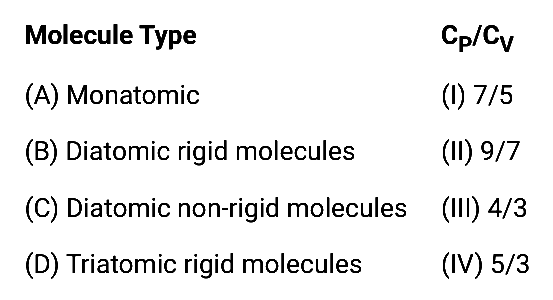
Answer: (c)
Specific Heats of Gases - Cp, Cv, γ & Mayer's Relation
Consider two ideal diatomic gases A and B at some temperature T. Molecules of the gas A are rigid, and have a mass m. Molecules of the gas B have an additional vibrational mode, and have a mass . The ratio of the specific heats ( and ) of gas A and B, respectively is:
Answer: (b)
Specific Heats of Gases - Cp, Cv, γ & Mayer's Relation
Consider a mixture of n moles of helium gas and 2n moles of oxygen gas (molecules taken to be rigid) as an ideal gas. Its CP/CV value will be:
Answer: (d)
Specific Heats of Gases - Cp, Cv, γ & Mayer's Relation
Two moles of an ideal gas with are mixed with 3 moles of another ideal gas with . The value of for the mixture is:
Answer: (d)
Specific Heats of Gases - Cp, Cv, γ & Mayer's Relation
If ' ' and ' ' are molar specific heats of an ideal gas at constant pressure and volume respectively. If ' ' is the ratio of two specific heats and ' ' is universal gas constant then ' ' is equal to
Answer: (a)
Specific Heats of Gases - Cp, Cv, γ & Mayer's Relation
The value of , for hydrogen, helium and another ideal diatomic gas X (whose molecules are not rigid but have an additional vibrational mode), are respectively equal to,
Answer: (b)
Specific Heats of Gases - Cp, Cv, γ & Mayer's Relation
The specific heats, CP and CV of a gas of diatomic molecules, A, are given (in units of J mol–1 K–1) by 29 and 22, respectively. Another gas of diatomic molecules, B, has the corresponding values 30 and 21. If they are treated as ideal gases, then :-
Answer: (b)
Specific Heats of Gases - Cp, Cv, γ & Mayer's Relation
Two moles of helium gas is mixed with three moles of hydrogen molecules (taken to be rigid). What is the molar specific heat of mixture at constant volume? (R = 8.3 J/mol K)
Answer: (b)
Specific Heats of Gases - Cp, Cv, γ & Mayer's Relation
Two moles of helium are mixed with n moles of hydrogen. If for the mixture, then the value of n is:
Answer: (c)
Specific Heats of Gases - Cp, Cv, γ & Mayer's Relation
An ideal gas has molecules with 5 degrees of freedom. The ratio of specific heats at constant pressure (Cp) and at constant volume (Cv) is:
Answer: (d)
Specific Heats of Gases - Cp, Cv, γ & Mayer's Relation
CP and Cv are specific heats at constant pressure and constant volume respectively. It is observed that
CP – Cv = a for hydrogen gas
CP – Cv = b for nitrogen gas
The correct relation between a and b is
Answer: (d)
Specific Heats of Gases - Cp, Cv, γ & Mayer's Relation
The ratio of the specific heats in terms of degrees of freedom (n) is given by
Answer: (a)
Specific Heats of Gases - Cp, Cv, γ & Mayer's Relation
Using equipartition of energy, the specific heat (in J kg K) of aluminium at room temperature can be estimated to be (atomic weight of aluminium = 27)
Answer: (c)
Specific Heats of Gases - Cp, Cv, γ & Mayer's Relation
If cp and cv denote the specific heats (per unit mass of an ideal gas of molecular weight M, then
Answer: (c)
Specific Heats of Gases - Cp, Cv, γ & Mayer's Relation
If and denote the specific heats of nitrogen per unit mass at constant pressure and constant volume respectively, then
Answer: (b)
Specific Heats of Gases - Cp, Cv, γ & Mayer's Relation
The molar specific heat at constant pressure of an ideal gas is (7/2) R. The ratio of specific heat at constant pressure to that at constant volume is
Answer: (b)
Specific Heats of Gases - Cp, Cv, γ & Mayer's Relation
A gaseous mixture consists of of helium and of oxygen. The ratio of the mixture is
Answer: (a)
Specific Heats of Gases - Cp, Cv, γ & Mayer's Relation
One mole of ideal monatomic gas is mixed with one mole of diatomic gas . What is for the mixture? Denotes the ratio of specific heat at constant pressure, to that at constant volume
Answer: (c)
Specific Heats of Gases - Cp, Cv, γ & Mayer's Relation
1 mole of a gas with is mixed with mole of a gas with then the value of for the resulting mixture is
Answer: (c)
Specific Heats of Gases - Cp, Cv, γ & Mayer's Relation
If for a gas, , this gas is made up of molecules which are
Answer: (c)
Specific Heats of Gases - Cp, Cv, γ & Mayer's Relation
For a certain gas the ratio of specific heats is given to be . For this gas
Answer: (b)
No questions match these filters.