
Law of Radioactive Decay
A radioactive sample has half-life of years. The percentage of fraction decayed in years will be
Show answer and solution
Answer: (c)
Loading the solution…
Home›Practice Hub›Chapters›Nuclear Physics›Law of Radioactive Decay
Nuclear Physics PYQs · MHT CET · JEE Main · NEET
Law of Radioactive Decay
A radioactive sample has half-life of years. The percentage of fraction decayed in years will be
Answer: (c)
Law of Radioactive Decay
Activity of a radioactive sample decreases to of its original value in days. Then in days its activity will become
Answer: (a)
Law of Radioactive Decay
Activity of a radioactive sample decreases to of its original value in 4 days. Then in 16 days its activity will become times the original value. The value of is
Answer: (c)
Law of Radioactive Decay
A radioactive element has rate of disintegration disintegrations per minute at a particular instant. After four minutes, it becomes disintegrations per minute. The decay constant per minute is
Answer: (c)
Law of Radioactive Decay
Two different radioactive elements with half lives and have undecayed atoms and respectively, present at a given instant. The ratio of their activities at this instant is
Answer: (b)
Law of Radioactive Decay
Initially atoms are present in a radioactive sample. The half-life of the sample is 1 hour. The number of atoms that will decay in the time interval hour to hour, is
Answer: (c)
Law of Radioactive Decay
th The half-life of the isotope is 15 hr. How much time does it take for of a sample of this isotope to decay?
Answer: (a)
Law of Radioactive Decay
The activity of a radioactive sample is measured as counts per minute at time and counts per minute at time minute. The time (in minute) in which the activity reduces to half the value, is
Answer: (b)
Law of Radioactive Decay
A radioactive sample having activity has twice the number of nuclei as another sample of of activity . If then the ratio of half life of to the half life of is
Answer: (a)
Law of Radioactive Decay
Two radioactive substances and have decay constant and respectively. At , they have the same number of nuclei. The ratio of number of nuclei of to those of will be after a time interval
Answer: (d)
Law of Radioactive Decay
Two samples A and B contain equal amount of radioactive substances. If of sample A and of sample B, remain after 9 hours, then the ratio of half life period of B to that of A is
Answer: (c)
Law of Radioactive Decay
In an alpha decay, the daughter nucleus produced is itself unstable and undergoes further decay. If the number of parent and daughter nuclei at time are and respectively and their decay constants are and respectively. What condition needs to be satisfied in order for to remain constant?
Answer: (d)
Law of Radioactive Decay
A radioactive nucleus X with a half-life , decays into a nucleus Y. At , there is no nucleus Y. After some time '', the ratio of the number of Y to that of X is . Then, '' is
Answer: (b)
Law of Radioactive Decay
A radioactive element having half-life 30 min. is undergoing beta decay. The fraction of radioactive element remains undecayed after 90 min. will be
Answer: (c)
Law of Radioactive Decay
A radio active element has rate of disintegration 8000 disintegrations per minute at a particular instant. After four minutes it becomes 2000 disintegrations per minute. The decay constant per minute is
Answer: (c)
Law of Radioactive Decay
A radioactive element has rate of disintegration 9000 disintegration per minute at a particular instant. After two minutes it becomes 3000 disintegration per minute. The decay constant per minute is
Answer: (a)
Law of Radioactive Decay
The activity of radioactive sample is measured as counts per minute at time , and counts per minute at time minute, The activity reduces to half its value in time (in minute)
Answer: (b)
Law of Radioactive Decay
Two radioactive materials and having decay constant ' ' and ' ' respectively, initially have same number of nuclei. The time taken to have the ratio of number of nuclei of material B to that of A as ' e ' is
Answer: (b)
Law of Radioactive Decay
A radioactive nucleus has 3 times the decay constant as compared to the decay constant of another radioactive nucleus . If initial number of both nuclei are the same, what is the ratio of number of nuclei of to the number of nuclei of , after one half-life of ?
Answer: (a)
Law of Radioactive Decay
A radioactive material first decays into and then decays to non-radioactive material . Which of the following figure represents time dependent mass of and ?
Answer: (b)
Law of Radioactive Decay
A radioactive substance has half-life of 60 minutes. During 3 hours, the amount of substance decayed would be
Answer: (d)
Law of Radioactive Decay
Two radioactive substances A and B have decay constants ' ' and ' ' respectively. At , they have the same number of nuclei. The ratio of number of nuclei of to those of will be after a time interval
Answer: (d)
Law of Radioactive Decay
Half-lives of two radioactive elements A and B are 30 minute and 60 minute respectively. Initially the samples have equal number of nuclei. After 120 minute the ratio of decayed numbers of nuclei of to that of will be
Answer: (c)
Law of Radioactive Decay
If 'T' is the half life of a radioactive substance then its instantaneous rate of change of activity is proportional to
Answer: (b)
Law of Radioactive Decay
Half life of radio-active element is 1600 years. The fraction of sample remains undecayed after 6400 years will be
Answer: (a)
Law of Radioactive Decay
A radioactive sample has half-life of 5 years. The percentage of fraction decayed in 10 years will be
Answer: (c)
Law of Radioactive Decay
The half life of a radioactive substance is 20 minutes. In how much time, the activity of substance drops to th of its initial value?
Answer: (c)
Law of Radioactive Decay
The half-life of a radioactive nucleus is 5 years. The fraction of the original sample that would decay in 15 years is:
Answer: (c)
Law of Radioactive Decay
The half life of a radioactive substance is T. The time taken, for disintegrating th part of its original mass will be:
Answer: (b)
Law of Radioactive Decay
A radio active material is reduced to of its original amount in 3 days. If of the material is left after 5 days the initial amount of the material is
Answer: (b)
Law of Radioactive Decay
If a radioactive element having half-life of is undergoing beta decay, the fraction of radioactive element remains undecayed after . will be
Answer: (c)
Law of Radioactive Decay
In a radioactive disintegration, the ratio of initial number of atoms to the number of atoms present at time is [ decay constant]
Answer: (b)
Law of Radioactive Decay
Two different radioactive elements with half lives ' ' and '' have undecayed atoms ' ' and ' ' respectively present at a given instant. The ratio of their activities at that instant is
Answer: (c)
Law of Radioactive Decay
The decay constant for a radioactive nuclide is 1.5 10 s. Atomic weight of the substance is 60 g mole, (). The activity of 1.0 g of the substance is ___________ 10 Bq.
Numerical answer type. Work it out, then open the answer.
Answer: 15
Law of Radioactive Decay
Two radioactive elements A and B initially have same number of atoms. The half life of A is same as the average life of B. If and are decay constants of A and B respectively, then choose the correct relation from the given options.
Answer: (a)
Law of Radioactive Decay
A radioactive nucleus decays by two different processes. The half life of the first process is 5 minutes and that of the second process is . The effective half-life of the nucleus is calculated to be . The value of is __________.
Numerical answer type. Work it out, then open the answer.
Answer: 300
Law of Radioactive Decay
Substance A has atomic mass number 16 and half life of 1 day. Another substance B has atomic mass number 32 and half life of day. If both A and B simultaneously start undergo radio activity at the same time with initial mass 320 g each, how many total atoms of A and B combined would be left after 2 days.
Answer: (b)
Law of Radioactive Decay
Given below are two statements
Statement I: The law of radioactive decay states that the number of nuclei undergoing the decay per unit time is inversely proportional to the total number of nuclei in the sample. Statement II: The half-life of a radionuclide is the sum of the life time of all nuclei, divided by the initial concentration of the nuclei at time t = 0.
In the light of the above statements, choose the most appropriate answer from the options given below:
Answer: (c)
Law of Radioactive Decay
A radioactive sample decays times its original quantity in 15 minutes. The half-life of the sample is
Answer: (a)
Law of Radioactive Decay
The half life period of a radioactive substance is 60 days. The time taken for th of its original mass to disintegrate will be:
Answer: (c)
Law of Radioactive Decay
Following statements related to radioactivity are given below:
(A) Radioactivity is a random and spontaneous process and is dependent on physical and chemical conditions.
(B) The number of un-decayed nuclei in the radioactive sample decays exponentially with time. (C) Slope of the graph of loge (no. of undecayed nuclei) Vs. time represents the reciprocal of mean life time ().
(D) Product of decay constant () and half-life time (T1/2) is not constant.
Choose the most appropriate answer from the options given below:
Answer: (c)
Law of Radioactive Decay
The half life of a radioactive substance is 5 years. After x years a given sample of the radioactive substance gets reduced to 6.25% of its initial value. The value of x is ____________.
Numerical answer type. Work it out, then open the answer.
Answer: 20
Law of Radioactive Decay
The activity of a radioactive material is curie. Its half life is 5 days. The activity will become curie after:
Answer: (d)
Law of Radioactive Decay
What is the half-life period of a radioactive material if its activity drops to th of its initial value in 30 years?
Answer: (c)
Law of Radioactive Decay
The activity of a radioactive material is 2.56 103 Ci. If the half life of the material is 5 days, after how many days the activity will become 2 105 Ci?
Answer: (b)
Law of Radioactive Decay
A radioactive nucleus can decay by two different processes. Half-life for the first process is 3.0 hours while it is 4.5 hours for the second process. The effective half-life of the nucleus will be:
Answer: (d)
Law of Radioactive Decay
A freshly prepared radioactive source of half life 2 hours 30 minutes emits radiation which is 64 times the permissible safe level. The minimum time, after which it would be possible to work safely with source, will be _________ hours.
Numerical answer type. Work it out, then open the answer.
Answer: 15
Law of Radioactive Decay
The disintegration rate of a certain radioactive sample at any instant is 4250 disintegrations per minute. 10 minutes later, the rate becomes 2250 disintegrations per minute. The approximate decay constant is:
Take
Answer: (c)
Law of Radioactive Decay
At any instant, two elements X1 and X2 have same number of radioactive atoms. If the decay constant of X1 and X2 are 10 and respectively, then the time when the ratio of their atoms becomes respectively will be:
Answer: (c)
Law of Radioactive Decay
Two radioactive materials A and B have decay constants and respectively. If initially they have the same number of nuclei, then the ratio of the number of nuclei of B to that of A will be "e" after a time . The value of a is _________.
Numerical answer type. Work it out, then open the answer.
Answer: 9
Law of Radioactive Decay
A sample contains 102 kg each of two substances A and B with half lives 4 s and 8 s respectively. The ratio of their atomic weights is 1: 2. The ratio of the amounts of A and B after 16 s is . The value of x is ___________.
Numerical answer type. Work it out, then open the answer.
Answer: 25
Law of Radioactive Decay
A sample of radioactive element contains active nuclei. The halt-life of the element is 15 days. The number of nuclei decayed after 60 days is
Answer: (a)
Law of Radioactive Decay
The nuclear activity of a radioactive element becomes of its initial value in 30 years. The half- life of radioactive element is _____________ years.
Numerical answer type. Work it out, then open the answer.
Answer: 10
Law of Radioactive Decay
A radioactive substance decays to of its initial activity in 80 days. The half life of the radioactive substance expressed in days is ____________.
Numerical answer type. Work it out, then open the answer.
Answer: 20
Law of Radioactive Decay
A radioactive sample disintegrates via two independent decay processes having half lives and respectively. The effective half-life T1/2 of the nuclei is:
Answer: (c)
Law of Radioactive Decay
The half life of a radioactive substance is 30 minute. The time taken between 40% decay and 85% decay of the same radioactive substance is
Answer: (c)
Law of Radioactive Decay
The half life of a radioactive nuclide is 100 hours. The fraction of original activity that will remain after 150 hours would be:
Answer: (c)
Law of Radioactive Decay
There are 1010 radioactive nuclei in a given radioactive element, its half-life time is 1 minute. How many nuclei will remain after 30 seconds?
Answer: (b)
Law of Radioactive Decay
If 'f' denotes the ratio of the number of nuclei decayed (Nd) to the number of nuclei at t = 0 (N0) then for a collection of radioactive nuclei, the rate of change of 'f' with respect to time is given as: [ is the radioactive decay constant]
Answer: (c)
Law of Radioactive Decay
Some nuclei of a radioactive material are undergoing radioactive decay. The time gap between the instances when a quarter of the nuclei have decayed and when half of the nuclei have decayed is given as:
(where is the decay constant)
Answer: (d)
Law of Radioactive Decay
Calculate the time interval between 33% decay and 67% decay if half-life of a substance is 20 minutes.
Answer: (d)
Law of Radioactive Decay
The half life period of radioactive element x is same as the mean life time of another radioactive element y. Initially they have the same number of atoms. Then:
Answer: (b)
Law of Radioactive Decay
A radioactive sample is undergoing decay. At any time t1, its activity is A and another time t2, the activity is . What is the average life time for the sample?
Answer: (d)
Law of Radioactive Decay
The half-life of is 3 days. If atomic weight of is 198 g/mol then the activity of 2 mg of is [in disintegration/second]:
Answer: (d)
Law of Radioactive Decay
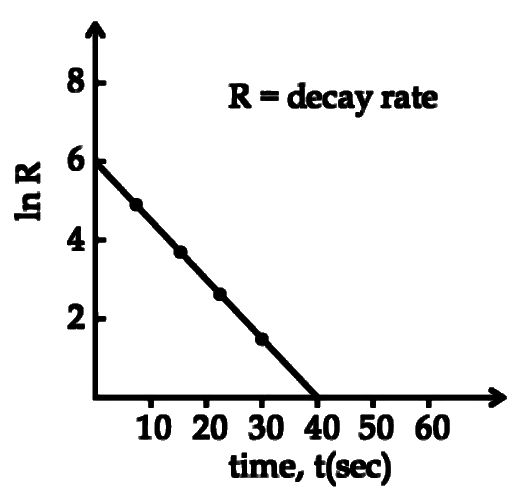
For a certain radioactive process the graph between In R and t(sec) is obtained as shown in the figure. Then the value of half life for the unknown radioactive material is approximately:
Answer: (d)
Law of Radioactive Decay
The half-life of Au198 is 2.7 days. The activity of 1.50 mg of Au198 if its atomic weight is 198 g mol is, (Na = 6 1023/mol).
Answer: (b)
Law of Radioactive Decay
Two radioactive materials and have decay constants '' and '' respectively. Initially, they have the same number of nuclei. After time '', the ratio of number of nuclei of to that of is . Then is equal to
Answer: (d)
Law of Radioactive Decay
Two radioactive substances X and Y originally have N1 and N2 nuclei respectively. Half life of X is half of the half life of Y. After three half lives of Y, number of nuclei of both are equal. The ratio will be equal to:
Answer: (d)
Law of Radioactive Decay
A sample of a radioactive nucleus A disintegrates to another radioactive nucleus B, which in turn disintegrates to some other stable nucleus C. Plot of a graph showing the variation of number of atoms of nucleus B versus time is:
(Assume that at t = 0, there are no B atoms in the sample)
Answer: (d)
Law of Radioactive Decay
A radioactive sample has an average life of 30 ms and is decaying. A capacitor of capacitance 200 F is first charged and later connected with resistor 'R'. If the ratio of charge on capacitor to the activity of radioactive sample is fixed with respect to time then the value of 'R' should be _____________ .
Numerical answer type. Work it out, then open the answer.
Answer: 150
Law of Radioactive Decay
At time t = 0, a material is composed of two radioactive atoms A and B, where NA(0) = 2NB(0). The decay constant of both kind of radioactive atoms is . However, A disintegrates to B and B disintegrates to C. Which of the following figures represents the evolution of NB(t) / NB(0) with respect to time t?
[NA (0) = No. of A atoms at t = 0
NB (0) = No. of B atoms at t = 0]
Answer: (c)
Law of Radioactive Decay
A radioactive material decays by simultaneous emissions of two particles with half lives of 1400 years and 700 years respectively. What will be the time after which one third of the material remains? (Take ln 3 = 1.1)
Answer: (a)
Law of Radioactive Decay
A radioactive nucleus decays by two different processes. The half life for the first process is 10 s and that for the second is 100 s. The effective half life of the nucleus is close to:
Answer: (b)
Law of Radioactive Decay
In a radioactive material, fraction of active material remaining after time t is 9/16. The fraction that was remaining after t/2 is
Answer: (a)
Law of Radioactive Decay
The half life of a radioactive sample undergoing -decay is . If the number of nuclei in the sample is , the activity of the sample is nearly
Answer: (b)
Law of Radioactive Decay
The activity of a radioactive sample falls from 700 s–1 to 500 s–1 in 30 minutes. Its half life is close to:
Answer: (a)
Law of Radioactive Decay
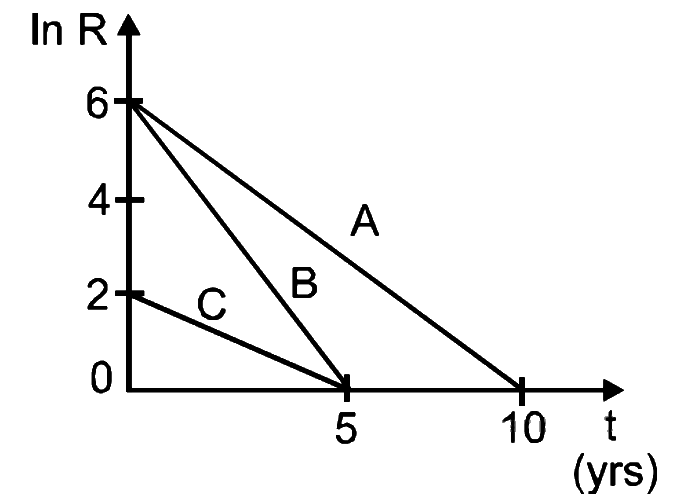
Activities of three radioactive substances A, B and C are represented by the curves A, B and C, in the figure. Then their half-lives
: : are in the ratio:
Answer: (d)
Law of Radioactive Decay
The rate of radioactive disintegration at an instant for a radioactive sample of half life is . The number of radioactive atoms in that sample at that instant is,
Answer: (a)
Law of Radioactive Decay
Using a nuclear counter the count rate of emitted particles from a radioactive source is measured. At t = 0 it was 1600 counts per second and t = 8 seconds it was 100 counts per second. The count rate observed, as counts per second, at t = 6 seconds is close to -
Answer: (a)
Law of Radioactive Decay
Half lives of two radioactive nuclei A and B are 10 minutes and 20 minutes, respectively, If initially a sample has equal number of nuclei, then after 60 minutes, the ratio of decayed numbers of nuclei A and B will be:
Answer: (a)
Law of Radioactive Decay
Two radioactive substances A and B have decay constants 5 and respectively. At t = 0, a sample has the same number of the two nuclei. The time taken for the ratio of the number of nuclei to become will be:
Answer: (c)
Law of Radioactive Decay
Two radioactive materials A and B have decay constants 10 and , respectively. It initially they have the same number of nuclei, then the ratio of the number of nuclei of A to that of B will be 1/e after a time:
Answer: (a)
Law of Radioactive Decay
A sample of radioactive material A, that has an activity of 10 mCi(1 Ci = 3.7 1010 decays/s), has twice the number of nuclei as another sample of a different radioactive materail B which has an activity of 20 mCi. The correct choices for half-lives of A and B would then be respectively:
Answer: (c)
Law of Radioactive Decay
At a given instant, say t = 0, two radioactive substance A and B have equal activities. the ratio of their activities after time t itself decays with time t as et. If the half-life of A is ln2, the half-life of B is:
Answer: (c)
Law of Radioactive Decay
For a radioactive material, half-life is 10 minutes. If initially there are 600 number of nuclei, the time taken (in minutes) for the disintegration of 450 nuclei is
Answer: (a)
Law of Radioactive Decay
At some instant, a radioactive sample S1 having an activity 5 Ci has twice the number of nuclei as another sample S2 which has an activity of 10 Ci. The half lives of S1 and S2 are:
Answer: (a)
Law of Radioactive Decay
A containing active cobalt having activity of and decay constant is injected in an animal's body. If of blood is drawn from the animal's body after hrs of injection, the activity found was decays per minute What is the volume of blood that is flowing in the body? decays per second and at hrs
Answer: (d)
Law of Radioactive Decay
Radioactive material 'A' has decay constant '8 ' and material 'B' has decay constant ''. Initially they have same number of nuclei. After what time, the ratio of number of nuclei of material 'B' to that 'A' will be e?
Answer: (a)
Law of Radioactive Decay
A radioactive nucleus A with a half life T, decays into a nucleus B. At t = 0, there is no nucleus B. At sometime t, the ratio of the number of B to that of A is 0.3. Then, t is given by:
Answer: (d)
Law of Radioactive Decay
The half-life of a radioactive substance is 30 minutes. The time (in minutes) taken between 40% decay and 85% decay of the same radioactive substance is
Answer: (d)
Law of Radioactive Decay
Half-lives of two radioactive elements and are minutes and minutes, respectively. Initially, the samples have equal number of nuclei. After minutes, the ratio of decayed number of and nuclei will be:
Answer: (b)
Law of Radioactive Decay
Let N be the number of particles emitted by 1 gram of Na24 radioactive nuclei (half life = 15 hrs) in 7.5 hours, N is close to (Avogadro number = 6.023 1023 / g. mole):
Answer: (b)
Law of Radioactive Decay
A radioactive X with a half life 1.4 109 years decays to Y which is stable. A sample of the rock from a cave was found to contain X and Y in the ratio 1: 7. The age of the rock is
Answer: (c)
Law of Radioactive Decay
A piece of wood from a recently cut tree shows 20 decays per minute. A wooden piece of same size placed in a museum (obtained from a tree cut many years back) shows 2 decays per minute. If half life of C14 is 5730 years, then age of the wooden piece placed in the museum is approximately:
Answer: (c)
Law of Radioactive Decay
A piece of bone of an animal from a ruin is found to have 14C activity of 12 disintegrations per minute per gm of its carbon content. The 14C activity of a living animal is 16 disintegrations per minute per gm. How long ago nearly did the animal die? (Given half life of 14C is t1/2 = 5760 years)
Answer: (b)
Law of Radioactive Decay
A radioactive nuclei with decay constant 0.5/s is being produced at a constant rate of 100 nuclei/s. If at t = 0 there were no nuclei, the time when there are 50 nuclei is:
Answer: (b)
Law of Radioactive Decay
The half life of a radioactive isotope 'X' is 20 years. It decays to another element 'Y' which is stable. The two elements 'X' and 'Y' were found to be in the ratio 1: 7 in a sample of a given rock. The age of the rock is estimated to be
Answer: (d)
Law of Radioactive Decay
The half-life of a radioactive element A is the same as the mean-life of another radioactive element B. Initially both substances have the same number of atoms, then:
Answer: (d)
Law of Radioactive Decay
The half life of a radioactive nucleus is 50 days. The time invertal (t2 t1) between the time t2 when of it has decayed and the time t1 when of it had decayed is
Answer: (b)
Law of Radioactive Decay
A mixture consists of two radioactive materials A1 and A2 with half lives of 20 s and 10 s respectively. Initially the mixture has 40 g of A1 and 160 g of A2. The amount of the two in the mixture will become equal after
Answer: (d)
Law of Radioactive Decay
The half life of a radioactive isotope X is 50 years. It decays to another element Y which is stable. The two elements X and Y were found to be in the ratio of 1: 15 in a sample of a given rock. The age of the rock was estimated to be
Answer: (b)
Law of Radioactive Decay
The half life of a radioactive substance is minutes. The approximate time interval between the time when of it had decayed and time when of it had decayed is:
Answer: (b)
Law of Radioactive Decay
Two radioactive nuclei P and Q, in a given sample decay into a stable nucleus R. At time t = 0. number of P species are 4 N0 and that of Q are N0. Half -life of P (for conversion to R) is 1 minute where as that of Q is 2 minutes. Initially there are no nuclei of R present in the sample. When number of nuclei of P and Q are equal, the number of nuclei of R present in the sample would be
Answer: (c)
Law of Radioactive Decay
The decay constant of a radio isotope is . If A1 and A2 are its activities at times t1 and t2 respectively, the number of nuclei which have decayed during the time (t1 t2)
Answer: (c)
Law of Radioactive Decay
The activity of a radioactive sample is measured as N0 counts per minute at t = 0 and N0/e counts per minute at t = 5 minutes. The time (in minutes) at which the activity reduces to half its value is
Answer: (d)
Law of Radioactive Decay
Two radioactive materials X1 and X2 have decay constants and respectively. If initially they have the same number of nuclei, then the ratio of the number of nuclei of X1 to that X2 will be 1/e after a time
Answer: (a)
Law of Radioactive Decay
Two radioactive substances A and B have decay constants 5 and respectively. At t = 0 they have the same number of nuclei. The ratio of number of nuclei of A to those of B will be (1/e)2 after a time interval
Answer: (c)
Law of Radioactive Decay
The half-life period of a radioactive element is same as the mean life time of another radioactive element Initially they have the same number of atoms. Then
Answer: (c)
Law of Radioactive Decay
In a radioactive material the activity at time t1 is R1 and at a later time t2, it is R2. If the decay constant of the material is , then
Answer: (b)
Law of Radioactive Decay
The is the correct unit used to report the measurement of
Answer: (c)
Law of Radioactive Decay
Starting with a sample of pure of it decays into in minutes. The corresponding half life is
Answer: (d)
Law of Radioactive Decay
The half life of radian is about 1600 years. Of 100 g of radium existing now, 25 g will remain unchanged after
Answer: (d)
Law of Radioactive Decay
A sample of radioactive element has a mass of 10 g at an instant t = 0. The approximate mass of this element in the sample after two mean lives is
Answer: (a)
Law of Radioactive Decay
A radioactive sample at any instant has its disintegration rate disintegrations per minute. After minutes, the rate is disintegrations per minute. Then, the decay constant (per minute) is
Answer: (a)
Law of Radioactive Decay
A sample of radioactive element containing 4 1016 active nuclei. Half life of element is 10 days, then number of decayed nuclei after 30 days
Answer: (c)
Law of Radioactive Decay
If is the original mass of the substance of half-life period years, then the amount of substance left after years is
Answer: (a)
Law of Radioactive Decay
Half life of a radioactive element is 12.5 hour and its quantity is 256 g. After how much time its quantity will remain 1 g?
Answer: (b)
Law of Radioactive Decay
Half-life period of a radioactive substance is . After activity is , what was the initial activity?
Answer: (d)
Law of Radioactive Decay
The half-life of a radioactive material is . If the initial amount is , then after , it will remain
Answer: (a)
Law of Radioactive Decay
The relation between and T1/2 as (T1/2 half life)
Answer: (a)
Law of Radioactive Decay
Half-lives of two radioactive substances and are respectively and . Initially the samples of and have equal number of nuclei. After the ratio of remaining number of and nuclei is
Answer: (c)
Law of Radioactive Decay
The count rate of a Geiger Muller counter for the radiation of a radioactive material of half-life of 30 minutes decreases to 5 after 2 hours. The initial count rate was
Answer: (a)
Law of Radioactive Decay
The half life of radium is 1600 years. The fraction of a sample of radium that would remain after 6400 years
Answer: (d)
Law of Radioactive Decay
A radioactive element has half life period 800 years. After 6400 years what amount will remain?
Answer: (d)
Law of Radioactive Decay
Curie is a unit of
Answer: (c)
Law of Radioactive Decay
A radioactive sample with a half life of 1 month has the label: 'Activity = 2 micro curies on 1 - 8 - 1991'. What would be its activity two months earlier?
Answer: (d)
No questions match these filters.