Q1 JEE Main 2026 · 2 APR · SHIFT 2 Easy ☆
Mass Defect & Binding Energy · Binding energy from masses
The binding energy per nucleon of 83 209 B i {}_{83}^{209}Bi 83 209 B i
[Take m ( 83 209 B i ) = 208.980388 m({}_{83}^{209}Bi) = 208.980388 m ( 83 209 B i ) = 208.980388 m p = 1.007825 m_p = 1.007825 m p = 1.007825 m n = 1.008665 m_n = 1.008665 m n = 1.008665 1 1 1 = 931 = 931 = 931 / c 2 /c^{2} / c 2
(a) 7.48 (b) 7.84 (c) 8.79 (d) 6.94 Show answer and solution
Answer: (b)
Loading the solution…
Report a mistake Q2 JEE Main 2026 · 24 JAN · SHIFT 1 Easy ☆
Mass Defect & Binding Energy · Binding energy curve & stability
Given below are two statements:
Statement I: For all elements, greater the mass of the nucleus, greater is the binding energy per nucleon.
Statement II: For all elements, nuclei with less binding energy per nucleon transforms to nuclei with greater binding energy per nucleon.
In the light of the above statements, choose the correct answer from the options given below
(a) Statement I is false but Statement II is true (b) Both Statement I and Statement II are true (c) Both Statement I and Statement II are false (d) Statement I is true but Statement II is false Show answer and solution
Answer: (a)
Loading the solution…
Report a mistake Q3 JEE Main 2026 · 5 APR · SHIFT 2 Medium ☆
Mass Defect & Binding Energy · Mass defect
Assuming the experimental mass of 6 12 C {}_{6}^{12}C 6 12 C 12 u 12u 12 u 6 12 C {}_{6}^{12}C 6 12 C _ _ _ _ _ MeV/c 2 \_\_\_\_\_\ \text{MeV/c}^{2} _____ MeV/c 2 = 1.00727 u = 1.00727\text{u} = 1.00727 u = 1.00866 u , 1 u = 931.5 MeV/c 2 = 1.00866\text{u}, 1\text{u} = 931.5\text{MeV/c}^{2} = 1.00866 u , 1 u = 931.5 MeV/c 2
(a) 127.5 (b) 89.03 (c) 272.0 (d) 92.0 Show answer and solution
Answer: (b)
Loading the solution…
Report a mistake Q4 JEE Main 2026 · 24 JAN · SHIFT 2 Medium ☆
Mass Defect & Binding Energy · Binding energy curve & stability
The binding energy for the following nuclear reactions are expressed in MeV.
2 He 3 + 0 n 1 → 2 He 4 + 20 MeV {}_{2}\text{He}^{3} + {}_{0}\text{n}^{1} \rightarrow {}_{2}\text{He}^{4} + 20\text{MeV} 2 He 3 + 0 n 1 → 2 He 4 + 20 MeV
2 He 4 + 0 n 1 → 2 He 5 − 0.9 MeV {}_{2}\text{He}^{4} + {}_{0}\text{n}^{1} \rightarrow {}_{2}\text{He}^{5} - 0.9\text{MeV} 2 He 4 + 0 n 1 → 2 He 5 − 0.9 MeV
If X 3 , X 4 , X 5 \mathrm{X_3, X_4, X_5} X 3 , X 4 , X 5 2 He 3 , 2 He 4 {}_{2}\text{He}^{3}, {}_{2}\text{He}^{4} 2 He 3 , 2 He 4 2 He 5 {}_{2}\text{He}^{5} 2 He 5
(a) X 4 > X 5 > X 3 X_4 > X_5 > X_3 X 4 > X 5 > X 3 (b) X 4 < X 5 < X 3 X_4 < X_5 < X_3 X 4 < X 5 < X 3 (c) X 4 > X 5 < X 3 X_4 > X_5 < X_3 X 4 > X 5 < X 3 (d) X 4 = X 5 = X 3 X_4 = X_5 = X_3 X 4 = X 5 = X 3 Show answer and solution
Answer: (a)
Loading the solution…
Report a mistake Q5 JEE Main 2025 · 23 JAN · SHIFT 2 Easy ☆
Mass Defect & Binding Energy · Binding energy curve & stability
Given below are two statements. One is labelled as Assertion (A) and the other is labelled as Reason (R).
Assertion (A): The binding energy per nucleon is found to be practically independent of the atomic number A, for nuclei with mass numbers between 30 and 170.
Reason (R): Nuclear force is long range. In the light of the above statements, choose the correct answer from the options given below:
(a) (A) is true but (R) is false (b) Both (A) and (R) are true and (R) is the correct explanation of (A) (c) (A) is false but (R) is true (d) Both (A) and (R) are true but (R) is NOT the correct explanation of (A) Show answer and solution
Answer: (a)
Loading the solution…
Report a mistake Q6 JEE Main 2024 · 9 APR · SHIFT 1 Easy ☆
Mass Defect & Binding Energy · Mass-energy equivalence & atomic mass unit
The energy equivalent of 1 g 1\text{ g} 1 g
(a) 5.6 × 1 0 26 MeV 5.6 \times 10^{26}\text{ MeV} 5.6 × 1 0 26 MeV (b) 5.6 × 1 0 12 MeV 5.6 \times 10^{12}\text{ MeV} 5.6 × 1 0 12 MeV (c) 5.6 eV 5.6\text{ eV} 5.6 eV (d) 11.2 × 1 0 24 MeV 11.2 \times 10^{24}\text{ MeV} 11.2 × 1 0 24 MeV Show answer and solution
Answer: (a)
Loading the solution…
Report a mistake Q7 JEE Main 2024 · 8 APR · SHIFT 1 Easy ☆
Mass Defect & Binding Energy · Mass-energy equivalence & atomic mass unit
Binding energy of a certain nucleus is 18 × 1 0 8 J 18 \times 10^{8}\text{ J} 18 × 1 0 8 J
(a) 20 μ \mu μ (b) 2 μ \mu μ (c) 10 μ \mu μ (d) 0.2 μ \mu μ Show answer and solution
Answer: (a)
Loading the solution…
Report a mistake Q8 JEE Main 2024 · 31 JAN · SHIFT 1 Easy ☆
Mass Defect & Binding Energy · Mass-energy equivalence & atomic mass unit
The mass defect in a particular reaction is 0.4 g 0.4\text{ g} 0.4 g n × 1 0 7 kWh n \times 10^{7}\text{ kWh} n × 1 0 7 kWh n = n = n = = 3 × 1 0 8 m/s ) = 3 \times 10^{8}\text{ m/s}) = 3 × 1 0 8 m/s )
Numerical answer type. Work it out, then open the answer.
Show answer and solution
Answer: 1
Loading the solution…
Report a mistake Q9 MHT CET 2024 · 16 MAY · SHIFT 1 Easy ☆
Mass Defect & Binding Energy · Binding energy from masses
If M O \mathrm{M_O} M O 8 O 17 {}_{8}\text{O}^{17} 8 O 17 M p \mathrm{M_p} M p M N \mathrm{M_N} M N
(a) M o C 2 \mathrm{M_o C^2} M o C 2 (b) ( M o − 8 M P ) C 2 (\mathrm{M_o} - 8\mathrm{M_P})\mathrm{C}^2 ( M o − 8 M P ) C 2 (c) ( M o − 17 M N ) C 2 (\mathrm{M_o} - 17\mathrm{M_N})\mathrm{C}^2 ( M o − 17 M N ) C 2 (d) ( M o − 8 M P − 9 M N ) C 2 (\mathrm{M_o} - 8\mathrm{M_P} - 9\mathrm{M_N})\mathrm{C}^2 ( M o − 8 M P − 9 M N ) C 2 Show answer and solution
Answer: (d)
Loading the solution…
Report a mistake Q10 JEE Main 2024 · 8 APR · SHIFT 2 Easy ☆
Mass Defect & Binding Energy · Binding energy from masses
If M 0 M_0 M 0 5 12 B , M p {}_{5}^{12}B, M_p 5 12 B , M p M n M_n M n
(a) ( 5 M p + 7 M n − M 0 ) C 2 (5M_p + 7M_n - M_0)C^{2} ( 5 M p + 7 M n − M 0 ) C 2 (b) ( M 0 − 5 M p − 7 M n ) C 2 (M_0 - 5M_p - 7M_n)C^{2} ( M 0 − 5 M p − 7 M n ) C 2 (c) ( M 0 − 5 M p ) C 2 (M_0 - 5M_p)C^{2} ( M 0 − 5 M p ) C 2 (d) ( M 0 − 12 M n ) C 2 (M_0 - 12M_n)C^{2} ( M 0 − 12 M n ) C 2 Show answer and solution
Answer: (a)
Loading the solution…
Report a mistake Q11 JEE Main 2024 · 27 JAN · SHIFT 2 Medium ☆
Mass Defect & Binding Energy · Binding energy from masses
The atomic mass of 6 C 12 {}_{6}\text{C}^{12} 6 C 12 12.000000 u 12.000000\text{ u} 12.000000 u 6 C 13 {}_{6}\text{C}^{13} 6 C 13 13.003354 u 13.003354\text{ u} 13.003354 u 6 C 13 {}_{6}\text{C}^{13} 6 C 13 1.008665 u 1.008665\text{ u} 1.008665 u
(a) 62.5 MeV (b) 6.25 MeV (c) 4.95 MeV (d) 49.5 MeV Show answer and solution
Answer: (c)
Loading the solution…
Report a mistake Q12 JEE Main 2023 · 1 FEB · SHIFT 1 Easy ☆
Mass Defect & Binding Energy · Binding energy from masses
The mass of proton, neutron and helium nucleus are respectively 1.0073 u , 1.0087 u 1.0073\,u, 1.0087\,u 1.0073 u , 1.0087 u 4.0015 u 4.0015\,u 4.0015 u
(a) 28.4 MeV 28.4\text{ MeV} 28.4 MeV (b) 56.8 MeV 56.8\text{ MeV} 56.8 MeV (c) 7.1 MeV 7.1\text{ MeV} 7.1 MeV (d) 14.2 MeV 14.2\text{ MeV} 14.2 MeV Show answer and solution
Answer: (a)
Loading the solution…
Report a mistake Q13 JEE Main 2023 · 13 APR · SHIFT 2 Easy Old syllabus ☆
Mass Defect & Binding Energy · Binding energy curve & stability
Given below are two statements: one is labelled as Assertion A \mathbf{A} A R \mathbf{R} R
Assertion A: The binding energy per nucleon is practically independent of the atomic number for nuclei of mass number in the range 30 to 170.
Reason R: Nuclear force is short ranged.
In the light of the above statements, choose the correct answer from the options given below
(a) A \mathrm{A} A R \mathbf{R} R (b) A \mathrm{A} A R \mathbf{R} R (c) Both A \mathbf{A} A R \mathbf{R} R R \mathbf{R} R A \mathbf{A} A (d) Both A \mathbf{A} A R \mathbf{R} R R \mathbf{R} R A \mathbf{A} A Show answer and solution
Answer: (c)
Loading the solution…
Report a mistake Q14 JEE Main 2023 · 1 FEB · SHIFT 2 Medium ☆
Mass Defect & Binding Energy · Binding energy from masses
Nucleus A having Z = 17 Z = 17 Z = 17 1.2 MeV 1.2\text{ MeV} 1.2 MeV
Another nucleus B \text{B} B Z = 12 Z = 12 Z = 12 1.8 MeV 1.8\text{ MeV} 1.8 MeV B \text{B} B A \text{A} A MeV \text{MeV} MeV
Numerical answer type. Work it out, then open the answer.
Show answer and solution
Answer: 6
Loading the solution…
Report a mistake Q15 JEE Main 2023 · 8 APR · SHIFT 1 Difficult ☆
Mass Defect & Binding Energy · Binding energy curve & stability
For a nucleus Z A X {}_{\text{Z}}^{\text{A}}\text{X} Z A X A \text{A} A Z \text{Z} Z
A. The surface energy per nucleon ( b s ) = − a 1 A 2 / 3 (b_{\text{s}}) = -a_1 A^{2/3} ( b s ) = − a 1 A 2/3
B. The Coulomb contribution to the binding energy b c = − a 2 Z ( Z − 1 ) A 4 / 3 \text{b}_{\text{c}} = -a_2 \frac{Z(Z-1)}{A^{4/3}} b c = − a 2 A 4/3 Z ( Z − 1 )
C. The volume energy b v = a 3 A \text{b}_{\text{v}} = a_3 A b v = a 3 A
D. Decrease in the binding energy is proportional to surface area.
E. While estimating the surface energy, it is assumed that each nucleon interacts with 12 nucleons. ( a 1 , a 2 a_1, a_2 a 1 , a 2 a 3 a_3 a 3
Choose the most appropriate answer from the options given below:
(a) C, D only (b) B, C, E only (c) B, C only (d) A, B, C, D only Show answer and solution
Answer: (a)
Loading the solution…
Report a mistake Q16 JEE Main 2021 · 25 JUL · SHIFT 2 Medium ☆
Mass Defect & Binding Energy · Binding energy from masses
From the given data, the amount of energy required to break the nucleus of aluminium 13 27 {}_{13}^{27} 13 27 × \times × − - −
Mass of neutron = 1.00866 u
Mass of proton = 1.00726 u
Mass of Aluminium nucleus = 27.18846 u
(Assume 1 u corresponds to x J of energy)
(Round off to the nearest integer)
Numerical answer type. Work it out, then open the answer.
Show answer and solution
Answer: 27
Loading the solution…
Report a mistake Q17 NEET 2020 · PHASE 1 Easy ☆
Mass Defect & Binding Energy · Mass-energy equivalence & atomic mass unit
The energy equivalent of 0.5 g of a substance is:
(a) 4.5 × 1 0 13 J 4.5 \times 10^{13}\text{ J} 4.5 × 1 0 13 J (b) 1.5 × 1 0 13 J 1.5 \times 10^{13}\text{ J} 1.5 × 1 0 13 J (c) 0.5 × 1 0 13 J 0.5 \times 10^{13}\text{ J} 0.5 × 1 0 13 J (d) 4.5 × 1 0 16 J 4.5 \times 10^{16}\text{ J} 4.5 × 1 0 16 J Show answer and solution
Answer: (a)
Loading the solution…
Report a mistake Q18 JEE Main 2020 · 4 SEP · SHIFT 2 Easy ☆
Mass Defect & Binding Energy · Binding energy from masses
Find the Binding energy per nucleon for 50 120 S n {}_{50}^{120}Sn 50 120 S n
(a) 9.0 MeV (b) 8.5 MeV (c) 8.0 MeV (d) 7.5 MeV Show answer and solution
Answer: (b)
Loading the solution…
Report a mistake Q19 JEE Main 2017 · 9 APR · SHIFT 1 Easy ☆
Mass Defect & Binding Energy · Mass-energy equivalence & atomic mass unit
Imagine that a reactor converts all given mass into energy and that it operates at a power level of 109 watt. The mass of the fuel consumed per hour in the reactor will be: (velocity of light, c is 3×10⁸ m/s)
(a) 0.96 gm (b) 0.8 gm (c) 4 × \times × − - − (d) 6.6 × \times × − - − Show answer and solution
Answer: (c)
Loading the solution…
Report a mistake Q20 NEET 2013 Easy ☆
Mass Defect & Binding Energy · Binding energy curve & stability
How does the Binding Energy per nucleon vary with the increase in the number of nucleons?
(a) Decrease continuously with mass number. (b) First decreases and then increases with increase in mass number. (c) First increases and then decreases with increase in mass number. (d) increases continuously with mass number. Show answer and solution
Answer: (c)
Loading the solution…
Report a mistake Q21 NEET 2010 · AIPMT · PRELIMS Easy ☆
Mass Defect & Binding Energy · Binding energy from masses
The mass of a 3 7 L i {}_{3}^{7}Li 3 7 L i 3 7 L i {}_{3}^{7}Li 3 7 L i
(a) 46 MeV (b) 5.6 MeV (c) 3.9 MeV (d) 23 MeV Show answer and solution
Answer: (b)
Loading the solution…
Report a mistake Q22 JEE Main 2009 · AIEEE Difficult ☆
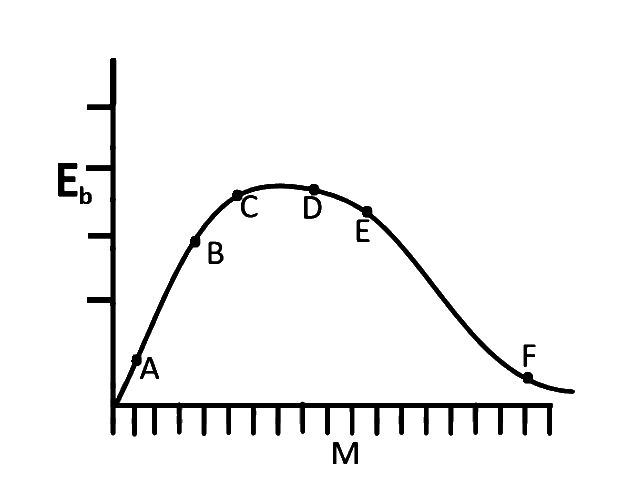
Mass Defect & Binding Energy · Binding energy curve & stability
The above is a plot of binding energy per nucleon E b , E_b, E b , M ; A , B , C , D , E , F M; A, B, C, D, E, F M ; A , B , C , D , E , F
( i ) A + B → C + ε ( i i ) C → A + B + ε (i)\ \ A + B \rightarrow C + \varepsilon \quad (ii)\ \ C \rightarrow A + B + \varepsilon ( i ) A + B → C + ε ( ii ) C → A + B + ε
( i i i ) D + E → F + ε ( i v ) F → D + E + ε , (iii)\ \ D + E \rightarrow F + \varepsilon \quad (iv)\ \ F \rightarrow D + E + \varepsilon, ( iii ) D + E → F + ε ( i v ) F → D + E + ε ,
where ε \varepsilon ε ε \varepsilon ε
(a) ( i ) (i) ( i ) ( i i i ) (iii) ( iii ) (b) ( i i ) (ii) ( ii ) ( i v ) (iv) ( i v ) (c) ( i i ) (ii) ( ii ) ( i i i ) (iii) ( iii ) (d) ( i ) (i) ( i ) ( i v ) (iv) ( i v ) Show answer and solution
Answer: (d)
Loading the solution…
Report a mistake Q23 NEET 2008 · AIPMT Easy ☆
Mass Defect & Binding Energy · Binding energy from masses
If M(A; Z), Mp and Mn denote the masses of the nucleus Z A X , {}_{Z}^{A}X, Z A X ,
(a) M(A, Z) = ZMp + (A − - − − - − (b) M(A, Z) = ZMp + (A − - − (c) M(A, Z) = ZMp + (A − - − − - − (d) M(A, Z) = ZMp + (A − - − Show answer and solution
Answer: (c)
Loading the solution…
Report a mistake Q24 JEE Main 2008 · AIEEE Easy ☆
Mass Defect & Binding Energy · Binding energy curve & stability
This question contains Statement- 1 and Statement- 2. Of the four choices given after the statements, choose the one that best describes the two statements:
Statement- 1:
Energy is released when heavy nuclei undergo fission or light nuclei undergo fusion. Statement- 2:
For heavy nuclei, binding energy per nucleon increases with increasing Z Z Z Z . Z. Z .
(a) Statement - 1 1 1 2 2 2 (b) Statement - 1 1 1 2 2 2 2 2 2 1 1 1 (c) Statement - 1 1 1 2 2 2 2 2 2 1 1 1 (d) Statement - 1 1 1 2 2 2 Show answer and solution
Answer: (d)
Loading the solution…
Report a mistake Q25 NEET 2007 · AIPMT Easy ☆
Mass Defect & Binding Energy · Binding energy from masses
A nucleus Z A X {}_{Z}^{A}X Z A X
(a) B.E. = [ZMp + (A − - − − - − (b) B.E. = [ZMp + AMp − - − (c) B.E. = M(A, Z) − - − − - − − - − (d) B.E. = [M(A, Z) − - − − - − − - − Show answer and solution
Answer: (a)
Loading the solution…
Report a mistake Q26 JEE Main 2007 · AIEEE Easy ☆
Mass Defect & Binding Energy · Binding energy from masses
If M O M_O M O 8 O 17 , M p {}_{8}O^{17}, M_p 8 O 17 , M p M N M_N M N
(a) ( M O − 17 M N ) C 2 (M_O - 17M_N)C^{2} ( M O − 17 M N ) C 2 (b) ( M O − 8 M P ) C 2 (M_O - 8M_P)C^{2} ( M O − 8 M P ) C 2 (c) ( M O − 8 M P − 9 M N ) C 2 (M_O - 8M_P - 9M_N)C^{2} ( M O − 8 M P − 9 M N ) C 2 (d) M O c 2 M_O c^{2} M O c 2 Show answer and solution
Answer: (c)
Loading the solution…
Report a mistake Q27 NEET 2004 · AIPMT Easy ☆
Mass Defect & Binding Energy · Binding energy from masses
If M(A; Z), Mp and Mn denote the masses of the nucleus Z A X , {}_{Z}^{A}X, Z A X ,
(a) M(A, Z) = ZMp + (A − - − − - − (b) M(A, Z) = ZMp + (A − - − (c) M(A, Z) = ZMp + (A − - − − - − (d) M(A, Z) = ZMp + (A − - − Show answer and solution
Answer: (c)
Loading the solution…
Report a mistake Q28 NEET 2003 · AIPMT Medium ☆
Mass Defect & Binding Energy · Binding energy from masses
The mass of proton is 1.0073 u and that of neutron is 1.0087 u (u = atomic mass unit). The binding energy of 2 4 {}_{2}^{4} 2 4
(Given helium nucleus mass ≈ \approx ≈
(a) 0.0305 J (b) 0.0305 erg (c) 28.4 MeV (d) 0.061 u Show answer and solution
Answer: (c)
Loading the solution…
Report a mistake Q29 JEE Main 2002 · AIEEE Easy ☆
Mass Defect & Binding Energy · Mass-energy equivalence & atomic mass unit
If mass-energy equivalence is taken into account, when water is cooled to form ice, the mass of water should
(a) increase (b) remain unchanged (c) decrease (d) first increase then decrease Show answer and solution
Answer: (c)
Loading the solution…
Report a mistake Q30 NEET 2001 · AIPMT Easy ☆
Mass Defect & Binding Energy · Mass defect
Mn and Mp represent the mass of neutron and proton respectively. An element having mass M has N neutrons and Z protons, then the correct relation will be
(a) M < {N ⋅ \cdot ⋅ ⋅ \cdot ⋅ (b) M > {N ⋅ \cdot ⋅ ⋅ \cdot ⋅ (c) M = {N ⋅ \cdot ⋅ ⋅ \cdot ⋅ (d) M = N {Mn + Mp} Show answer and solution
Answer: (a)
Loading the solution…
Report a mistake Q31 NEET 1993 · AIPMT Easy ☆
Mass Defect & Binding Energy · Binding energy curve & stability
The binding energy per nucleon is maximum in case of
(a) 2 4 He {}_{2}^{4}\text{He} 2 4 He (b) 26 56 Fe {}_{26}^{56}\text{Fe} 26 56 Fe (c) 56 141 Ba {}_{56}^{141}\text{Ba} 56 141 Ba (d) 92 235 U {}_{92}^{235}\text{U} 92 235 U Show answer and solution
Answer: (b)
Loading the solution…
Report a mistake Q32 NEET 1992 · AIPMT Easy ☆
Mass Defect & Binding Energy · Mass-energy equivalence & atomic mass unit
The energy equivalent of one atomic mass unit is
(a) 1.6 × 1 0 − 19 J 1.6 \times 10^{-19}\text{ J} 1.6 × 1 0 − 19 J (b) 6.02 × 1 0 23 J 6.02 \times 10^{23}\text{ J} 6.02 × 1 0 23 J (c) 931 MeV (d) 9.31 MeV Show answer and solution
Answer: (c)
Loading the solution…
Report a mistake Q33 NEET 1992 · AIPMT Easy ☆
Mass Defect & Binding Energy · Mass defect
The mass of α \alpha α
(a) less than the sum of masses of two protons and two neutrons (b) equal to mass of four protons (c) equal to mass of four neutrons (d) equal to sum of masses of two protons and two neutrons Show answer and solution
Answer: (a)
Loading the solution…
Report a mistake Q34 NEET 1989 · AIPMT Easy ☆
Mass Defect & Binding Energy · Binding energy curve & stability
The average binding energy of a nucleon inside an atomic nucleus is about
(a) 8 MeV (b) 8 eV (c) 8 J (d) 8 erg Show answer and solution
Answer: (a)
Loading the solution…
Report a mistake
No questions match these filters.