Work, Energy and Power PYQs · MHT CET · JEE Main · NEET
Potential Energy & Equilibrium
Questions
16
MHT CET
0
JEE Main
11
NEET
5
0 of 16 attempted
Q1JEE Main 2026 · 22 JAN · SHIFT 2Easy
Potential Energy & Equilibrium
Given below are two statements:
Statement I: An object moves from position r1 to position r2 under a conservative force field F. The work done by the force is W=−∫r1r2F⋅dr.
Statement II: Any object moving from one location to another location can follow infinite number of paths. Therefore, the amount of work done by the object changes with the path it follows for a conservative force.
In the light of the above statements, choose the correct answer from the options given below:
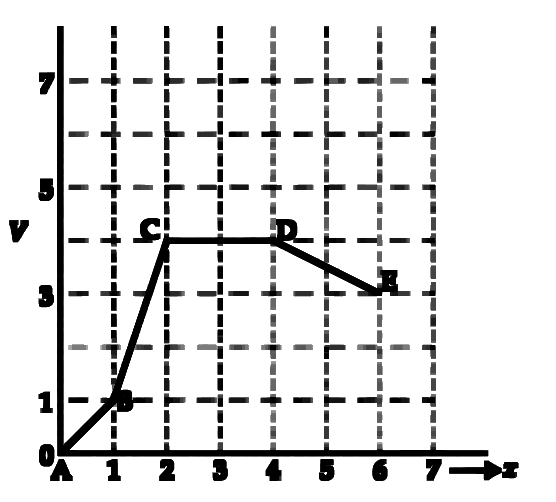
Potential energy ( V) versus distance ( x) is given by the graph. Rank various regions as per the magnitudes of the force ( F) acting on a particle from high to low.
Given below are two statements: one is labelled as Assertion A and the other is labelled as Reason R
Assertion A: In a central force field, the work done is independent of the path chosen. Reason R: Every force encountered in mechanics does not have an associated potential energy. In the light of the above statements, choose the most appropriate answer from the options given below
The potential energy function (in J) of a particle in a region of space is given as U=(2x2+3y3+2z). Here x,y and z are in meter. The magnitude of x-component of force (in N) acting on the particle at point P(1,2,3) m is:
Potential energy as a function of r is given by U=r10A−r5B, where r is the interatomic distance, A and B are positive constants. The equilibrium distance between the two atoms will be:
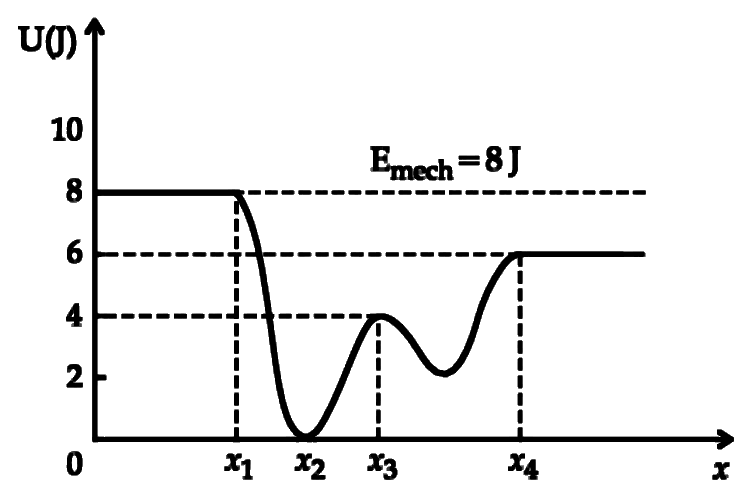
Given below is the plot of a potential energy function U(x) for a system, in which a particle is in one dimensional motion, while a conservative force F(x) acts on it. Suppose that Emech = 8 J, the incorrect statement for this system is:
The potential energy of a particle in a force field is U=r2A−rB where A and B are positive constants and r is the distance of particle from the centre of the field. For stable equilibrium, the distance of the particle is
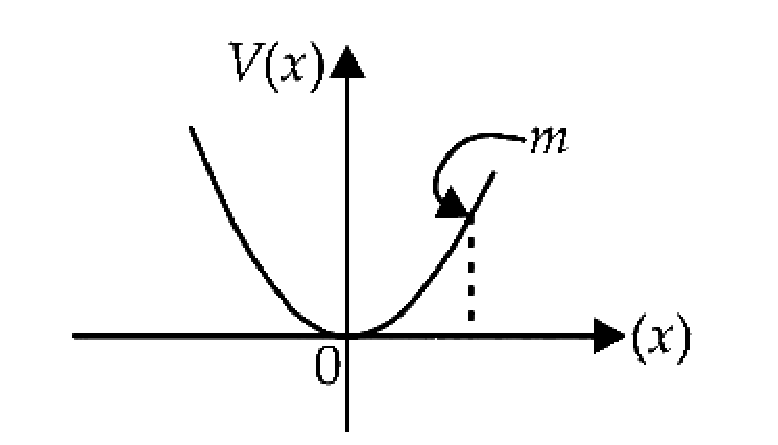
A particle of mass m is released from rest and follows a parabolic path as shown. Assuming that the displacement of the mass from the origin is small, which graph correctly depicts the position of the particle as a function of time?
The potential energy function for the force between two atoms in a diatomic molecule is approximately given by U(x)=x12a−x6b, where a and b are constants and x is the distance between the atoms. If the dissociation energy of the molecule is
The potential energy of a 1 kg particle free to move along the x-axis is given by V(x)=(4x4−2x2) J. The total mechanical energy of the particle is 2 J. Then, the maximum speed (in m/s) is
The potential energy between two atoms, in a molecule, is given by U(x)=x12a−x6b where a and b are positive constants and x is the distance between the atoms. The atom is in stable equilibrium, when